What is Needed

Often in this space, I write about the students at my small charter high school in Detroit. From time to time, I share their needs and invite you to partner with me in meeting them. One time I mentioned the need for athletic shoes, and a handful of you helped me purchase about twenty (yes, 20!) pairs for our track athletes! Other times, I’ve asked for support at Christmas, and some of you have sent items from an Amazon wish list, purchased gift cards, or simply sent cash. It’s not always the same people — some of you are local to me, some are friends from way in the past, and some of you I’ve never even met — but when I ask, the needs of my students always get met.

This past week, not having the time or inspiration for a complete blog post, I just flung out a request via social media. I said we had 8-10 families with extraordinary hardship that we’d like to send on their holiday break with grocery and gas gift cards. I’ve been coordinating efforts like these for five years or more, and my school community has come to count on the fact that “I’ve got a lot of great friends.” However, every time I ask, I momentarily wonder if the magic will continue — will people see my request? will they want to contribute? Then I usually remind myself that “before I am asking, He is answering,” and trust that God will provide.

This week was no different. That Facebook ask was just a week ago and we have plenty of donated cash and gift cards to support ten families in ways that they are not expecting — what a fun day our principal will have later this week, handing fat envelopes over to families who have no idea they are coming! I can’t know the impact your gifts will have!

So, first, let me say thank you to those who stop by to read my posts about education, my health, politics (gasp), and the things I am learning, but also to those who choose to contribute to students they have never met. I am astounded by your generosity that keeps showing up at just the right time. Even sometimes when I haven’t asked, a need is just around the corner, and you have met it in advance. Thank you for your heart, for your thoughtfulness, for your care.

Now, let me tell what I learned this week about what kids really need.

A few weeks ago, a teacher who is somewhat new to our district, a woman who just has a way of connecting with kids — the kind of teacher who kids show up to school for, the rare one who can get a whole room to lean in and listen as she walks step by step through a procedure, the kind who can glance up from a demonstration and silence a chatterbox without saying a word — this teacher mentioned to me that she’d like to put on a Christmas event for our students, did I think that would be ok?

I, thinking of our students’ physical needs, immediately (and wrongly) assumed that she wanted to coordinate the giving effort I have just described, and I directed her to speak with our principal. I thought it would be a great idea to pass the baton. LOL. It took me a couple of weeks to realize that what she was planning was very different than what I was assuming. She had a vision for a night of games and fun for a select group of students — a meal, prizes, and gaiety. No presents, nope. Instead, these students would “pay” the entry fee of a donated hat or mittens for someone less fortunate than themselves.

You heard me. She wanted our students — all of whom qualify for free breakfast and lunch — to make a sacrifice to be there. And not just anyone could attend. It was invitation only — kids who consistently come to school, kids who lean into learning, kids who lead, kids who volunteer, kids who do the right thing.

This was so far off my radar that I couldn’t picture the impact until I actually showed up.

The teacher asked her church to donate a meal, and churches being what they are, they had a crew walking in with wings, fries, mac and cheese, and green beans in chafing dishes that they placed over sterno pots.

She asked our staff to donate water, cookies, and prizes for the games — each category filled a table.
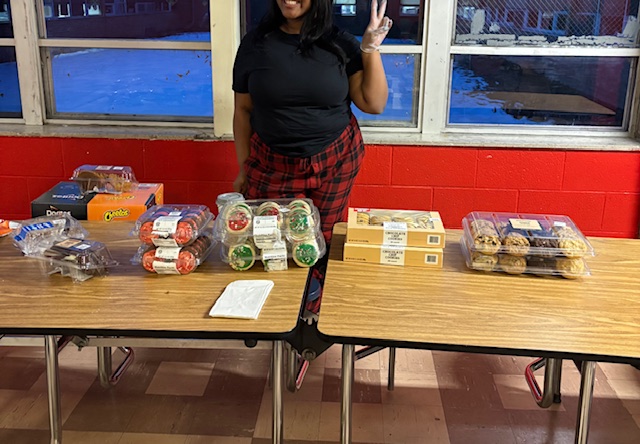
“What can I bring,” I asked around Tuesday when most of the above had already been donated.

“I have hot chocolate. Would you bring toppings?”

“Toppings? Like whipped cream?” I asked.

“Yeah, and I like mini chocolate chips, and sprinkles, and marshmallows…you know, to make a self-serve hot chocolate bar.”

“Ok, I can do that.” I said.

Since I was headed to the grocery anyway to pick up gift cards with the cash that some of you had sent me, it was easy to throw a few more things into the cart.

“Oh,” she said, “one more thing. Would you go around to the classes on Friday and hand out tickets to the ones who can attend?”

“Sure. Whatever you need,” I said — before I realized that this would mean handing them out in front of kids who were not invited. This was a struggle for me — little miss equity this and access that — but, I did it. It was uncomfortable saying, “I’m sorry, you are not on the list. This is an invitation-only event,” but I had to trust my colleague’s vision.

School was dismissed at 3:30 and a crew of students moved to the gym to set up. They were in charge of decorating and setting up the space for the meal, the games, the celebration. While they were doing that, I retreated to my office to finish an administrative task. When I arrived shortly after 5:00, students clad in Christmas pajamas were personalizing their hot chocolate, greeting their friends, chatting at tables, and listening to Christmas music. You might expect this at any Christmas party, but in this community’s world of scarcity, it felt different.

Teens who are normally just trying to get through the day — to get a ride to school, to find something to eat, to stay warm, to manage all the expectations of all the people around them — were free just to be.

And then, the silly Christmas games began!

Asked to find a partner and line up in the gym, students who typically display reluctance to engage, jumped out of their seats, grabbed hands, and ran to the designated location. They tossed miniature Christmas ornaments into cups, they played a version of Head, Shoulders, Knees, and Toes, and they raced to steal Christmas bows that were stuck to each other’s shirts (the one who ends up with the most wins)!

They laughed. They played. For a few moments on a Friday evening, they were allowed to be kids.

Students who typically have to put up a hard exterior — who have to save face — in this small group of students felt safe enough to put their guard down and be silly.

And that my friends was exactly what our students needed. They needed a safe space, they needed to feel like contributors, they needed the extravagance of a meal prepared just for them, of a hot chocolate bar, of games with prizes, of a fun Friday night with their friends. I sat and took it in — smiling, laughing, snapping photos — and realizing that I need to broaden my view of what is essential.

Friends, I am likely going to keep asking for contributions, so thank you in advance for tolerating my boldness and joining when you choose, but I am also going to open my eyes to what else my students need. I’m going to look for more opportunities to acknowledge all of Maslow’s hierarchy (not just the the foundation) because the sense of connection, of respect, of fulfillment are just as essential to developing teens as food, as transportation, as shelter, as safety.

Hats off to my colleague for leveraging her community to meet these needs. In doing so, she also challenged me.

God will meet all your needs. Philippians 4:19

Life These Days

The question of the moment around folks my age — and for the record, I’m just shy of 60– is “how much longer do you think you’re gonna work?”

My most frequent response is often something like, “I’m not in a hurry to be done. I love what I do. I hope I can stay at it a while!”

This is, of course, not how everyone feels. Many my age have put in a long, hard 40 or more years of work in jobs and careers that have taken a toll — physically, mentally, relationally, or in other ways that might make a person want to walk away.

Let’s be honest, if you’ve spent 30-40 years on an assembly line — you might be ready for a change of scenery. If you’ve led a corporation and had the weight of the bottom line, personnel challenges, and inventory management on your back, you might be ready to sit by a pool, sipping a cool drink. If you’ve been in a classroom for 40 years — attending to the needs of children, designing instruction, managing behavior, and adapting to continuously changing policies, cultural norms, and learning challenges, you might be ready to just have a day that doesn’t involve managing anything but yourself.

And while I have certainly had my challenges and seasons of disillusionment and burnout, none of those scenarios truly describe me. After working in many different settings over the years, I find myself in a role that feels like a culmination — the place I was intended to arrive at, so I don’t find myself asking how much longer I want to work, but rather: When I look back at all I have learned, what do I have to offer these days?

In the early years — the first 3-5 of my career — bravado carried me past insecurity so that I could survive in situations that were way outside my experience. A middle school special ed classroom in Detroit? No problem for this secondary English major from small town Michigan! A self-contained classroom inside a residential facility teaching not only ELA but also social studies, math, science — I got this! I faked my way through and while I can’t say that my students (or I) won any awards, everyone learned something — including me. I learned about being overwhelmed and about working with limited resources. I learned to lean into the uncomfortable and to try just about anything. Did I occasionally lose my shit and come undone in front of a classroom full of typically behaving students? Sure. Did I also take a van load of Detroit teenagers on a day-long adventure to Ann Arbor? Yes, I did! Did we overfill our day with activities? Absolutely! Did we arrive back to school late after dismissal? We sure did! Did those kids and I have a ball touring a college campus, going to a hands-on museum, and eating at Pizza Hut? Yes! Rookie me swung for the fences, folks.

The bravado only carried me so far into my years at home with my own children. In fact, I think it was day one home from the hospital when I called a friend emergency-style to come save me because nursing wasn’t working out according to plan. I wish I would’ve admitted right there and then that I was clueless about mothering, but faking it until I made it was my theme song, and I just kept singing. Before I knew it, I was sitting on the living room floor with three children of my own, reading stories, learning letters, and playing games. Those days were exhausting and precious to me! We had a lot of fun, but I was making it up as I went along, so I certainly made plenty of mistakes. I pushed myself and the kids way too hard, and I expected way too much, but in continuing to give it everything I had, I learned how to schedule out a day that included learning, adventure, rest, and play; how to turn a few hot dogs and some popcorn into a baseball watching party; and how to get through a puke-filled night with little to no sleep. I learned that I could manage much more than I imagined, that I had a lot of people who were willing to help, and that it wasn’t a weakness to ask them.

When I returned to the classroom the first time, it was to a position that was far bigger than my experience — the English Department Chair and Dual-Enrollment ELA teacher at a small private high school. Not only would I, once again, be faking it ‘til I made it, I would be doing so all day long in a new environment while I was also still —at home — learning how to parent my own children who were in the process of transitioning from childhood to adolescence in a new home in a new city in a new state.The lift in both arenas was immense, but I was gonna make it happen. I learned a curriculum, read dozens of books, short stories, poems, and essays and adapted to a modified block schedule and the world of Apple computers while I also navigated the needs and ever-changing emotions of a family that was struggling to find its footing. For nine years, it seems, I was in constant motion — either preparing to teach, teaching, or grading in one space or cooking, cleaning, driving, scheduling, or otherwise parenting in another. Those years seem like a blur as I look back, probably because I never stopped running.

And then, all the motion came to a halt. Readers of this blog know that those years ended in an autoimmune diagnosis and an exit from the classroom followed by convalescence and a [next chapter] of re-learning how to live which landed me where I am now.

I came into this season humbled by the knowledge that I did I have a limit, and that I did not indeed know everything. When I was offered the position to teach ELA at a small charter high school in Detroit, I was grateful to be in any classroom at all. The fact that it was familiar territory — teaching seniors about college and the skills they would need to be successful — meant that I would NOT have to fake it til I made it. I could just be the authentic me, sharing what I know and loving the students who were in front of me. Granted, I still had much to learn — our school has an instructional model that was new to me, and I would, for the the first time in my career, have a coach, but none of that was overwhelming. In fact, it was comforting to know that I had support and that I wouldn’t have to find all the answers on my own.

That was over five years ago, and now I’m no longer teaching but coaching other teachers who may be in their very first year or nearing their 10th or 20th year. Some of them are faking it until they make it, some are disillusioned, and some are managing a lot in other areas of their lives.

I have a front row seat to their experience and that’s why I’m asking myself this question: What have I learned and what do I have to offer these folks?

I’ve learned that showing up and doing your best goes a long way — even if your best isn’t amazing, it’s likely good enough.

I’ve learned that being brave can lead to remarkable opportunities that change you forever.

I’ve learned that others are willing to support you if you are willing to ask.

I’ve learned that family is much more important than work and that your health needs to take priority over any perceived deadline.

I’ve learned that who I authentically am is much more valuable to my students and the people I love than getting every decision right or accomplishing every task.

I learned these things the hard way over the last many years, and maybe these folks — the people I rub elbows with every day and those that I coach — will have to learn them the hard way, too.

I think what I have to offer right now is the empathy and compassion gained from my own journey. I have a rare opportunity to offer support and encouragement, and the wisdom that comes with each of these gray hairs.

I’ve got perspective — each day is important but no day is definitive.

I’ve got plenty of gas left in the tank to come alongside the members of my team, to see their passion, their frustration, their hope, and their fatigue. If they are willing to keep showing up, I will, too.

Maybe I’ll get a chance to share what I’ve learned. More likely, I, too, will learn something new.

Teach us to number our days, that we may gain a heart of wisdom. Psalm 90:12

Capacity

Did you ever wonder what your capacity is? How much you can truly hold, carry, manage, or deal with? Have you, like me, recently found yourself staring that limit right in the face?

Yesterday, I walked into my principal’s office for a meeting we had scheduled. She was wrapping up a conversation with a student who had lashed out at a classmate because she “just couldn’t do it today” — she couldn’t handle his joking, couldn’t deal with the annoyance.

“Every other day I can just ignore him, but today wasn’t that day.”

“You didn’t have the bandwidth?”

“Nope.”

“I get it. I’m glad you’re talking about it. We all have days when we have reached our limit.”

At the age of nearly 60, I’ve had loads of days where I have reached my limit. When I was a child, I might’ve reached my limit quite quickly — I might have fallen to pieces simply because it was time to leave my grandparents’ house. When I was in high school, like the student above, a classmate’s comments might have pushed me over the edge.

But here’s the thing about life, as you move through it, you build muscle — and capacity — and you are able to manage much more than you ever thought possible. Still, everyone of us can find our limit.

I mean, everyday life can be seemingly at the “this is working” phase — you’ve finally found something that resembles work/life balance. You can meet job demands and also attend to the laundry, meal prep, family needs, and even routine maintenance of the house and the car. In fact, you can also easily manage your role in meeting the ongoing life and healthcare needs of an aging family member. You’re feeling pretty good because you also managed to budget for and schedule your participation at a weekend family vacation/celebration in the first quarter of the school year and you’ve plotted out on the calendar how to keep all systems functioning while you are away.

But then.. just as you are packing your suitcase, a major household system (think HVAC, plumbing, or electrical) has a major issue.

“No problem,” you announce boldly. “We’ve prepared financially and we can deal with it fully when we return.” You’ve been through enough difficult situations in your life that you know this isn’t the end of the world. A frustration? Yes, but meltdown worthy? No.

You merrily leave for the event, and upon your return home just a couple days later, you realize that said major household issue could possibly still be an issue, but it’s late, and you’re tired, so you try to get some sleep.

You wake the next day, to “knock out” a deliverable on a pre-arranged work-from-home day, only to realize it’s not the kind of thing that can indeed be “knocked out” in a day, so you lift up your concern to a supervisor who directs you to “just A, B, and C”, so you spend a few hours doing A, B, and C, and then your supervisor’s supervisor drops into the group chat and says, “No, A, B, and C won’t work. So, I’m just going to complete this deliverable so that you can run with it,” and your face falls flat. You close your laptop and go for a walk.

Did you let your supervisor know that you were annoyed? that it bothered you to spend time on a project that was subsequently dismissed? Did you perhaps have a tone? Did you perhaps register your complaint a bit too strongly and too repeatedly?

Perhaps. But have you hit capacity? Not even close. You can’t even count how many frustrating days you’ve had at work, how many hours you’ve spent on projects, or how many times you’ve had to toss the product of hard work.

However, while you were elbowing your way through your work day, your husband was discovering that the major house issue has actually turned into a much more major house issue involving multiple contractors, several estimates, insurance adjustors, and scheduling.

“Ok,” you say, taking deep breaths, “we are still ok. We’ve gotta keep doing yoga, keep eating right, keep walking, keep writing, but we’re ok.”

Your husband, thankfully, continues to manage most of the house details, while also meeting his own professional responsibilities, and you pinch hit when needed while juggling the demands of yours.

The next weekend arrives and while he stays home to continue project management, you head north to support the aforementioned family member. The weekend is less than demanding, and you catch up on sleep, before returning home in time to eat, rest, and return to work on Monday morning.

The work week starts out typically, but on Tuesday, things start to pile on. The family member needs additional medical tests, you learn the work on the house isn’t scheduled to start until December, and as you leave work, you find yourself driving through a torrential downpour so that you can make an appointment for a routine oil change. After waiting for an hour and managing various pieces of correspondence, you learn from the technician that it’s time to replace the tires and she has prepared you with three separate quotes. You can feel your affect going flat just as you receive a notification on your phone that the storm has caused a power outage at your house.

And that was it.

You hit capacity. You couldn’t talk about it. You couldn’t process it. You had not one shred of bandwidth.

You drove the 20 minutes home in silence, made your way into the house, and plunked into a chair by the window overlooking your husband who was trying to start an uncooperative generator.

You needed food. And sleep. And something to shift.

Somehow, the two of you found your way to a vehicle, drove to a restaurant, ordered food, ate it, and returned home. You had cleaned up and crawled into bed just before the lights came back on and the furnace kicked in.

[Thank God.]

The next day the repair date was moved up to the first week in November.

[Exhale.]

The family member was seen by the doctor and a plan was put in place.

[OK.]

The tire replacement was scheduled.

[We have a plan.]

Just enough shift happened, and somehow, everything seems manageable again.

For now.

Take it from this old head, wherever you are in life, trying times are going to come and test your capacity — you may lose your mind when someone eats a bag of corn chips that were intended for the evening meal, but the experiences of today are building your capacity for the difficulties of tomorrow. And, be assured, tomorrow will certainly have difficulty — maybe just an irritating boy at school, possibly just a flat tire on the way to work, hopefully just a major house system repair that can be done and dusted in the space of a month. We need those light and momentary troubles so that we can manage it when the shit gets particularly real. And that will happen, too, I’m sorry to say. That will happen, too.

And at those times, you may find you have reached capacity — you may find you don’t have words, or reason, or the ability to make a meal. I pray you discover you are not alone or without hope. I pray that something shifts and you find that once again have some capacity.

[Indeed…] in this world you will have trouble, but take heart [I have endless capacity,] and I have overcome the world. John 16:33

Typical, 2025 version

It’s been a pretty typical week for 2025– a virtual genocide continues in Gaza (albeit with talks of a coming ceasefire and hostage release, all of which we’ve heard before), the US government is shut down, four people were killed in a church shooting an hour away, and Jane Goodall — a universal treasure– passed away. Oh, and I’ve spent the week trying to provide an equitable educational opportunity to six sections of high school science students.

Here’s what’s going on — I am the instructional coordinator in a small charter school on the border of Detroit and Dearborn. You could drive right by us and not know we are there. We operate out of a run-down former Catholic elementary school which we rent for a rumored gasp-worthy sum from the Archdiocese of Detroit. The parking lot of this building, which our busses have to traverse twice a day, is literally crumbling under our feet/wheels. To come onto the property each day, I have to ignore the willful negligence that would allow a literal lake to form in the center of the asphalt, but I digress.

We aren’t glamorous is my point. The building is too hot in the fall and spring because we have no air conditioning and too hot in the winter because of the antiquated boiler system we use to heat it. Windows need repair, and the gym, which we use as cafeteria, gym, and auditorium, is way too small to host any kind of athletic competition. If you could, based on facilities, choose to teach anywhere else, you probably would. Or, if you could choose to teach students who read at grade level or who have involved parents or who come to school prepared to learn every day, you would probably choose to do that.

But we aren’t that school.

Nevertheless, we have almost 300 students who deserve a high quality education. And we can’t provide that — we can’t get them up to their current grade level, we can’t adequately prepare them for postsecondary education or the work world, we can’t give them an opportunity to change their circumstances — without well-trained teachers, and I’m not sure if you’ve heard, but there isn’t a surplus of those lying around.

This is my 6th year at my school, and every single year we’ve had at least one, if not two or three, classes covered by long term substitute teachers or, more recently, online alternatives, and that’s not because we aren’t doing everything we can to find teachers — we are!

So here’s what happens — each spring we post all of our openings, then we interview all summer, we make offers to the most qualified people, we believe we are fully staffed for the fall, then days before school starts, we realize that one or more of our teachers has changed their mind and moved on — maybe for more pay, maybe for a different environment, maybe for a promotion. The reason doesn’t matter. We suddenly find ourselves with a hole to fill.

Now, because this is our reality, we do always staff 2-3 permanent building substitutes. These folks are salaried employees who come into the building every day. They are typically not certified teachers or subject matter experts, but they are committed members of our team who know and love our students. We also have a creative leadership team that has found myriad work-arounds over the years.

This year’s shortages were looming all summer — we found and hired multiple math and science teachers only to have each of them move on before the first day of school, so in the final hours we made a plan. Our Geometry and Algebra II courses would be staffed by a returning qualified educator. Our financial literacy course would be taught by a permanent employee who also runs his own business. Algebra I, Principles of Physics, and Chemistry would be covered by a company called Elevate K-12. This company hires certified teachers who live in other locations to zoom into our classrooms and provide high quality instruction. For these classes, we provide an in-person facilitator — a member of our team who knows the students and manages all on-location needs such as attendance, providing physical materials, and managing any student behavior issues. This is our second year using Elevate, and although last year’s start was bumpy, I must say that we have found our rhythm.

With all of those classes covered, we still had three sections of Biology and three sections of Earth Science to cover with days remaining before students would arrive. With no applicants in the hiring stream, we turned to an agency that provides long-term subs to area schools. (You read that right — the teacher shortage is so profound that agencies exist solely to provide long-term substitutes.) That agency sent us two people to interview. We chose the one who had some experience in a high school science classroom, and she started right away.

She did a good job of getting to know the people, finding her way around the building, fostering relationships with our students, and showing up for work everyday…until she didn’t.

And now we are looking again.

The students have not had a teacher now for seven school days. They have had members of our team covering, and I have been providing assignments (without instruction) and grading papers. Even if I could stay in the classroom every day, I don’t know enough about population dynamics or the chemical composition of the sun to guide these young minds through their learning. And I can’t stay in the classroom anyway — I have a whole job of coaching and supporting the other teachers in the building in their quest to meet the needs of our students who have profound knowledge gaps and who nevertheless have dreams and goals and deserve every opportunity to make them happen.

No, we need to find someone qualified to teach these classes.

My principal sent me a calendar invite to join her for an interview on Thursday — someone the agency sent to take over these courses. He was a career scientist — full of content knowledge. However, although he’d done some one-on-one tutoring over the years, he’d never been in a classroom, never kept a grade book, never presented with a slide deck. We’re starting week six of classes on Monday and we need someone to jump in there, hit the ground running, and salvage what is left of this semester for these kids.

So we’re still looking, and I’m still giving assignments and grading and encouraging students and their substitutes to stay the course. This is where we are, and this is what we have.

Meanwhile, a few states away, grown men who have their education can’t agree on how to fund the government while they are simultaneously allowing millions to be spent rounding up undocumented immigrants.

I wonder if they care that 411,549 teaching positions in the US remain unfilled or filled by folks not fully certified. I wonder if they care about the students impacted by those vacancies, many of whom are from low-income homes that struggle to meet their everyday needs for food, housing, and transportation. I wonder if they think about that when they are deadlocked on their decision over spending for healthcare that will most certainly impact these same families.

I wonder who we have become and how this has become just another typical week.

Do you wonder, too?

Seek justice. Defend the oppressed. Isaiah 1:17

If you or someone you know (certified or not) has a background in science and a heart for kids, click on this link and tell them I sent you. (We have openings at our elementary school, too.)

Support That Claim

Click the arrow above to listen to me read this post. Printed text has linked content, some of which supports my claims.

Since we discussed bullying in my last post, perhaps we should also discuss another adolescent behavior — making unsubstantiated claims.

Guys, I’ve been hanging out with teenagers and children since 1989 when I taught my first class of mostly male 7th graders in a small school on the east side of Detroit. From there to suburban Detroit to a couple small towns in south central Michigan to St. Louis, Missouri, to Ann Arbor, and back to Detroit where I teach now, one hallmark behavior of all the teenagers and youth I have worked with is blurting out accusations without proper evidence.

I’m walking down the hall and a senior runs up to me frantically, “Mrs. Rathje, can you talk to Mr. Smith. I’m failing his class, and I did my work. He’s just not putting in the grades.”

A young man says, “We would’ve won that game last night, but the other team cheated.”

Someone else says, “My parents won’t pay for me to go to the prom. Can you help me out?”

These are all claims that one might be tempted to immediately believe. They might reply, “The teacher can’t do that! I’ll make him post his grades immediately.” or “They cheated! What did they do?” or “What a shame! Of course I will get you some money for prom.”

But critically thinking adults know that before they believe a claim, they need to ask for the evidence.

“Come with me to that teacher and let’s see what work has been recorded and what work has not.”

“Tell me more about the game. Who scored? How? What did your team do?”

“I know you want to go to the prom. What conversations have you had with your parents? What kinds of things do you think you need?”

Often, when we ask a follow up question we find out that the student did indeed do some of the school work and that the teacher had put in those grades, however, the student had missed some other critical assignments that he may or may not have been aware of. The team may have suffered a loss, but the other team may have simply outplayed them. The prom-goer might have assumed the parents couldn’t afford to pay for any of prom, but after a brief conversation, the student learns that they can cover the needed clothes, just not the admission ticket.

Teenagers (and other folks who have not matured beyond adolescent thinking) make unsubstantiated claims for lots of reasons. Often they are panicking — about their grades, about finances, or about feeling slighted — or they are feeling insecure — about their performance, their identity, or their social standing. One of the most important roles of the adults in the room is to identify that dysregulated emotion and to help ground the developing mind in reality.

Critical thinkers have to ask questions. If we see in the news that a man was shot and some are suggesting that a particular group was responsible, we have to ask the question, how do you know that?

If a political leader claims that a well-known and widely used medication causes neurodivergence, adults need to ask for the studies that prove this. Those in the room who know the claim to be false need to stand up and say, “Um, sir, that simply has not been proven.”

Most people from time to time make an unsubstantiated claim. I might say, for example, “prices are sky-rocketing; retailers really don’t care about the average consumer.” I may really feel this way, but unless I have evidence of retailers making decisions — setting prices — with blatant disregard for consumers, my claim is unsubstantiated. It might seem fairly harmless for me to say this in a fit of exasperation, but I may impact others simply by making the claim. Some people who trust me and know my track record of being thoughtful and researched may actually believe my unproven rant and form an opinion about retailers based on my spouting off. They may even change their shopping behavior because of their belief in my momentary rant.

And I’m just an every day middle-aged woman from the midwest. What if I had a national platform — what if I held a position of leadership or even power? What if I, standing on a national stage made the claim that a large northwestern city was under the siege of war? Would my constituents believe me? Would they form opinions about that city? Would they act on my claim? Would anyone in my orbit have the courage to demand that I provide evidence before broadcasting such incendiary language?

In a typical day, the average person is peppered with claims — from their coworkers touting the most efficient way to get the job done to their social media feeds spouting the latest health fad to their television news shows (whichever angle they are espousing) delivering their packaged opinions, to their neighbors and family members simply sharing their thoughts. It can be exhausting to interrogate every single claim you hear, but responsible adults must.

What complicates matters is that all of these claims are being made at a time when 54% of US adults (aged 16 to 74) read below a 6th grade level and 21% are functionally illiterate. More than half of the adults you encounter in a day may not be able to comprehend the evidence that supports some of the claims being made or may not have the critical thinking skills required to interrogate them.

However, some of us do! Some people have positions in rooms where very big decisions are made based on unsubstantiated claims, and they have the knowledge and ability to ask hard questions, to challenge authority, to stand up to crazy.

And they — we — must.

Whatever room you are in, whatever claims are being made, you have the responsibility to identify the dysregulation in the room and ask the questions that ground people in reality.

For the love of God and all things holy.

Ask for the evidence. Question the claim.

…examine everything carefully; hold fast to what is good. I Thessalonians 5:21

Of (not politics, but) Bullying

Some people don’t like it when I talk about politics….I get it. If, as Wikipedia* states, politics is “the set of activities that are associated with making decisions in groups, or other forms of power relations among individuals, such as the distribution of status or resources,” I can see why the topic might make some people feel uncomfortable.

I mean, why would you want to examine the reality of which folks hold the power, which groups benefit from the decisions of those folks, and which groups are historically and perpetually disenfranchised by those decisions. That examination could lead to unsavory images, to be sure, and we wouldn’t want anyone to have to see that, so, let’s not talk about politics.

Instead, class, today let’s talk about bullies.

Every single school I have been a part of has had its bullies.

They don’t have to be the stereotypical intimidatingly oversized thugs that might be populating on your brain screen. In fact the bully of my first class was quite undersized. Physicality is not essential to the bully. Rather what characterizes the bully is the behavior that seeks to dehumanize, belittle, embarrass, or otherwise harm others and the presence of, at first, a yes man, then a crew, and ultimately the compliance of the larger group in allowing the bully to continue harming others.

It often starts with the bully targeting someone who is demonstrably “weak”. The bully might make fun of the disabled, denigrate immigrants, or even make jokes about someone’s weight. He (or she) looks around for a target then slings a grenade with the intent to do harm. But the harm is not where the power lies.

No. The power lies in the reaction to the harm. He gets a laugh at the expense of the disabled, a snicker at the expense of the immigrant, a guffaw at the expense of the overweight. And those responses are the fuel for the next attack.

Still high from the reaction of the yes men, the bully begins to scope out his next target — maybe someone with a little more clout — maybe a classmate or a peer. First he spreads rumors to harm his target’s reputation, he engages in name-calling to dehumanize his foe, he might even accuse others of wrong-doing, whether or not there is credence to his claims.

Throughout all of this, those around him, seeing the power he is building, have to make a choice — do they want to land in the bully’s sites or take a position at his side?

That’s a tough call, especially if you are in middle school or still have the insecurities that you had when you were in middle school. You might not think you can handle humiliation. You might not think you could weather the name-calling. You might not think you could bear up under the rumors. So, you chuckle at his antics, you move to his side of the room, you excuse his behavior as harmless, and you turn your eyes away from the victim.

And you continue to live with that decision because it still feels safer than having him turn the attention on you.

But then the assaults escalate. The blows become physical. And he’s going after someone who is or who used to be your friend. He might even attack a member of your family. Then you have to face a crisis of identity — who do you want to be? Do you want to stand behind this guy, smiling for the camera in your suit, waving your flag of allegiance, as he takes shots at not only the least of these but also at your neighbor, your brother, your friend, or your mom?

This moment happens in every bullying movie you’ve ever watched — The Karate Kid, when Danny LaRusso takes the blows of Johnny Lawrence almost to his peril in the final match, Mean Girls when Cady, who was once part of Regina George’s crew, finds herself a target when the burn book is circulated — the individual who had chosen to capitulate or even join a bully has to decide if they are going to stand up.

The rare ones who, despite their inner terror, find the courage to say “Not here, not today,” rise up from their devastation and face the bully. In the movies, this usually results in the bully walking away in shame or, in the most ideal of scenarios, having a change of heart and determining to be a different kind of person.

This sometimes happens in real life, too, although not inside the space of 90 minutes, and certainly not when the bully has been allowed to gain control beyond the schoolyard and into the community. No, in those cases, one person standing up will not be enough. To stop a bully who has, through all the text-book tactics of instilling fear through intimidation, established a culture of systemic compliance to the most ludicrous of actions, the community must come together and take a collective stand. They must, united, shout “Not here, not today!”

One person might not stop a bully, but a lot of single people, together, can do almost anything.

The bully can’t continue unless the community lets him.

Certainly the community will wake up and put a stop to it — it’s not politics, after all, it’s just refusing to let one person dehumanize another.

Defend the weak and fatherless; uphold the cause of the poor and the oppressed. Psalm 82:3

A couple of notes:

*If you were a student of mine in the early 2000s and cannot believe that I actually cited Wikipedia, see also lecture #497 entitled “Anybody Can Change”**.

**And when I say “anybody can change”, I do mean even bullies.

Also, if you listened to this post, you might be interested to know that the text version has several embedded links.

Back to School: Before and After

I write a post like this almost every year — scroll back, you’ll see! Each fall, I can’t stop myself! I’m still filled with the child-like wonder and excitement of going back to school. I mean, yeah, I had outfits picked out, bought a new pair of school shoes (okay, two pair!) and kept them fresh for day one (and two!). I had my classic teacher terror nightmare — only this year it wasn’t me showing up naked, late, and unprepared, it was my teaching cohort! And I’m here to tell you that the stress was not less!

I get so excited about the return to school because it holds so much possibility — imagine the potential for transformation!! And in any story of transformation you need the “before” pic. Let me see if I can paint it for you.

The students first showed up on the Thursday before Labor Day. I can spot the freshman from a mile away. They shyly and awkwardly accompany their parents and older or younger siblings. They stand quietly as their people sign them in, looking around to see who else is there, who is looking at them, who is judging them, who can see their insecurity.

Sophomores roll up with slightly more confidence, sometimes with a parent tagging along ten paces behind. These students steal glances, seeing what looks familiar — teachers, friends, anything.

Juniors have just a hint of swagger — they know the drill — they know who’s who, what’s what, and where’s where. They quickly run through the requisite stops — schedule pick-up, bus sign up, sports physical — then find their friends to take laps inside the building, check out new students, get into a little harmless mischief, or do a little peacocking.

Seniors? You can’t tell them nothin’. They have their hair done, are wearing a dope ‘fit, and have texted their friends to arrive at the same time. They run this place — they are beaming and bouncing. This is their year and they know it.

And that’s all on the Thursday before school even starts — before the three-day weekend, before reality hits, before they have to arrive on time, sit in an assigned seat, do the coursework, take notes, stand in lines, or listen intently.

But all that has begun now, too. We have finished a week of students being in the building, running to get to class before the bell, asking permission to use the bathroom, looking for a snack, trying to hide their phones, getting caught with their phones, turning over their phones, and waiting to get their phones back at the end of the day.

They came in on Tuesday, and we were ready for them.

Our teachers had on shirts emblazoned with our Activate Excellence motto, arriving early to put finishing touches on their rooms and man their stations in the gym for arrival. We had some teachers collecting phones, some handing out schedules, and some stationed as greeters. There were hugs and fist bumps and hand shakes with our returning students, so it wasn’t difficult to pick out those who are new to our building — freshmen, of course, but also quite a few transfers.

In Detroit, a district with over 50,000 students, most high schools have enrollments of over 700, and some have over 1000. Our charter high school is small — under 300 students — so we often get students who found those larger contexts to be untenable. Maybe they were overwhelmed. Maybe they didn’t find a connection or friend group. Maybe they got into a fight and are now dealing with the aftermath. Whatever the reason, we often end up with a unique collection of students who for whatever reason couldn’t or didn’t want to make it happen somewhere else.

We’re a charter school — so students choose to come to us. Granted, sometimes that choice is because they have run out of other options, but I like to think they choose us because we are a small community. Everyone knows everyone else — no one goes unseen. If you came to school without a jacket, someone saw that. If you look particularly down or quiet on a given day, a person noticed. You’re hungry? You know who to ask for a snack. You don’t have a ride home? Chances are you have a connection with a staff member who will help you figure it out.

Changed your hair? We saw it.

Grew up over the summer? We know.

Your ability to manage conflict is improving? We give you kudos.

Let me give you a glimpse at an “after” pic.

For the past four years, we have had a student in the building who was classified as “homeless” and qualified for resources under the federal McKinney-Vento Act. Last June, this student graduated despite having transportation challenges, learning difficulties, and very little family support. Staff at the school made it possible for him to attend prom and participate in all senior activities, and the young man was repeatedly overwhelmed with gratitude. When he walked into our decision day celebration in early May, he hugged several of us and wiped away tears. When he arrived at prom, he approached staff members, tearfully repeating, “I can’t believe this is actually happening!” and when he showed up for graduation, he could barely find words. He savored every moment, and his classmates and teachers saw it for what it was — the realization of a dream.

On that day, he didn’t know what his summer or future would look like. Because of his situation, he was having difficulty getting access to the documents that would make him work eligible, but late in summer we received word that he had what he needed and had found employment in a hospital. This past week, he reached out to one of our staff members and said he was working a lot of overtime and was looking for an affordable apartment.

The staff member reported this in our group chat, and I must say that in the middle of a school day at the end of the first week of school, when everyone is getting tired and ready to go home for the weekend, that little notification reminded us all what a special place we work in.

Just four years ago, this young man was one of our awkward freshmen — he missed a lot of school days, and we noticed. He often came unprepared to learn, and we said something. He had the support of a friend who got him to the building every day, but he came late and left early. It was frustrating, to be sure, but we found ways to work with him. He had the support of the social worker, the principal, the resource room teacher, and literally every single adult in the building. It was not uncommon to see him checking in with one of our custodians who might as well be everyone’s momma.

And now he’s a high school graduate, he’s got a job, and he’s looking for an apartment. If that’s not a transformation, I don’t know what one is.

I guess that’s why I get excited every September — that’s why I can’t stop writing about it. Every day is a miracle waiting to happen. I can’t believe I get to do this. Just like my student, “I can’t believe this is actually happening.”

[We] will see the goodness of God in the land of the living. Psalm 27:13

Job Postings at DLA!

DLA Wishlist

Finding a Footing

At the end of the last school year, as I waved goodbye to students and wished my colleagues a safe and restful summer, I was envisioning long days of reading broken up by an hour here or there with my hands in the dirt — weeding our garden, tending to our plants, and bringing in the fruits of our labor. I saw days on the beach of a great lake and others poolside with our granddaughters.

While I did manage to experience all of that, much of my summer was not what I was expecting. At all. Particularly not when, just a month ago, I was searching for an assisted living facility for my stepfather, helping my brothers move him in, being present for his rapid decline, then processing with my mom and siblings through his passing.

The flurry of activity was unanticipated and un-mooring. I’ve felt a little tossed about for several weeks, so the return to the rhythms of back-to-school prep of the past many days has been a welcome and anchoring exercise.

As I’ve been walking the hallways of our school buildings, I’ve been wondering if our students, too, have felt a little at sea. What has their summer been like — have they been working? helping out at home? have they had plenty to eat? time and space to rest? have they experienced loss? or trauma? joy? or celebration? Has their summer been what they were expecting? Are they, too, in need of the rhythms that will bring stability?

Because I’m not teaching this year, but rather supporting our teachers and students from a more global perspective, I’ve been managing tasks all summer like updating scope and sequence documents for various courses, familiarizing myself with the curricula taught in our building, creating Google classrooms for all of our teachers, updating our school’s testing plan, organizing and auditing the curriculum I created, and managing several other tasks. Over the last couple of weeks, I’ve also been preparing presentations and materials for the teacher orientation that begins this week.

As I’ve been checking all these boxes, I’ve needed some support (and grace) from my supervisors to reconnect with the world of school, to remind me what each of the pieces are exactly, to steady me as I find my way back to the vernacular of academics — to norms and standards, to unit plans and instructional strategies, to engagement and discourse.

I’m guessing that our teachers and students are going to need support (and grace), too. Certainly their summers have been far from the academic realm — less structured or predictable. Sure, some of them have punched a clock or had regular eating and sleeping habits, but many will have had no routine at all. Surely few, if any of them, will have sat in a desk, attended to a slide deck, navigated to a Google classroom, or submitted a document for review.

Transitioning away from my erratic summer to more routine work has not been easy nor has my body been quick to adapt. While I’m being quite diligent in getting back to eating three meals a day at the designated times and observing my normal bedtime, my body is still on high alert after weeks of urgent phone calls, last minute trips, and unexpected decisions. My digestive tract is suffering from role confusion, and my sleep patterns remain inconsistent.

Perhaps the bodies of my students and teachers, too, will be a bit out-of-kilter. Perhaps they will find it difficult to endure a seven hour school day, to sit upright for long stretches, to use the restroom at designated passing times, to make it from breakfast to lunch without a snack, to remember to get a drink between classes, or to stay awake for the entire day.

I’m finding a few things helpful in my regulation. First is seeing my people. As I’ve gone into our buildings over the last few weeks, I’ve reconnected with my colleagues, many of whom have offered hugs both of “I’ve missed you” and “I’m sorry for your loss.” We’ve shared stories and laughter as we’ve navigated our tasks.

I’ve found stability in the familiar — the drive, the building, and the faces.

I’ve found comfort in the physical — walking into my office, arranging my supplies, moving books, and touring classrooms.

I’ve found security in doing what I know how to do — creating a document, sending an email, meeting a deadline, planning a presentation.

I’m thinking about how I can use my experience of re-entry, my realization of what I’ve needed to re-acclimate, to support my teachers and students as they move from what also may have been erratic to what is more routine.

We already engineer the first week to be less about curriculum and more about connection. We are a trauma-informed organization, after all, and we know that Maslow comes before Bloom. We have a system of delivering school-wide norms and expectations, and we support teachers in integrating warm-ups, games, and getting-to-know-you activities. The first week is all about learning names and building community. It’s an opportunity for our students to get a literal or metaphorical hug– to reconnect with their teachers and classmates.It’s a time to situate themselves inside of the familiar — not only the building and its classrooms but the bell schedule, the movement patterns, the physicality of being in the space, and the kind of routine assignments that warm up muscles and build confidence.

How can I normalize the weirdness of it all — how our bodies and minds take time to adapt, how we may feel irritated, foggy-headed, tired, and out-of-sorts? The best way I know is to name it — call it out — talk about it.

Our teachers and our students may need the leaders in the building to acknowledge the heavy lift of transition — of moving from the summer-realm to the world of school. These worlds are not the same, and the move can be jarring. For me, back to school has always been a comfort — school is a place where I know how to be, what to do, and how to succeed — but it’s not like that for everyone. For some, school is an increase in stress, a place of conflict, a world of insecurity.

So, in my new role, I think one thing I can be is present — observing what is happening for teachers and for students, being willing to acknowledge that what they are experiencing is real. Of course you’re tired! Coming back to school takes a lot of effort! Yes, this is a lot of information to take it all at once, and our summer brains are not used to it.

I can also offer compassion. I get it! My body is still adjusting to the school day, too! I can cover your class while you run to the restroom. How can I support you in getting your documents completed on time? Would you like to tell me about what you are experiencing?

That’s the benefit of my role — I’ve got a head start on my teachers and my students. I have had a preview of what they might experience in the coming weeks. Now that I am feeling a little more stable, I can lend some of that to them as they transition. I can be a reminder that they will soon be settled in as well.

That, and I can make sure that my snack drawer is full, because I can bet that soon I will be hearing both teachers and students say, “Mrs. Rathje, you got anything to eat?”

I’ll be ready for them; I’m getting closer each day.

put on compassion, kindness, humility, gentleness, and patience. Colossians 3:12

**If you’d like to support what we do at Detroit Leadership Academy, here is a current wish list

It’s complicated

The seemingly unintelligle words of hospice — one month, a few days, 48 hours, probably today — all started making sense and then were undeniable. My stepfather took his last breath in the early morning hours last Saturday. In the days that followed, we gathered, made arrangements, gathered again, handled details, cared for our mom, and came to terms with the fact that my stepfather, Roger, is no longer here.

We’re still working on that last part, of course, and for me, the essence of our relationship makes it little complex.

While many found him charming, Roger and I had what was often a prickly relationship. We didn’t agree on hardly anything — politics, the setting on the thermostat, the way to wash dishes, vacuum a floor, wipe off a table, or do just about anything. I found him to be demanding, opinionated, and critical. I often felt great irritation toward him over our 50-year relationship, probably because I always felt that he usurped the position that should’ve been held by my father who I have long-adored and often idolized, likely because he and I haven’t had many opportunities to interact on politics, the thermostat, or dishwashing.

Because of this complicated relationship with Roger, it came as a great surprise to me when I found myself feeling tenderness, compassion, and love for this man as he declined, as he lost his agency, as he forgot where he was, as he was unable to breathe, as he was confined to bed — a man who rarely sat still, who worked and golfed and bowled and rode a motorcycle halfway across the country. I was stunned to watch my heart shift from irritation to caring, advocating for, and comforting this man who has been an annoyance in my life for most of my life.

When my mom married Roger, she had four kids aged 8-14. He had two kids aged 8 and 10. Together there were three boys and three girls — just like the Brady Bunch, which was in vogue at the time. For a few years, the eight of us took vacations together and hung out together, but as we turned into teens and then adults, we were rarely together. In fact, my three birth siblings and I have only managed to all be together on a dozen or so occcasions in the last 30 years, and the six of us “kids” hand’t been together in the same room for close to 40 years before we all gathered on a Monday night for pizza a year ago.

Who knows how this happens — people are busy with their own lives, and if one person doesn’t act with intention, folks never come together. But last year we did, and then, miraculously, Roger took his turn for the worst just as we were scheduled to all be in the same state again this past month.

We all worked together — getting him moved in to assisted living, taking phone calls, running errands, and sitting by his bedside. We took shifts. His daughter, who claimed the overnights, fell asleep holdng his hand that last night, saying, “Good night, Dad. I love you” and reading him the 23rd Psalm.

We crammed in a small room at the funeral home — writing an obituary, picking out flowers, deciding on printed materials, then shared a meal with our mom, who kept saying, “I can’t believe this is happening.”

And then, on Wednesday, we all rolled in — the six kids, and our kids, and even some of their kids. Because of the nature of this complex family, some cousins met each other for the first time. Some nieces and nephews met their aunts and uncles for the first time.

Families can be like this, can’t they? Frustrations can lead to fractures and before you know it, you’re meeting your brother’s kids for the first time, marveling at their kids, and watching your own kids (and nieces) interact with their new-found family with curiosity and grace.

I probably won’t ever understand the complexity of Roger — why he was the way he was — but I can celebrate the fact that despite my irritation with him, he remained invested. He cared for my mom to the end (even if that in itself was complicated) and he cared for all of us in his own way, too.

Mom and Roger married when I was 10, and maybe because of “ew — cooties” or that previously mentioned loyalty to my dad, I rarely let Roger touch me — not a hug or a pat on the back, let alone a kiss on the cheek. So imagine my surprise when near the end, I found my hands on his waist steadying him, or when I agreed to scrub his back when he couldn’t shower himself, or when he grasped my hand to say goodbye, or when I kissed his head to reassure him when he was afraid.

We don’t know the love we have inside of us that is sometimes buried under hurt or anger or a little girl’s longing for her actual dad, but it is there, and it surfaces when it matters — when you need to sit beside a hospital bed, empty a urostomy bag, or say “I’m sorry this is what’s happening right now. I know you want it to be different.”

It doesn’t mean I don’t love my dad or that you could ever take his place. It means that I saw you show up and hang in there, even when I found you to be annoying, critical, demanding, and cootie-infested.

It’s complicated, that’s true. Much of life is.

Rest well, Roger, I’m pretty sure it was complicated for you, too.

Love one another. John 13:34

Rapidly-shifting Reality

Three weeks ago, I made a phone call. Just a simple call.

My stepfather had just returned home from the hospital again — I’ve lost track of how many times he’s been in and out in the past year or so — and this time he was prescribed 2L of oxygen to be worn 24 hours a day. He has COPD, among other health issues, and he’s been on a slow decline for a few years. When he came home with the portable oxygen tank, the nurse from the home health agency who had been doing weekly visits on my parents for the past many months, just happened to be at the house accompanied by her clinical director who planned to evaluate the need for more services. She saw my stepfather enter the house, assisted by my brother, and rewrote the script in her head.

She’d been planning to offer palliative care services to support him through this ongoing and prolonged illness, but when she saw how difficult it was for him to just enter the house, she suggested to my mother that perhaps it would be wise to enlist the help of Hospice. “It’s different now,” she said. “Hospice isn’t just for end of life; it can provide prolonged in-home care so that your husband doesn’t have to travel to the doctor or hospital any more. We can manage his care right here.”

My mom called me, told me what was going on, and I asked, “what do you think?” She admitted she could no longer do it alone, which my siblings and I had been suggesting for months. “Well,” I said, “it might be nice to have someone coming to the house regularly that can help us make decisions when it’s time to make other changes. Would you like me to call them?”

“I think so. She said so much. Maybe you can hear the details yourself.”

So, I made the call.

Hospice would be covered 100% by medicare. They would adjust their visits as needed. They would handle all medications and would assist us in the transition if the time came for my stepfather to move to a facility.

I called my brother, who has been the point man through our whole journey, and he agreed that I should set up an appointment.

Hospice came to the house the next day. We signed my stepfather up, and the visits began — a nurse, an aide, a social worker. The door on the house was continually opening, and my mother was overwhelmed.

The following Monday, I sat down at my desk to complete some tasks for work and texted my siblings. “Hey guys, hospice is up and running. I won’t be able to come this week or next to help out, but I will be available by phone.”

I opened some documents, started working, and then spoke to my husband, “I think I’ve gotta go up there.” No one had called. Nothing had changed, I just felt myself pulled to my suitcase and mentally moving toward my vehicle. I called my mom, “How about I bring you guys dinner and stay til tomorrow afternoon? I can just provide you with a little support.”

“I hate to have you drive all the way up here, but that would be great.”

By early afternoon I was on my way.

I brought dinner. We ate. I got them both their meds, did the dishes, and made sure they were all set for the night before heading to the guest room.

Around 4am I heard yelling. I ran to my stepfather. He’d had trouble standing to go to the bathroom and was having some respiratory distress. I administered his new emergency med regimen, then helped him stand. He stood right there by his chair for several minutes so he could catch his breath, and then slowly, so slowly, used his walker to get to the bathroom. It took us 20 minutes to travel 20 feet. Once there, he was unsteady — teetering. I had to use my body weight to brace him so he wouldn’t topple into the bathtub. He did what he came to do, then we stood there for a moment, so he could steady his breathing before the trip back to his recliner.

It had been an emotional event for both of us, and neither of us got any more sleep.

The hospice nurse came that morning. My brother, mother, stepfather, and I spoke with her about what options we had. If I hadn’t been there for the incident the night before, what would our 100 pound mother have done? The nurse suggested she send over the social worker that afternoon to walk us through some options. Also, since my stepfather was having difficulty standing up from his chair, she recommended we purchase a lift chair.

That afternoon, the social worker came and talked my brother, my mother, my stepfather, and I through our options. We could keep him at home and hire additional home health aides (we were already paying for eight hours of assistance a week), or we could move him to adult foster care, a nursing home, or an assisted living facility. But before we made any decisions, we needed, she said, to meet with a lawyer who specializes in elder law. Any of these options would be quite expensive and we should have guidance on how to protect our parents’ assets before we acted.

We had a plan of action, so my brother ran a mile down the road to our small hometown’s furniture store to purchase a lift chair. While he and my other brother arranged to bring it home, I ran to the pharmacy to pick up some prescriptions. We met back at the house, brought in the chair, and while all of us were rearranging furniture and tidying up the space, my stepfather attempted to move from his walker to sit into his new chair. Up until recently he had been independently getting in and out of his chair without difficulty, so none of us thought to stand near him, and down he went. We all rushed to see that he was ok, my brothers lifted him back to his feet and got him in the chair, and we all looked our new reality right in the face.

That reality would start changing day by day.

The next morning, the hospice nurse stopped by the house to assess any damage from my stepfather’s fall. We’d been up again in the night — for breathing issues, for trips to the the bathroom, for confusion. She examined him, found the cut on his arm from where he’d hit the coffee table and a large bruise on his backside from the point of impact. She assessed his breathing and other vitals then met my mother, sister-in-law and I in the kitchen.

She used words we hadn’t heard before rapid decline…24-hour assistance… and about one month. We tried to comprehend this adjustment to our new reality.

And the scramble began — some siblings investigating elder lawyers, the social worker and I investigating facilities. Phone call after phone call, text message after text message. Eventually a couple tours. Finally an open bed. Then digesting the cost, then agreeing to the terms. All the while, on-going conversations with my mother and stepfather about what is happening and why…over and over and over.

Four days after I had decided that I was too busy to go up to my parents and then pivoted on that decision and went anyway, we were loading my stepfather, his clothes, his walker, and his newly acquired lift chair into our vehicles and transporting him to his new residence.

He didn’t love it, but we couldn’t see another way.

That was two weeks ago.

Hospice has continued to use incomprehensible words…rapid decline, days, family should come.

Family has come. Someone is beside him now.

It won’t be long.

That’s a reality.

From his fullness, we have all received grace upon grace. John 1:16

Rested and Ready for a new Rhythm

I wrapped up school year 2024-2025 –watched another group of seniors cross the stage into adulthood, entered final grades, and cleaned up my classroom.

Next, I joined my husband in clearing the clutter in our home.

Then we left town for two short treks — one to play with our granddaughters in Ohio and another to lie on the beach of Lake Huron. We crossed the miles listening to podcasts and chatting about everything from family to politics to music to our future. With our grand girls we lazed in the pool, played Uno and Skip-Bo, and were entertained by intricately choreographed dances. Near the beach, we ate well, slept long, took leisurely walks, and lost track of time.

They were luxurious and welcome — these two little trips back to back — and now we are re-entering real life. Since we’ve returned home we’ve been in the business of unpacking, doing laundry, tending to yard work, and taking stock of the new rhythms we are noticing since a) my husband transitioned from an almost four-decade-long career in church work to a private counseling practice and as b) I am making the shift from classroom teacher to full-time instructional coordinator. Some of the work each of us does in our new roles is similar to what we have done in the past, however, the routines and workloads are quite different. While he has been adapting to his new rhythm for over eighteen months, my real shift begins this week as I embrace the responsibilities of my new role.

How will it be the same? How will it be different?

What won’t change is my morning commute — I will still drive 30 minutes east from Ypsilanti to the edge of Detroit. I will park my car in the same spot, work with many of the same colleagues and students, and follow the same daily bell schedule and school year calendar. I will also continue to serve on our school’s leadership team, meeting at least weekly to plan initiatives and events, troubleshoot current issues, and collaborate toward best practices for our building.

However, many things will change — I will no longer have my own classroom. I will no longer have my own students or a grade book or lesson plans or the responsibility for all that happens inside a teacher’s classroom through the course of the day — behavior management, attendance, organizing materials, and managing the constant flow of information.

I will have plenty of new responsibilities on my plate. In addition to coaching the instructional moves of a handful of teachers like I did last year, I will also be partnering with those teachers to unpack curriculum, analyze assessments, and plan instruction. Further, I will be our building’s testing coordinator, responsible for all things PSAT/SAT, ACT Workkeys, and MSTEP.

All of this, of course, is in the interest of our students. I came to this position because I recognize the systemic inequities in American education that have benefitted some students (mostly white and affluent) and have disadvantaged others (mostly low-income and/or students of color). I wanted to lend my years of experience and expertise in service of closing the gap that continues to widen; I wanted to provide a high level of instruction and rigor for students who have, through no fault of their own, fallen multiple grade levels behind their peers who live sometimes just a few miles away.Over the past five years, I feel I have had limited success. I have, within my classroom, provided glimpses of rigor, moments of engagement, and small gains for individual students.

However, individual teachers in isolation cannot overcome centuries — literal centuries! — of harm. They do make a difference, of course, but for the sweeping change that is needed, we need a broader — a more systemic — solution.

I joined the team at my school in August of 2020. Covid had sent all of our students home the previous March, and because of the disproportionate impact on low income communities of color, particularly Detroit, our district provided instruction virtually for the entire 2020-2021 school year. The administrative team was making it up as they went along, and I — a teacher returning to the high school classroom after a six year hiatus — was enthusiastic about giving it my best. I popped into Zoom rooms, chatting with any students who would talk to me, leading lessons, and providing office hours every afternoon. We didn’t close any systemic gaps that year; we merely did what we could to slow the ever-widening distance between our students’ academic progress and that of those in neighboring districts.

The following year (2021-2022) , fully masked, we returned to in-person learning, bouncing back to virtual instruction several times throughout the year. It actually took us that year and the next (2022-2023) to re-establish routines within the building. We were on pretty solid footing as we started school year 2023-2024, but some mid-year leadership changes kept us from moving too far forward.

The standardized test scores told the story — about a tenth of our students were proficient in English Language Arts and none — 0% — were proficient in math. Our staff took in those realities as our newly appointed principal delivered them before the return of students in the fall of 2024. She gave us the hard truth and then cast a vision for us — we, the staff and our students, would activate excellence. We could no longer allow this to be the reality for the students in our building — things were going to change.

And, over the year I did see evidence of shift — in attitude, in practice, in thinking. However in order to overcome systemic inequities of the proportions that I have witnessed, we need a reimagining of what school likes like in our context. The principal sets the tone, and she has. The leadership team has come alongside our principal, supporting her vision, agreeing with the need, and implementing strategies. Staff members have also caught the vision, to a degree, but the kind of transformation that is needed is going to take the whole team — every teacher, every paraprofessional, every custodian, every social worker — to activate excellence, consistently and continuously, day in and day out.

Certainly in my own classroom, I have strived to provide excellent instruction, to have high expectations, and to inspire my students toward greatness, but I will admit that my efforts have sometimes been inconsistent. I have grown tired, and I have from time to time been merely mediocre. However, as I step into this role, I have been given an opportunity to activate excellence beyond my classroom — taking care to do my very best with the responsibilities I have been given, and to bring other staff members along with me.

I will push my team of teachers — some of whom are experienced, some who are brand new — toward excellence. Together, we will grow this year, beginning by building relationships, but then quickly moving into strategies, into accountability, into doing whatever it takes to activate excellence for our students — to give them the tools they need to move forward into their futures.

It’s a big job, but I’m rested, I have the vision, and I’ve been equipped. May God grant me the strength to persevere, the compassion to both see and inspire my team, and the heart to sustain my insufferable belief in restoration.

He is faithful, and He will do it. I Thessalonians 5:24

Clearing the Clutter

Click to listen. Sources and resources linked in text.

My husband and I just completed the minimalist challenge. For the month of June, each of us found items around the house that we were willing to toss, donate, or sell — one item on the first, two items on the second, three items on the third, and so on. (The last time I did this — in 2014 — is chronicled here in my blog, starting with this post.) As we’ve been purging — through our clothes, our kitchen, our books, our garage, and our storage — our kids, our friends, and our siblings have said, “How? You guys are already minimalists!”

And it’s true! We moved halfway across the country twice — paring our possessions each time — and we are pretty committed to hanging on to only what we use, but still we were able to find [over] 465 items each. No, we didn’t count sheets of paper or even individual pens and pencils, but we did count individual books, unused kitchen utensils, extra T-shirts, pairs of shoes, decades old journals, dusty trophies, and extra picture frames. The first 10 days we hardly had to move beyond our bedroom closets to find items we were no longer using!

So what inspired us to do this now? It’s a good question that could probably be answered by looking back at our experiences over the last year or so.

Maybe it began when we started spending more time with our aging parents. As their health declines, we’ve heard them say over and over, “What is going to happen to all this stuff?” We look around the room, around the house, around the garage, and we wonder the same thing — what indeed will happen to it? Last summer, I was staying with my mother while my stepfather was in the hospital, and I posted two treadmills that hadn’t been used in decades on a Facebook free group . Within a day someone had come to get them, and I registered the relief on my mother’s face — she was so glad to be rid of them! A few months ago, as we made room for a hospital bed, we found a new home for a large desk. Again, my mother said, “I’m so glad someone else could use it!”

While I have been with my mother seeing all her “stuff”, my husband, in the aftermath of his mother’s passing, has been sorting through all of her stuff. He’s touched countless items that had accumulated in 88 years of life and has often come back to our place with treasure or two but also with an intent desire to eliminate excess — to rid ourselves of anything that we do not need.

After all, extraneous stuff leads to clutter that can prevent us from seeing the things that are important to us.

This “stuff processing” has been happening against a political backdrop that is itself cluttered with a different shocking headline seemingly every day. It can be hard to sift through all the noise to find the issues — particularly the ones that seem meaningful to us. From the recent bombing of Iran and the role of the US in Gaza and the Ukraine, to the pending legislation that threatens to cut Medicaid, raise the debt limit by $5 Trillion, and increase the budget deficit by 2.4 trillion all while providing tax cuts to the wealthy (5 Calls), we find ourselves wanting to register our protest, and one way that we are able to do that is by considering where we want to spend our money and what we want to spend it on. What do we need? What companies do we want to use to meet those needs? What do we want our money to support?

We have been re-evaluating almost every expenditure, and it turns out that when you take a step back and look carefully at your life, you truly don’t need much.

Living in America has taught us otherwise, hasn’t it? We are barraged with ads from morning to night showing us “stuff” that we “need” that we can purchase with a single click. We don’t even have to leave our homes — a package will arrive sometimes the very same day! Wouldn’t our lives be just a little bit better with that new outfit, better shoes, handy tool, or sweet technology?

Purchasing is so easy that we don’t often consider the cost — to our bank accounts (a mere $20 once a day adds up to $600 a month) or to the environment (A report by Oceana estimates that Amazon alone created 208 million pounds of packaging waste in 2022.) Further, we don’t often look at who is profiting — is the handy new travel bag I’m considering made in the US? in China? What are the workers being paid? Who is getting the majority of the money I am spending? What are the other impacts of this purchase? What materials were used? Do the materials hurt me or the environment?

Each purchase, though easy to make, can have complex meaning, if we are willing to take the time to consider it. And I guess that is what we have been doing — considering each possession, each purchase. We want to be careful that our lives don’t become so cluttered that we fail to see what is important.

Each of us, in sorting through our stuff will deem different items to be of value.

What does it say about me that I still (after eliminating over 900 items from our house) have a few dozen writing implements on my desk, a stack of empty notebooks waiting to be written in, and more greeting cards than I could ever possibly send?

Why did I choose to hold on to those things and not the journals I have written in for more than thirty years? Why did I feel ok about letting go of crystal that we got for our wedding but not a jar of paper clips? Why did I keep baby blankets that haven’t been used over 25 years but toss plastic mixing bowls that I used last month?

It’s interesting to see what matters when you start combing through the stuff.

This latest round has trimmed away some excess, but I feel there is more that needs to go — but what leaves next likely won’t be possessions, those are fairly easy to eliminate. No, next might be attitudes and judgments, habits and pastimes.

It’ll be easier to see what needs to go next now that we have cleared some of the clutter.

Let us lay aside every encumbrance…and run with perseverance the race that is set before us. Hebrews 12:1-2

“Money” Moments

Eight days. That’s it. Eight more days with this group of seniors, and then, I might possibly be done with my years as a classroom teacher.

I’ve known this was coming. Last summer I took the role of Instructional Coach at the same school where I’ve been teaching since 2020. I interviewed, accepted the position, and came to terms with the fact that I would not be in the ELA classroom even for school year 2024-2025. But, things being as they are in the world of education where teachers are hard to come by, my replacement was not found. So, a long-term substitute took three sections from my previous load, and we crammed all the seniors into the two classes that I would cover.

It was my idea. I’ve been teaching senior English on and off since the fall of 2005, and angsty as they are, these are my people. They are wrestling to find their path from childhood to the world of adults, and that path (let me assure you) is quite circuitous. One day they are presenting their goals for their future via slideshow from the front of the room, the next day I stop them from throwing paper wads at each other. One day they applaud a peer who got accepted into college, the next day I’m having a conversation with them about how we don’t always have to announce when we smell someone’s body odor or flatulence. One might stop by to explain that they’ve been absent because they’ve been “going through it” and another might blurt out “you got any snacks?” in the middle of a lesson.

Yes, they get under my skin. Yes, they do indeed at times offend my sense of smell. Yes, they do give me a challenge every day of my working life, but these students, year after year after year, these seniors, have helped me to learn, to grow, to evolve.

One of this year’s seniors interviewed me this week for an article he’s writing for another class. His questions showed me that he sees me: “Mrs. Rathje, why do you take so many steps each day?” They showed me that he wants to make a connection: “What made you want to be a teacher?” And they showed me that he wants to gauge my commitment to him and our community: “Do you like teaching here?” That conversation gave us an opportunity — to sit one-on-one, knee-to-knee — to see each other not as teacher and student, but as two humans who are sharing the same space for a small season of time.

That is the money of teaching, friends — those intermittent interchanges that happen when you least expect them. These moments are what I treasure most from all my years in the classroom.

All year, I have navigated two roles — instructional coach in the AM, ELA teacher in the PM — and since I’ve known it was a transition year, I have tried to see ways that I can experience these same kinds of moments with the teachers that I coach. Most of the time our relationship looks like me observing a class then meeting with the teacher afterward to provide feedback — data and my observation of moves that were impactful and less impactful. Many of the teachers in our building lack experience, training, or certification, and my role is to facilitate their transition to being more experienced, more skilled, more effective. This path, too, can be circuitous. Teaching is hard work — all day long our teachers lead classrooms full of students at various levels of skill and engagement with the task of capturing the attention of 100% and providing them with high-level instruction, all while following our school’s instructional model and managing multiple interruptions.

One day I observe a teacher greeting his students at the door, providing them directions as they enter, and ensuring that all students are engaged in the day’s learning. Three days later, I notice that same teacher hasn’t replied to my email, is late to a meeting, or didn’t notice the student sitting in his room who was supposed to be in a different class.

Just like with my seniors, I am not looking for perfection; I am looking for growth.

I must confess this is hard for me. Any student I’ve ever had will tell you that my expectations are high, and if they are high for students, they are exponentially more so for the teachers of those students. I didn’t come out of a medically imposed leave from teaching to do a substandard job for students. No. I returned to the classroom in the middle of Covid because of the vast inequities in America’s school system. I came back to push the bar higher for students who have been historically underserved, under-challenged, and undereducated. I am not trying to enable low expectations for either my students or their teachers.

Yet…

Yet, I have learned from a couple decades worth of students (not to mention my own children), that folks don’t want to meet your expectations unless they know that you love and accept them for who they are. If I don’t love and accept you when you are late to class, smell of weed, and don’t know what unit we are on, what are the chances that you’ll be able to hear my expectations let alone take a swing at them. If I don’t hug you in the hallway, why should you listen to me when I approach you at your desk. If I can’t hear your request to use the bathroom or get a drink of water, how will you hear me give you feedback on a paper.

Over the years, it’s gotten easier for me to love a kid, even when they are disruptive, even when they are failing, even when they skip my class. I used to be very judgmental, but I’ve learned that judgment pushes kids away; love draws them closer.

I was tempted to judge one of my teachers recently. I was walking to my classroom one morning when I noticed a group of students standing outside a classroom instead of going in. “What’s going on here?” I asked, “why aren’t you all going in?” The students replied that the principal was inside speaking with the teacher. They intimated that the teacher was “getting in trouble” for something. I was curious, but instead of getting more information, I moved the students to my classroom to give the teacher and the principal room to speak. For all I knew, the conversation was of a personal and unrelated nature, and it was none of my or the students’ business.

However, later, when the teacher wanted to speak with me, I found out that they had been reprimanded. They had made a poor choice in the heat of the moment and things had escalated into the realm of unprofessionalism. We were sitting one-on-one, knee to knee, and this teacher was expressing regret and shame and the desire to undo what had been done. And in that moment I knew what to do. Years of parenting and teaching missteps had taught me that what this teacher needed was not judgment, but love. So I gave it. I heard the confession and acknowledged the regret, “Oh, wow. Yeah. That’s unfortunate.” I affirmed the teacher’s record, “This is not your typical m.o. I’ve seen you many times manage similar situations with finesse.” I heard their concern about the impact of this action on their relationship with the principal, “I see what you mean, yet I believe our principal to be fair, and I know she values opportunities to restore.” I encouraged the teacher to give the situation some space and then to circle back to the principal for a follow-up conversation. I finished with, “This moment does not define you; it’s unfortunate, but it’s over. You’ll get past it.”

In that moment, I saw it. I was going to miss my classroom for sure, but I wasn’t going to miss the money moments. They might be fewer and further in between, but I would still get opportunities to experience rich human to human interactions with the teachers I would be coaching. Even better, I might be showing them the impact of such conversations in a way that could inspire them to seek opportunities to engage similarly with their own students.

I am certainly going to miss my classroom, but here’s to loving my new students.

For of his fullness, we have all received grace upon grace. John 1: 16

Here’s the thing(s)…

*A quick note, sources and resources are linked in the text.

I’ve been kind of quiet in this space lately. It’s May, and I’ve only posted six times so far this year. For a girl who posted almost daily when this blog began, six times in four months is virtually silent.

But here’s the thing….

Just kidding…there isn’t one thing that is keeping me from putting words on the page (or rather the screen)…it’s more like a steady stream of things that seem to keep coming at me (at you?) in such a way that I can’t really focus. I can’t keep my eyes on one thing for long enough to form a thought, let alone an opinion.

At work, I’m down to just a few weeks with my seniors, and their excitement/ambivalence/annoyance would be a lot to process and respond to on its own, but we’ve also had Family Conferences and Decision Day. Each of these events takes a team effort to prepare for and execute. (You know the drill — communications, set up, station assignments, and the running of the actual event, and although neither is my responsibility, I am a member of the team.) I also have had the responsibility this year to recognize students of the month (one for each teacher in the building) and honor roll recipients. This entails identifying honorees, pulling them from class for a photo, and sending those photos to someone — preferably not myself — to have them loaded into a Canva document before they are printed out and posted in the hallways. In addition to all of this “normal” school activity, the authorizer of our school charter is visiting us this week for an educational program review that we learned about just several weeks ago. Such a visit, like school accreditation, requires the submission of countless artifacts such as lesson plans, IEPs, coaching trackers, professional development documents, etc. I was part of a team that pulled all those together and submitted them electronically. This past week leadership and staff met to prepare for the visit that will be spread over three days — all while school is in session, you know, the actual teaching and learning part. Spring is always busy at school, but this year is exceptionally so.

At home, things are a bit more relaxed –we have no major repairs pending, and we’re happily in the midst of installing our garden — but if home life includes extended family, then I have to disclose that my mother and stepfather have had some pretty difficult challenges for all of 2025 that just right now seem to be stabilizing if you don’t mention the fact that at least one of them is recently ready to start exploring assisted living facilities, which takes the coordination of six adult children to do lots of fact finding. I would also be remiss if I did not mention that my dear Aunt Margaret, after many years of relative health, has taken a sudden and recent decline.

All of this is, of course within the realm of “normal” adult life. You have also had busy seasons at work and at home — they come and they go — and although they are at times taxing to navigate, we somehow make it through to the other side in time for the next wave of whatever it is that is coming.

But these are not the things that are blurring my focus. No, they take time, of course, and energy, but they are manageable. I think what has me off balance may have many of us off balance — the continuous stream of government actions that may or may not impact us directly, but nevertheless are jarring to the brain and that lead us, at least me, to at times retreat, to dissociate, to not want to process or deal with any of it.

In 2018, presidential strategist Stephen K. Bannon bragged about that administration’s strategy to “flood the zone” with initiatives. The idea was to roll out a constant flow of orders and directives to throw “the opposition” (you know, other Americans) off balance so that they could not respond (Source). Since that administration regained the presidential office this past January, this strategy is being used again, only to the nth degree.

In the first 100 days of this administration (in just under four months) we have been overwhelmed by actions such as: the pardoning of those who invaded the US capitol on January 6, 2020; the freezing of funds for cancer research, Meals on Wheels, and disaster relief; the implementation of tariffs on every country in the world, the pause in tariffs, the subsequent roll-back of said tariffs, and currently, the exponentially high tariffs on China (which will certainly impact most of us); the firing of countless federal employees followed by the attempt to rehire some of them; the withholding of funds to public universities who refuse to comply with the administration’s agenda; the deportation of countless immigrants, some whom are legal residents, with some being sent to foreign prisons; the continuing and hard to follow involvement in the ongoing conflicts in Israel/Gaza and Russia/Ukraine; the president’s attendance at the funeral of the Pope followed by his posting of an image of himself dressed as the pope on social media; and this is just scratching the surface (Source). You might be shouting at me right now, “what about the…[fill in the blank].”

Frankly, I’ve got to look at what is happening on the national scene through a peep hole with one eye covered. I can’t look at it in full — and that’s exactly the idea. This administration is using the everything, everywhere, all at once strategy to keep us all in this state of slack-jawed disbelief.

And that is where I find myself, only I’ve moved from stunned to numb. I feel detached from reality, not wanting to engage because I can’t keep up. But that is what this administration has said it wants — to “flood the zone” so that we become overwhelmed.

But here’s the thing — the actual thing — we can’t do that.

We can walk away. We can take breaks. We can sit for two hours after a long day and work on a 1000-piece puzzle depicting van Gogh’s “Irises”, or take a walk through the park plucking lilac sprigs, inhaling their beauty on a glorious spring day, or lose track of time choosing the latest fiction from the library shelves, or binge-watch “The Four Seasons” on Netflix, but then we’ve got to re-engage.

We’ve got to notice the actions that are being proposed — such as cuts to education, to PBS, to NPR!! — we’ve got to let our voices be heard — through letter writing, phone calling, boycotting or participating in peaceful protests. What we tolerate, what we look away from, what we allow — these are the things we accept.

And, overwhelmed though I might be, I cannot accept funding cuts to public education — not when I see the inequities that already exist. I cannot accept the devaluing of other humans — not immigrants, not members of the LGBTQ+ community, not minorities, not women, not anyone. I cannot accept that as the profits of billionaires increase their taxes are not commensurate, especially not at the expense of the poor. I cannot accept a disregard for the fragility of the environment — when we know better we have to do better.

Together we can weather a flood.

Beloved, let us love one another. 1 John 4:7

Educational Break

On Thursday afternoon, I tidied my classroom, finalized some grades, and walked away from school and toward my Spring Break. The mere thought of not having to set an alarm for 10 days would’ve put a pep in my step if I’d had any pep left at all, but I did not.

All teachers are exhausted by this time in the year. Even though we had Christmas break, even though we might’ve had a long weekend or even a full week off in February, we’ve been, since September, coordinating learning for our students, planning multiple presentations each day, keeping records, reporting to our supervisors, and (and this is the most draining part) making countless in-the-moment decisions:

What is the first thing I need to do when I walk in the door?

Do I have an extra stapler, know where more chart paper is, and can I laminate another hall pass for Room 117?

No, you can’t go to my classroom unattended; yes, I can get you a bandaid; no I don’t know where Mr. Smith is,

You can’t go to the bathroom right now, but ask me again in 10 minutes.

Yes, you can take that pencil, borrow that book, eat that snack.

You sit over here; you stay there.

Yes, your topic sentence is solid, but no, that is not an adequate example.

You’ve used AI here, and you must re-do the assignment.

You’ve used AI here, and you cannot re-do the assignment.

Yes, you can turn it in late. No, the deadline has passed.

Yes, you can work with a partner. No, you can’t get the answers from a peer.

This is non-stop all day long, but teachers, while keeping this decision-making machine running, must also, intervene in interpersonal conflicts, address misbehavior, meet demands for mandatory documentation, and, oh yeah, provide high quality instruction.

And most of us are happy to do all of this. We see each piece as necessary for supporting human development, for preparing the next generation of humans for meaningful life in our society. We’re teaching our students to co-exist with one another, to manage themselves, to hold themselves accountable, to read, to write, to identify a career, and to begin to take steps toward attaining that career. We’re in this work because we like kids but also because we believe in the power of education to create possibility for students of all backgrounds and abilities and to create a better future for all of us.

In the school where I work — a small charter school on the edge of Detroit, where 99% of my students are Black, where 100% of the students qualify for free breakfast and lunch, where almost all of the students are below the national average in reading and math scores by no fault of their own but because of centuries-long inequity in education–the teachers, like me, believe in the transformative power of education. We see it as an opportunity to not only change lives but to save lives.

In addition to the exhausting work that teaching is in any context, teachers in buildings like mine have the added weight of wondering if our kids have enough to eat, if they have a home to sleep in, if their home is safe, if they will have what they need for the next 10 days, or if they will be alone, hungry, cold, or in danger. Our students have the same needs as any students in the country, but they have additional needs as a result of poverty that stems from systemic inequities that go back through the history of our nation — school segregation, red-lining in real estate, unconscious bias in hiring practices, and other elements of historical and current systemic racism.

So, you might imagine how I am feeling, heading into a much-needed break while simultaneously worrying about my students’ welfare, to learn that the president of this country has ordered the Director of the Department of Education to dismantle it.

You may say, “Settle down, Kristin, most funding for education comes from the state.”

That is true, most money for education comes from the state — but do you know what does come from the federal government? Funds that make a difference for students like mine. For example, Title I, which provides $18 million to low-income districts. It’s not enough to make up for the economic disparity between neighboring districts, but it’s a start. The Department of Education also provides IDEA (Individuals with Disabilities Education Act) funds to the tune of $15 billion to help districts provide additional resources to students with learning disabilities, cognitive impairments, and other diagnoses such as autism. Source.

Furthermore, the US Department of Education manages Federal Student Aid for post-secondary education, providing over $120 billion annually in grants, loans, and work study that allows students like mine to dream of a career. And not just students like mine — I myself relied on federal money to get my degrees, didn’t you? Source

Can you imagine what might happen in communities across the country if high school seniors no longer have access to the FAFSA? if they can no longer apply for federal dollars to fund their education through grants and/or loans? Tuition alone for Michigan State University is over $16,000 a year. Add in room and board and your talking about $35,000+. Most students need at least four years to get a basic degree. Who among us can fund $140k without the aid of at least a student loan?

Now, the State of Michigan is prepared to fund up to two years of community college and up to $5,500 per year at state universities, but states rely on the federal mechanism of the FAFSA to distribute those funds. If the DOE is dismantled, how long will it take for states to pivot to their own systems to ensure that students who need these funds get them? And, where will students borrow the balance that is not covered by state funds if they don’t have access to federal student loans?

How many students will take post-secondary education right off the table — including trade school programs that prepare our electricians, plumbers, welders, builders, and the like?

As I consider the potential outcomes of such action, the faces of my seniors are appearing in my mind — J. who wants to be a programmer, who has already completed several summers developing coding skills, L. who plans to be a nurse, K. who wants to be a truck driver, and S. who plans to become a police officer. None of these students can take one more step without the FAFSA and right this minute the Secretary of Education (who has zero experience with issues that impact schools) is busy laying off DOE employees under a directive from the president.

I am exhausted, and it’s my Spring Break, but I can’t just sit by and watch this happen.

So, I’m doing two things: First, I’m writing this post, and second I’m committing to use the app “Five Calls” to involve myself in the American process.

Here is how it works. Download the app, select the issue you are concerned about, and enter your zipcode. You will see a timeline of updates on that issue and a list of representatives from your district. One click later, you will see a page like this:

You click on the number, wait for an answer, read the script, and and click a blue button to register whether you left a voicemail or made contact, and the app sends you to the next number.

In just a few moments this morning I made three calls.

This may seem like something small — just like my boycotting may seem small and ineffectual to some –but if we truly believe that our government is of, by, and for the people, then we, the people, need to get involved. We need to do something when we see that our government is not representing all of the people — particularly when they are taking steps to further disenfranchise the most marginalized among us.

Look, you’re probably exhausted and overworked, too. You might feel like this is not worth your time, but perhaps you can take a journey back to your high school self, remember what it feels like to have a dream in front of you — of a career, a family, a whole adult life. Remember what that feels like? Don’t we want to make sure that every kid in America has an opportunity to pursue their dreams?

If you believe in the transformative power of education like I do, I urge you to make 5 calls — today, tomorrow, and until our voices are heard.

It’s a small decision you and I can make that could make a monumental difference for our kids, our country, our future.

Speak up … defend the rights of the poor and the needy. Proverbs 31:9

Re-post: For a Pair of Shoes

**I wrote this is Spring of 2024, and here we are in Spring of 2025. Track season started Monday, and we have a handful of kids who need running shoes. If you would like to contribute, an address is at the end of this post, or you can choose to reach out via message.

I’d been watching the girls’ basketball team all season — from the first game of their first season ever, where very few showed any evidence of having played the game before, where one girl received a “traveling” call for carrying the ball football-style while running down the court, where our players froze in place as the other team stole the ball, where the referees pulled our girls aside to teach them the rules in the middle of the game. From that game forward, I had been encouraging the girls, both on the court and in the hallways, letting them know I was seeing their progress. They were not only learning the game –the skills, the rules, and the strategies — they were also building confidence, stamina, and resiliency.

Many on the team were girls I had had the previous year in my reading intervention class. They had been freshmen– freshmen who had spent most of middle school on Covid lock-down, freshmen who had missed some social development experiences, freshmen who had very little capacity to manage challenge, difficulty, or conflict. So when I saw them during that first game, barely hitting double digits on the score board, I wondered if they would make it the whole season. Could they take the losses they would certainly face? Could they [and their coach] see this for what it was — a building year. Could these young women show up every day, practice the basic skills of basketball, and arrive at the end of the season better for it?

Only time would tell.

But here I stood at the end of the season, watching this same group of girls prepare for one of the last games. As the other team was rolling into the building, our girls were practicing an inbounding strategy while the coach called cues from the sideline. The girl with the ball slapped it loudly, and the four on the floor quickly shifted to their new positions to receive the thrown in ball. I stood on the sidelines, recording the scene on my phone, grinning with pride.

I was there to sell concessions, so I was in a little room at the corner of the gym with one eye on the game and one eye on my concession window, when I noticed that one of the players, the center, was shuffle-jogging down the court. I had noticed that she wasn’t a very fast runner earlier in the season, but I had assumed it was as fast as she could move given that she was about 5’10” and probably close to 200 pounds or that she simply didn’t have the stamina to run up and down the court for an entire game. Being the first season, the team only had about ten team members total, and typically only six or seven of them were eligible to play on any given day. Whoever showed up typically played all four quarters — that’s a lot of running for anyone, even those who are are in top physical shape.

But for some reason on this day when I noticed her shuffle jogging, my eyes moved toward the floor and I noticed that her shoes appeared to be untied. When I looked a little closer, it appeared that they were not actually untied, but in a permanently knotted state of floppiness. She could neither tie nor untie them., so the laces flopped as she ran, and the shoes, a pair of high tops that appeared to have seen some days on and off the court, seemed to be of little support in her efforts to improve her pace.

Is this the pair of shoes she’s been wearing all season? Why didn’t I notice this before?

Now look, every day at my school I see need. I see students who need food, who need new clothing, who need a haircut, personal hygiene supplies, pens, pencils, or even a water bottle, but this pair of shoes got to me.

This girl, who against all odds shows up for school every day, goes to basketball practice every day, has a C average, and dares to put herself in front of an audience of classmates, teachers, and parents, has been doing so inside sneaker head culture where the shoes on your feet can be linked to your status, your belongingness, or your ridicule. (It would take another whole post to examine the complexity of sneaker head culture within the context of high poverty neighborhoods, so let me just say that yes, a student may have brand new Jordans and still experience housing insecurity or food insecurity. It is what it is.)

This girl, despite her classmates’ comments and/or ridicule, has enough grit and determination to continue to show up on the court in these beat up kicks for the entirety of the season. That should tell you something about her.

So, I’m standing, watching the game from the concession stand, a game in which an adult in the stands got in an insult contest with one of our sophomores that escalated into a fist fight that DID NOT disrupt the game play — nope, our girls kept right on playing as security officers wrangled a punching mass of bodies out of the gym–a game in which they were down by double digits, came back to tie and go into overtime, a game where they lost by two points at the buzzer, and I’m taking in the wonder of these young ladies who could barely bounce a ball at the beginning of the season, who were making eye contact and passing, who were boxing out under the boards, and I’m understanding the impact of it all on their development — their ability to overcome difficulty, their ability to stay the course, their ability to trust themselves in difficult times.

I was overwhelmed.

A couple weeks later, after the season had ended and track season was getting started, the same group of girls was walking down the hallway, headed to practice.

“Ya’all on the track team?” I asked.

“Yes, of course!” they replied.

“Excellent!” I said.

“Are you going to come to our meets?”

“Definitely!”

And during this quick exchange, I noticed that all of the girls had on the same shoes they had worn to run up and down the basketball court all season — including that beat up pair of high tops.

And something inside me snapped.

A few minutes later I saw the track coach, “Hey,” I said discreetly, ‘I notice that K’s shoes are not really appropriate for track. I’d be happy to anonymously fund a new pair for her. Is there a way to make that happen?”

“I’ll figure out a way,” she said.

A few days later, I mentioned the situation to our athletic director. “I don’t know how many students you have that could use running shoes or spikes for track, but if I gathered a few hundred dollars, could you put it to use?”

“I would love that,” she replied. “Let me take a little inventory and see how many pair of shoes we need.”

So here I am telling this story, friends, because this is what I know how to do. I know how to tell you that having athletics is transformational for all kids — but for my students, who have experienced poverty and trauma beyond what I can imagine, who have every reason to give up hope for a brighter future for themselves, sports can offer an opportunity to practice navigating low stakes wins and losses and build the muscle they need to weather bigger wins and losses outside of sports. For my students, the power of athletics is essential.

My school is doing what it can to build programs. Two years ago, the only sports we offered were boys’ basketball, football, and cheerleading. Last year we added track. This year we added girls’ volleyball and basketball. In the fall, we hope to have a cross country team.

Teachers show up to coach, to run a clock, and to sell concessions because we see the impact of these programs on the educational engagement and morale of our students. If they aren’t passing classes, they don’t get to play, so they get more invested in their classes. When they are invested in their classes, they learn more, their grades improve, and they have more opportunity for their future.

It’s not hard to connect the dots between athletic programs and successful adulthood. We’ve known this for decades. All students should have access to programs that lead to a hopeful future, and they should have everything they need to participate in such programs.

So I’m asking, friends. I’m asking you for help — again. If you love sports, if you love kids, if you have an insufferable belief in transformation, please consider joining me in building an Athletic Shoes Fund for my students. Funds will be used to provide athletic shoes for students like K who cannot otherwise purchase their own.

Email me at krathje66@gmail.com for details on how to give or simply send a check with “DLA Athletic Shoes Fund” in the memo line to Detroit Leadership Academy 5845 Auburn Street, Detroit, MI 48228.

And if this isn’t your project to give to, I hope you’ll keep cheering us on as I keep on sharing our stories.

Why boycott?

Note: If you are listening to this blog post, several links are embedded in the print if you are interested in reading further.

Many years ago, not long after I met my husband, we began discussing a topic I’d never really considered before — boycotting. As I’ve mentioned here before, I grew up in a family that rarely, if ever, discussed politics. I remember when the Watergate hearings were on TV, but I have no shred of memory of how my parents felt about Nixon or the scandal. I have no idea, even, how they voted..

So when I met my husband, it was a little surprising to hear open political discussions — in the back yard, over dinner, on a car ride — about elections, of course, but much more specific issues such as unions, public assistance, and even (gasp!) abortion.

When I learned that in my husband’s family everyone drove American made cars or were required to park across the street when visiting, it made sense to me. My father-in-law was a retiree of General Motors and brand loyalty mattered. However, when my husband said he didn’t want to shop at Walmart, I had to ask why. He explained that Walmart was anti-union, and as a child of an autoworker, he had learned the power of the union to protect and support workers. He preferred not to support a company that wouldn’t allow its employees to organize. I didn’t feel passionately about it at the time, but I could get behind it.

As the years have passed, I’ve learned more about how Walmart underpays its employees while the owners become billionaires, I’ve grown my own distaste for the company and have shopped elsewhere. (This Time article chronicles some of Walmart’s journey including attempts they have made — under pressure from boycotting! — to improve.)

Of course, Amazon is similar in its practices. While it has made moves to reform, well-documented accounts cite drivers not being able to stop on their routes to use the bathroom and how they adapt to this expectation by carrying urine receptacles in their vehicles or by wearing disposable undergarments. Other accounts cite unpaid overtime, unsafe working conditions, and low wages, all while corporate profits rose to $88 Billion in the first quarter of 2025.

Amazon, Walmart, and other large companies are known for using employees — many of whom are low income and/or people of color — working them just up to the number of hours that don’t require them to pay benefits like insurance and sick leave and hiring for “provisional” employment and firing before the employee qualifies for permanent status. As a result, many employees of these companies remain on state and federal assistance while their CEOs pay a lower tax rate than the average American.

I have seen many of my students lured into jobs at Walmart, Amazon, and McDonald’s, promised pay raises, promotions, and an actual future, only to realize just weeks or months later that they had been misled.

So, what’s a middle-aged, middle-income woman like me supposed to do? How can I show that I don’t stand for this kind of corruption, that I don’t agree with these unfair practices? I vote with my purse. I’ve been doing this for years — avoiding companies that I don’t want to support and purchasing from those that I do. For many years this has been an isolated act that helps me feel like I have integrity. I doubt that I’ve made much impact, but I’ve slept better at night.

But this year, in 2025, anything can happen! All kinds of everyday people, using the engine of social media, can rise up and say, “You’re not getting our money!” If you take away your DEI programs, “you’re not getting our money.” If you won’t pay your employees a fair wage, “you’re not getting our money.” If you stand behind causes that harm our fellow Americans, “you are not getting our money.”

In 2025, I am not standing alone! People across the country are cancelling their Prime memberships and refusing to shop at Target, Amazon, Walmart, and other retailers. Last weekend, many refused to spend any money at all for 24 hours. This week, thousands are abstaining from Amazon purchases, and this is just the beginning!

Organizations like the People’s Union have coordinated efforts to systematically send a message to corporations that will hurt their bottom line without jeopardizing the jobs of those who currently work for these entities.

And the beauty of this protest is that it doesn’t cost anything, you don’t have to go anywhere, no one gets hurt, and if you don’t like it, you get to make your own choices. That’s what is great about living in the United States — we still have the freedom to say what we want, to spend what we want, and to support what we want.

For me, that means speaking up about inequity wherever I see it — in education, in health care, in commerce.

Now, I’m sure I still spend money, unwittingly, at businesses that have practices that don’t jive with my guiding principles, and if I learn about them, I will shift. It’s as easy as that.

What do I hope to accomplish? I truly hope the combined efforts of all those who are shifting their buying habits (some sources say 24% of Americans so far in 2025) will get the attention of these corporate giants and they will begin to change some of their policies. I think this could happen, because although the pen is mightier than the sword, money is what really talks.

If this movement can sustain itself long enough for these large corporations to notice changes in their quarterly earnings, we just might get their attention. And if we get their attention, they may hear our message — you can’t abuse people and still get our business.

It’s a small action of many that stands up for those whose voices are not being listened to; it’s an expectation that in a country that professes that all are created equal, that all would be given equal opportunity. Period

That’s reason enough for me to boycott.

uphold the cause of the poor and the oppressed; rescue the weak and the needy;
    deliver them from the hand of the wicked. Psalm 82:3-4

Home On Their Own

I’m at my parents’ house this weekend. I’ve been here quite a bit in 2025. In their early 80s, they have been having health issues for years, but this is the first year that we’ve seriously considered that living on their own might be just beyond their reach, especially since my mother fell and broke her femur last month.

However, nothing convinced my mother that she wants to stay in her own home more than two and a half weeks in hospitals and rehab. Although (or perhaps because) she worked in a hospital for over 40 years, she does not like being a patient, particularly not one who can’t get out of her bed unassisted.

So, she learned how to get up by herself, how to use a walker, how to transfer into the shower using a special bench, and how to pull on pants healing-leg-first. She allowed my brothers to carry her in a chair up the seven stairs into her house and acquiesced to hiring a home health aide to come to the house for four hours five days a week.

That lasted one week.

Having allowed this aide to make her breakfast, do her laundry, and clean her floors, my mother has determined that having her just two days a week will be adequate. She and my stepfather can manage the rest of the time on their own.

My husband continues to remind me that our parents are adults and can make their own decisions. And I’m working hard to stand back and let them.

It’s a little like parenting teenagers except I’m older and a little wiser. I think I know better than my parents, but I’m trying to be willing (along with my five siblings who seem much less controlling than I am) to let them call the shots and, as my oldest sister says, “let the changes be their idea”.

She’s right, of course.

When I look at my mother and her fierce determination to be at home and take care of herself, I know that I will be just like her in 20 years or so. I won’t want my kids calling the shots. I will need to see for myself when I’m out of my depth, and I’ll want to be the one to yell “help” when, and only when, I’m about to sink.

I don’t want them to get there, of course. I don’t want to watch my parents flounder, but who I am to determine how much struggle they can manage? Who am I to say when enough is enough?

I’m just a kid looking on, watching my parents navigate their reality.

And right now their reality looks like side by side rocker recliners in front of the TV watching cooking shows, Perry Mason, football, Jeopardy, and Wheel of Fortune. It looks like excitement over a chocolate shake or a delivered chicken chimichanga. It looks like rearranging the furniture to accommodate walkers and canes and oxygen machines. It looks like my brothers and sister-in-law dropping by several times a week to bring in mail and groceries, to pay bills, to manage household maintenance, and to simply check in. It looks like me coming on weekends to work on projects, to problem-solve, and to bear witness.

What it doesn’t look like right now is me taking charge, me kicking butts, me taking names.

It looks more compassionate than that — more understanding — more loving. It looks like running to Meijer two days in a row to get the items that weren’t on the list my sister-in-law took with her the day before. It looks like picking up a McDonald’s milkshake at 2pm and a Wendy’s Frosty at 5pm because I was asked and someone who is all but confined to a recliner doesn’t need my judgment. It looks like bringing all the towels in the house to the living room so that my mom can sit in a chair and identify which towels go upstairs, which go downstairs, and which go to the rag pile. It looks like making a pot of chili, instant chocolate pudding, and scrambled eggs and toast– “I’ll take mine with strawberry jelly.”

For a while last night I sat with my mom on the edge of her bed showing her how to operate the television my brother installed — how to use the remote, how to access Netflix, how to navigate with the Roku to watch her regular shows. She did a lot of nodding then asked me to write it down step by step, which I did. I placed the instructions, laminated with packing tape, on her bedside table under the remotes.

This morning I found them sleeping side by side in their recliners. Evidence suggests that my mom tried to sleep in her bed but just couldn’t get comfortable and so carried her pillow back to the chair where she finally nodded off. They were still sitting their unmoved at 11am when I finally decided to make them some breakfast, deliver their meds, and load my things into the car before my trip home.

My exit was made easier because my brother and his family showed up. I didn’t have to leave them alone in their chairs, even if I did know that that would be their eventual reality. I got to leave believing they were in good hands, not worrying if one of them would fall, if they would forget their meds or my stepfather’s breathing treatment.

I called, of course, when I got home. My mom picked up and said, “hold on a minute, let me get to my chair.” I felt myself get tossed into the bag attached to the front of her walker, heard the step-slide as she crossed the floor, and, moments later, she said, “OK, what’s up?”

I knew she’d have to get back out of her chair to heat up dinner, to change into pajamas, to go to the bathroom. I knew it was gonna be a struggle every step of the way.

Everything is going to be a struggle for a while, but they want to give it a try.

This is me trying to be ok with that.

Honor your father and mother. Exodus 20:12

Team Effort

Although my mother is in a rehab facility two miles from her home recovering from a broken femur and the surgery to repair it, although my stepfather needs almost ’round the clock support to manage his physical and cognitive health issues, although there are appointments on the calendar and decisions to be made, I returned home last week and went back to work.

I felt ok returning because my parents are in the hands of a very capable team.

Two of my brothers are moments away, able to (mostly) cover the day to day, but the needs are increasing as physical and coggnitive health diminishes, and it’s nearly impossible to manage all the pieces while you are running a business or managing a division. Another brother is a moderate drive away, and he’s not working at the moment, but he has a family, two grandbabies on the way, and commitments he made before the current status emerged.

Two sisters are states away — time zones away — and they chime in to group chats and email threads; one is spearheading the investigation into care options, the other is providing funds for incidentals. They both stopped their lives and showed up for a week last summer to offer support during the last high intensity moments. Our sister-in-law has, for over a year, been managing the lion’s share of doctors’ appointments and errand running.

Right now, my daughter is boots on the ground, going back and forth between her grandma and papa, filling requests, attending to medical needs, purchasing groceries, and doing laundry.

I’m not close enough to my parents to pop over, but in between answering emails, attending meetings, leading classes, and grading assignments, I field texts and phone calls from siblings, agencies, and, of course, my parents.

Each of us has a role to play.

We’re trying to determine next steps. Should they/could they be in assisted living — are there any openings? what is the cost? would they be together? apart? Could they/should they remain in their home — what supports would they need? how often? for how many hours? what is the cost? what changes would have to be made?

It’s an all-out team effort. And, thankfully, everyone is here for it. Because even though each of us has a whole life of our own, we are doing our best to share the load. This is not always the case, especially not in blended families.

We’ve seen it, haven’t we? Siblings who refuse to speak to one another because of something that happened in 1995, or 1974, or 2021. Children who won’t show up because of the ways they felt mistreated or neglected by their parents. The hurts are usually real and the feelings valid, and our family is not immune from dysfunction, so the fact that everyone is able to show up and contribute is a testament to the maturity, healing, and selflessness of each individual.

And we’re learning.

We’re learning about how memory loss can change personality. We’re learning how the feeling of helplessness can look like anger. We’re learning how to take phone calls in the middle of the night with understanding and compassion. We’re learning to take a step forward, not knowing if it’s the right step, but being prepared to change course at any time.

We’re learning about each other — how one is a quick responder, an in-the-moment solver of every kind of problem, a leader who can make the decision when faced with myriad options, how another is a patient presence, willing to just hang out during a losing football game, nodding off in a chair, but staying to the end, ready to go to the grocery store three days in row, willing to heat up a meal or help a senior pull on a pair of socks. A third consistently has a can-do attitude — I can run the vacuum, I can mop the floors, I can stay the night, I can try to bring some humor to the situation. The fourth speaks up for the parents — almost without fail — what do they want? what do they need? are they comfortable? are they able to be together? The fifth speaks sparingly, and sometimes just one-on-one, but she seems to be observing what is happening, offering what she has, and watching for how she can make a contribution. And the last? She has a lot of words — in emails and texts and phone calls and google docs. She’s sharing information like she’s getting paid by the word — documenting the moments of each day so that everyone is in the loop, sees what’s happening, has all the information.

It’s almost like a hiring agent built a team specifically for this task, like the members have been training for these roles their whole lives. The time has come, and everyone is playing their part.

Tomorrow, several members of the team will show up for an assessment by a home health care provider who will determine exactly what is needed, whether or not they can provide it, and what exactly it will cost.

When I called my mom today to ask how she is feeling about this meeting, she said, “hopeful.” She really just wants to be at home, and we really want to make that happen for her, but even though we have a whole team, it is hard for us — the adult children — to know what is best. So, we’ll see what the experts have to say — this provider, our mom’s surgeon, her OT and PT team. Then, with our parents’ input we’ll make a decision.

Then we’ll see how it goes.

Then we’ll communicate with one another.

We’ll decide whether to stay the course or change direction.

It’s gonna be a journey. It’s nice to know we’re in it together.

from the whole body…each part does its work. Ephesians 4:16

I told you so.

See? I told you so! Anything can happen in 2025!

You can have your whole week planned — your students will do a peer review on Friday, you’ll sleep in on Saturday, and then you’ll pack a bag and head south to your grand girls to play for the weekend.

But instead, since it’s 2025, your mother will fall down and break her leg on Thursday, you’ll put some sub plans together, pack a different kind of bag to head north. You’ll sit in a hospital room, watching the second hand click so that your mother’s turn for surgery will come at 5:00…no 6:30. Really, it’ll be at 7…we just got pushed to 8, but it’s still gonna happen…no sorry, an emergency brain surgery just bumped her place. We’re moved to 9am tomorrow.

You’re watching her writhe in pain even though they’ve given her NORCO and morphine, then you see her finally settle when they administer dilaudid.

You drive 45 minutes, picking up a chocolate shake on the way, then deliver it to your stepfather who has probably not left his recliner today. You tell him to take his meds, then put on your pajamas, crawl into bed, and set the alarm. You don’t ask if the cat has gone outside. You don’t remind him to put on his oxygen.

Meanwhile, your husband is following through on the initial plan, packing a bag and preparing to drive south.

The alarm blares and you jump up, do a little yoga, gather the items your mother asked for, tell your stepfather that no, you won’t be running to get a coffee, but he should take his meds, take his inhaler, and get himself some breakfast. The last you knew he was still driving, still running to get his own coffee, telling you he can manage on his own, but his wife of 48 years, his primary caregiver, just fell and broke her leg two days ago, he has memory issues, COPD, and a urostomy, and he is quite confused.

He takes his night meds instead of his morning meds. He doesn’t use his inhaler. He doesn’t go get coffee or something to eat. No.

So, while you are waiting through your mother’s surgery, chatting with your younger brother, reading a book, completing a crossword, your stepfather is home struggling.

You call to tell him that his wife is out of surgery, and he says great, but he’s having trouble breathing.

Part of you is worried, but part of you thinks he just wants some of the attention for himself. All of you just wants one moment that isn’t a crisis.

“Do you have your oxygen on?”

“I don’t think so.”

“Ok, put it on. Keith is headed your way soon.”

You and your brother grab a lunch then head to your mother’s room to see her post op. As she’s wheeled in, sound asleep, your brother’s phone rings. Your other brother is with your stepfather, trying to get his oxygen on him, administering an inhaler, making him something to eat.

You stay at the hospital. Your brother goes to the other crisis.

And it’s just Saturday afternoon.

Your husband will watch one grand girl play basketball. He’ll watch the other one play in a school hallway then throw up in the middle of the night. Then, he’ll watch their parents leave on vacation. He’ll go to procure gatorade, make toast, cuddle on the couch, and play games.

You’ll advocate for your mom over the next two days and slowly come to terms with the fact that your stepfather indeed cannot remember which meds to take, which inhaler to use when. He spends 23 hours a day in a recliner because that’s what he has the strength and capacity for, not simply because he’s a selfish asshole.

Although your fatigue is growing, so is your compassion. Your words get softer. You start putting the meds right in his hand. You refill his juice for the 17th time today, and you pick him up one more chocolate milkshake.

Although the experts point out the obvious — your parents need assisted living — and although you and your siblings are trying to make that happen, you also hear their desire to stay at home. Can’t they get chair lift for the stairs? Can’t they get in-home care?

So, you text in the group chat with your five siblings, each of whom are contributing in one way or another. You create a Google doc to keep track of everything that is happening and share it with the group. You assure your mom you won’t make decisions without their input. You’ll try to help them keep their cat. You know this is hard. You know it’s been hard.

Because she voted for the incoming president, you sit beside her and watch the inauguration. Because she’s frail you shut your mouth. You don’t react to the audacity, to the misrepresentations, to the falsehoods. Instead you watch her fall in and out of sleep while the crowd boos former presidents and then applauds the renaming of the Gulf of Mexico. You don’t so much as cuss under your breath or facepalm. You just quietly take it in.

And as you’re driving home, you don’t listen to news. No. You listen to the sermon you missed on Sunday. You sing along with worship music. You’re so exhausted you miss your exit and have to turn around. You pick up dinner, meet your husband — who has picked up groceries — at home, unpack, put on pajamas, eat dinner, and try to stay awake for a movie.

You’re not surprised when you wake up to see that a newly appointed government official used what looks like a Nazi salute. You’re not surprised by the immediate executive orders that have been made. No. We’ve seen this coming.

And, it’s 2025. Literally anything is possible.

A girl could grow compassion for her step-father. Six siblings who have spent little time as a group for the past 40 years could come together to care for their parents. An arctic blast could close school for a couple of days and give a girl a chance to do some laundry, to binge-watch a period drama, to put together a puzzle, to catch her breath.

…with God, all things are possible. Matthew 19:26

In 2025…anything is possible

The turn of a calendar page, particularly from December to January over the line of a year, can signal a fresh beginning. We can get our hopes up that this year life will be different — the bills will all get paid, the friends will all get together, our health will improve, and we’ll witness less violence. But we weren’t even to the dawn of the first day of 2025 when we were reminded that terror still exists; we weren’t two solid weeks into this new year before we had to admit that tragedy will still come. Grief will be part of 2025 just as it was part of 2024.

It’s not what we want — we who make resolutions, who join gyms, who buy dot planners, who clean out our closets. We don’t want to read that teenagers were killed as they celebrated, that houses of thousands have burnt straight to the ground. We don’t want our loved ones to be sick, our friends to be overwhelmed, or ourselves to have anxiety about the future.

But reality is what we have. Our parents are admitted to the hospital, a strained relationship marches right into the new year, an appliance breaks down, work stress increases over night, and you suddenly notice a crack in your windshield.

Turning the page on a calendar isn’t magic. No. It’s just a moment in time.

So, shall we throw our hands in the air? give up hope? trudge on knowing that there’s nothing we can do?

You already know that’s not what I’m about here. You know I’m the one with an insufferable belief in restoration. You know I believe the pain could go away, the relationships could be renewed, the bills will get paid. You never know — your savings might grow in 2025. Your appliance might start working again. You just might figure out that impossible issue at work.

But it won’t happen just because you turned the page on a calendar. No. You might have to take action. You might have to start exercising and do the PT they showed you how to do. You might have to forgive someone and change your own behavior. You might have to stop buying that bougie coffee you love so much and put that money in the bank. You might have to call a repairman. You might have to ask for help.

We don’t love asking for help — we who like to pull ourselves up by our own bootstraps, we who kick butts and take names, we who take pride in getting shit done. We like managing things on our own, thank you very much.

We don’t love interruptions to our routine — broken equipment, illness, accidents. We like things to go as planned.

But in 2025, just like in all the years before, interruptions will happen. The sink will get clogged, a copier will get jammed, and the traffic will back up. In those moments, you might find a solution on your own, but you might have to network as a team with a spouse, a sibling, a coworker, a qualified professional.

Or, you may just have to wait it out.

But friends, don’t lose heart. Things are not worse than they have ever been. Nope. Since the dawn of time, the struggle has been exceptionally real. And people just like us have found a way to come together, to find solutions, to face the unexpected, to overcome difficulty, to not lose hope.

I am not sure how they did it in days of yore — I’ve heard tales of women gathering over quilts, of dinner parties where folk discussed issues and devised strategies, of community organizing in dusty offices under glaring light. I’ve read of sweeping movements that have made dramatic change in the culture, in policy, in the everyday lives of people.

I don’t know if I have the steam for all that, but I do have what it takes to get out of bed every morning, to write a few words on the page, to practice yoga, and to put this hopeful hunk of flesh in my car, drive 30 minutes east, and show up for my students. And, I can also find the wherewithal, when the unexpected happens, to pivot. When a call comes early in the morning, I can point my vehicle in a different direction and show up for my family.

I think that’s what I am bringing to 2025 — the knowledge that things are going to be as they always have been and the willingness to keep showing up anyway.

My goal is to show up without judgment and full of hope.This is the challenge, isn’t it? to show up without an attitude, without preconceived notions of what others should or should not be doing, with a heart that says anything is possible. Already this year I have shown up once or twice annoyed, irritated, and wringing my hands — this would all be different if only they would …fill in the blank.

But it’s still January, and I can’t expect to be hitting my goal with 100% accuracy from the jump.

It wouldn’t be a goal if I could already do it.

So here’s to 2025 — may we keep showing up full of hope. After all, anything truly is possible.

May the God of hope fill you with all joy and peace as you trust in Him. Romans 15:13

Ten Years Later #11: A String of Miracles

This is the last of the “Ten Years Later” series that I had intended to be a weekly feature in 2024. The year, as most are, was more than I had anticipated — more struggle, more loss, more healing, more restoration, more hope. This post, written and recorded in January 2023, sums up the vibe I want to carry into 2025 — the continuing hope that all things can be made new.

We purchased the gifts and wrapped them. We planned menus, purchased loads and loads of food, and baked ourselves silly. We cleaned the house and made all the beds, and then we waited.

As we sat on the coach, staring at Netflix, the texts started to come in.

“We’re checked in at the hotel! See you in the morning!”

“Our flight just landed!”

“We should be there in an hour!”

And then our family started rolling in — from Ohio, from Massachusetts, from Missouri.

We hugged, we laughed, and we ate.

We puzzled; we played games. We did crafts, watched movies, and traveled to celebrate with even more family.

It sounds like what most families do over the holidays, but I suppose many families, like ours, can get together like this only because of a string of miracles — only because of choosing forgiveness, of going to therapy, and of healing and time and the stubborn belief that things get better.

Didn’t you, too, have the holiday where everyone was yelling at each another?

And the one where no one spoke a word?

And the one where everyone walked out of church sobbing?

And the one where some decided they just. couldn’t. do it — not this year.

And then there was the covid year (or years — who remembers?) where we packed presents into flat rate boxes and stood in line for hours at the post office, hoping our parcels would get there before Easter. The year (or was it two?) where we sat in Zoom rooms with family members, some of us trying not to hog the air time, others trying to endure those who were hogging the air time.

It seems after all those difficult years we might have stopped believing that we could once again be all in one space, laughing, eating, agreeing on what to watch, moving upstairs to open the gifts, and leaning together over a puzzle, snacking on chips and rock candy and cookies.

But we didn’t stop believing — really — did we?

Didn’t we keep hoping for the day when all the therapy would pay off? Didn’t we long for the moment when we all laughed at the same joke, all smiled at the same memory, all managed to load ourselves and our gifts and bags full of food into cars only to discover most of the way there that we had left the main dish warming in the oven and no one lost their shit but we rebounded easily, picking up take out on the way?

Didn’t we imagine it could happen? Didn’t we dream it?

And so I’m sitting here pinching myself, trying to believe that it actually happened. And someone in the Christmas 2022 group chat sends a text checking on someone else who left the festivities feeling subpar. Another sends a pic of a present that broke upon opening, and everyone laughs. More pics are shared, more laughter, and then a commitment to what we will do next year.

They want to do it again next year.

I need a moment to just take that in.

Every family relationship doesn’t get this gift, does it? We don’t all get the moments we prayed for.

Don’t we all have at least one relationship where we do all the initiating? where tender topics are avoided? where our hearts ache with disappointment at the end of each phone call? where we can’t shake the feeling of being unwanted?

In fact, I was sitting in therapy the very day that the last of our family left, on the come down, for sure, and all I managed was, “our Christmas was amazing, but this one relationship over here still sucks and that’s all I can think about.”

And over the hour of belaboring the one less-than-stellar relationship I have spent most of my life bemoaning, my therapist offered suggestions, role-playing, expectation-setting, and the like, and near the end of the session, I began to realize that the beauty we experienced with our family at Christmas didn’t come without the hard work of many — of all of us, really.

I can’t expect this other relationship to magically transform on its own. If I want something different, I’ll need to return — to my knees, to forgiveness, to therapy, to the stubborn belief that things can get better.

It’s risky — even just the hoping for change — because happy endings or even happy moments are not guaranteed. I might experience disappointment — again.

But I might risk hoping, and a series of miracles might just happen. We might laugh at the same joke or smile at the same memory. We might play a game together or lean toward each other over a puzzle. We might agree on a movie. We might enjoy a meal.

And it might be amazing.

Witnessing the string of miracles that led to an amazing Christmas has me thinking that I just might risk hoping again.

[He] is able to do far more than we would ever dare to ask or even dream of”

Ephesians 3:20

Last-minute Christmas Prep

You are all but ready for the holidays, but you’re starting to feel a little edgy because the gatherings are starting to happen? Me, too! Seeing all of our people can tricky — especially at the holidays.

It’s not because of the presents or the food or the clothing we choose to wear, it’s because of all the meaning we attach to the smallest of things. We come carrying the historical experiences we’ve had with each important person in our life, and our brains use some kind of warped algorithm to assign emotional value to every holiday interaction:

the language in that text,

the gesture she made when she said that thing about you know what,

the fact that she said nothing about you know what,

the size of the gift,

the absence of a gift,

the appropriateness of the gift,

the inappropriateness of the gift,

that phone call,

the lack of a phone call,

the food that was served,

the food that wasn’t served,

how much he ate,

how much he didn’t eat,

the church service,

the hymns we sang,

the hymns we didn’t sing,

the outfit they wore,

what they didn’t wear,

who showed up,

who didn’t show up…

It’s all laden with our individual and collective histories of hurt, joy, regret, longing, grief, love, loss, and all the other emotions that seem amplified around the holidays.

And why are they amplified? Maybe because holidays are times of expectation — we build them up to be the pinnacle of our human existence. When did you see your first holiday commercial or store display this year? When did you hear your first Christmas carol? When did you purchase your first Christmas present or attend your first holiday party?

For months we look forward to this season with expectation, creating scenarios in our minds, imagining who will be with us, how they will react to the gift that we bring, how we will embrace and enjoy one another’s company, and how perfect the experience will be. But when each of us arrives lugging our history and our expectation, there is bound to be disappointment.

I will be so busy tending to my historical hurt — the disappointment of Christmases past when I wasn’t with my father, the longing for the holidays my grandparents created, the belief that I didn’t fit in with my family — and trying to process my current reality — the work stresses, health issues, and dysfunction in relationships– that I don’t realize that you, too, are tending to your historical hurt and current reality, which may be very similar or very different from mine.

And, since my gaze is at least partially turned inward, I might say something that is less than thoughtful or even insensitive and you may feel hurt. And since it’s a holiday, you may contain your reaction to a mere shifting of your eyes, but I will see it, and, being focused on my own hurt, I won’t see that shift as you reacting to my insensitivity but will assign it some other type of meaning — I might assume the worst about you rather than taking accountability for my own actions.

And it doesn’t take many of these small interactions to lead to a tense and emotionally charged holiday gathering, even among the most civilized and emotionally evolved among us.

Before you know it, someone says, “What do you mean by that?” and storms away to a different room or out the front door. Or, they contain their hurt inside, plastering over it with a smile, but carrying the hurt to the car with them and taking it out to nurse and nurture in the privacy of their own home so that it can be brought back to the next holiday gathering. It’s not what we are hoping for, but it’s what we often do.

Hurt people hurt people, and if we are being honest, we are all hurting.

We are all longing for someone to say:

I’m really sorry about that thing that happened to you,

I didn’t mean what I said — I was angry when I said it,

I want to heal with you,

Will you forgive me?

Can we talk about it?

How can I help?

I’m proud of you,

I support you,

I love you.

We often approach holidays playing defense — putting up our guard, expecting the blows, preparing for the worst.

What if we tried a different way? What if we planned ahead and practiced checking in, listening, caring, and supporting? What if we processed our historical hurt through writing or therapy before we loaded up the car? What if we were vulnerable and admitted to a few at our gatherings, “I’m struggling. This season is hard. I’m sorry if I seem distracted.”

How might these little moves have a significant impact on our experience of the holidays?

And while we are at it, can we plan to overlook any insensitive comments someone else might make, any seemingly judgmental facial expressions, any downright rude comments? Can we chalk them up to the heightened emotions of the holidays and not give them too much weight? Can we decide in advance not to gather these infractions up in a bag to take home and examine under a microscope? Can we instead choose to sweep them up with the crumbs from the table and toss them in the trash, not because they are meaningless, but because we are not choosing to assign them any additional meaning?

Can we plan to check in with the oldest, the youngest, the quietest among us? Can we set out to embrace those we know are grieving? Can we provide space for those who need an ear? Can we offer to help? Can we turn our gaze away from ourselves?

Could we give that one extra gift?

…Love one another. (John 13:34)

The Giving Season

Since seven (yes, 7!) of our immediate family members have December birthdays, our “season” starts a little earlier than most. We have said for years that we start partying on Thanksgiving and finish on New Year’s Day. This year is no different. The birthday gifts are all but purchased, at least one package has been shipped, and our our living room is staged with “gifts in process” for both birthdays and Christmas so that we don’t miss anyone.

And each morning, I leave my comfortable home that is well-stocked with food, clothing, and this somewhat moderate collection of gifts, cross 28 miles of metro Detroit, pull into a disintegrating parking lot, enter the building, and prepare to meet the reality of the students that I serve.

Today’s reality came in the form of Kaden*, one of my seniors. I was in the gym when he entered from the bus, scowling.

“Good morning, Kaden. Everything ok?”

“I don’t know why we had school today. I almost froze to death.”

“Hey, come here a minute. You only have on a hoodie. Do you need a coat?”

“I mean, I have a coat,” his demeanor was shifting, “we just don’t have a washing machine right now, so I can’t wash it.”

“Ok, but we have coats. I can get you one this morning. Would you be good with that?”

“Yeah, that would be good. I would take a coat.”

Later in the day, I found him, we walked to our clothing closet, and he chose one of several new coats that remained from a large donation we received last year.

We have a fairly decent supply in that closet — coats, shirts, hats, and some miscellaneous toiletries and nonperishable food items — but it goes away quickly because our students are continuously in need of something.

Each day I am asked if I have something to eat — often by students I’ve never even had in class. I try to always say yes and walk students to my stash where they can select a granola bar, some trail mix, or a package of cheese crackers. Most teachers of teenagers probably have a similar routine.

I also get requests for deodorant, for socks, for cough drops, band aids, a toothbrush, or a safety pin — again pretty typical requests for teenagers, and fairly easy to accommodate. These small items solve in-the-moment problems for my students and allow them to get back to learning. I have a pretty healthy stash that many in my village help keep stocked, but when the holiday season comes around, the depth of my students’ need comes into sharp focus.

Before coming to this school, I’d never met families who simply “don’t do Christmas” but here I have met many students for whom December 25 is just another day because their families simply don’t have the financial capacity to purchase anything extra, let alone the privilege many of us have to line their living rooms with gifts, to create an elaborate feast, to deck the halls, and to gather with friends and family.

I have students who are housing insecure — one young woman whose mother died during Covid and who is currently carrying her possessions with her and bouncing between two places to “find a place to sleep”. I have students whose families bounce from apartment to apartment — one young man I spoke to yesterday said “we are definitely moving in a couple of weeks, but I don’t know where yet.” We have families who don’t have reliable transportation — who can’t join the basketball team because they don’t have a ride home after practice and have to take the school bus that leaves at 3:15. I have students who, in addition to coming to school, work to help their parents pay the bills. I have a senior whose very demeanor and aptitude scream “engineer” who is in the manager training program at McDonald’s. He often closes the store and does inventory or other related tasks that keep him up well into the night rendering him incapable of staying awake in school the next day. He’s working this hard, yet he is wearing the same worn clothes and shoes I’ve been seeing him wear since I’ve known him, which is most of high school.

Our students and their families are barely getting by. How in the world can they dream of doing anything for Christmas?

Yet these students keep showing up. They come to school, they log onto their school-issued chromebooks, they complete independent modules to earn their financial literacy credit, they come to my class, bend over their notebooks scrawling out the purpose and audience for their next essay, practice the nuance of Standard Academic English while teaching their middle-aged English teacher the current vernacular. They have big dreams — of being nurses and engineers and game designers and ultrasound technicians — and they need a whole village to rise up around them to give those dreams every chance at reality.

I’m part of their village, and I’m raising my voice to invite you to be part of their village with me.

School leaders have selected nine families who are in dire need of support this holiday season. Because it is already December 6, and we have to get items to our students before they leave for break on December 20, we won’t be filling traditional wish lists. Instead, we have set a goal of giving each of these 9 families one grocery gift card, one department store (Target or Kohl’s) gift card, and one gas gift card. Additionally, I have created an Amazon wish list of items that our students frequently request.

Joining this initiative may be a small part of your holiday giving, but it could make all the difference for a struggling family — it could help them put food in the fridge, buy some new jeans for a child, and put gas in their car so that they can visit a friend. It won’t change their whole world, but it might just change their opinion about the people in it.

All of us have many opportunities to give at Christmas. If caring for my students in Detroit is something you are interested in doing, I invite you to check out that Amazon wish list or to make a donation to our gift card initiative. To do that, you can send a check to Detroit Leadership Academy, 5845 Auburn Street, Detroit, MI 48228 or donate via CashApp.

so in Christ we …form one body, and each member belongs to all the others. We have different gifts, according to the grace given to each of us. If your gift … is serving, then serve; if it is teaching, then teach; if it is to encourage, then give encouragement; if it is giving, then give generously. Romans 12: 5-8, selected portions

2024, How Extraordinary!

From day one, 2024 suggested it would be one for the books, but never could I have imagined just how extraordinary it would turn out to be (and yes, I do realize I am writing this with six whole weeks remaining in this storied year).

Now, when I use the word extraordinary, I am not trying to say it has been wonderful or fantastic. I am sticking with the dictionary definition of very unusual. So much about this year — in my personal life, but also in the public realm — has been extraordinary.

It might have seemed ordinary that my 61 year old husband took his pension after a thirty-seven year long career and began a private practice — lots of people do that. But it was rather extraordinary that within two weeks of his new reality his mother was diagnosed with stage 4 liver cancer and my stepfather was diagnosed with bladder cancer. We couldn’t have known when my husband decided to make this major life transition that we would be stepping into more supportive roles with our parents for the next many months and that he would need the flexibility that his private practice has allowed.

It is pretty ordinary for an organization to go through transitions when key people leave, but it is rather extraordinary that within two months of my husband leaving his university role, the board of directors of that institution announced that it would be all but closing within the next academic year. It’s rather ordinary for institutions to have a life cycle, of course, but it is rather extraordinary that this life cycle would be ended when the university was as strong — or stronger — as it had ever been.

I could continue…the whole year has been like this. I mean, it’s ordinary to have family drama, and we’ve had some of the ordinary kind, but since it’s 2024, we’ve had some extraordinary family drama. A friend, early in the year made the observation that when families are under distress or trauma, all the dysfunction shows up to an exponential degree, and I can attest that it is so. (In fact, I may have been a little exponential myself on a couple occasions, truth be told.)

We had some extraordinary moments with my mother-in-law — some of the very good kind of extraordinary moments — before she passed away on October 1. And it was extraordinary to see the friends and family roll in to say goodbye and to honor her life.

I had a couple pretty extraordinary moments with my stepfather during his chemo, during a couple hospitalizations, and during his recovery. And since his chances were 50/50 with the type of cancer he had, it might be considered extraordinary that he is now cancer free!

As we ordinarily do, my husband and I prepared our garden in the spring, sowed seeds for lettuce, radishes, carrots, and beets and planted tomato plants and potatoes. And, as usual, the radishes and lettuce thrived, the carrots and beets struggled, and the potatoes and tomatoes gave a respectable yield. But what was extraordinary was that despite the fact that we didn’t plant pumpkins, have never planted pumpkins, we harvested dozens — yes, dozens — of pie pumpkins, many of which are still in my pantry.

I don’t ask questions. It’s 2024. Anything can happen.

I can take a new role and expect to transition away from teaching, only to find two weeks before school that I will be doing the new role and teaching. I can expect this to be overwhelming only to find that I am thriving — loving the opportunity to do both roles.

It’s very ordinary to have a presidential election every four years, but how ordinary is it that both candidates are basically octogenarians? how ordinary that one of them — the actual president — drops out of the race months before the election? how ordinary that a Black and Asian female would take his place? how ordinary that her opponent is a convicted felon under investigation for myriad crimes? how ordinary that she breaks all fund-raising goals on record? how ordinary that her opponent has two attempts on his life while campaigning? how ordinary that his running mate creates a racist narrative and admits to creating it? how ordinary that a candidate campaigns from a garbage truck, spends thirty minutes of a rally playing random songs from his playlist, and still — still — still gets elected?

That’s extraordinary. And then it just gets even more unusual when he selects someone else under criminal investigation for sex-related crimes to be the United States Attorney General and someone accused of “traitorous parroting of Russian propaganda” to be the Head of U.S. Intelligence!

But it’s 2024 — anything can happen!

I can fly to Philadelphia, visit dear relatives, attend a wedding on the Jersey Shore, fly back home, and test positive for Covid all within the span of a week. That might be pretty ordinary in these post-pandemic times, but is it also ordinary to follow a Covid isolation with food poisoning? Probably not.

This year has been anything been ordinary, and it’s not over yet.

What will the next six weeks bring? I wouldn’t dare to guess.

But I am not afraid — a little obsessive about self-care, but not afraid.

After all, “What has been will be again, what has been done will be done again; there is nothing new under the sun.” (Ecclesiastes 1:9). Since the dawn of time there has been disease, death, corruption, immorality. Perhaps the brazenness of 2024 is what is catching me off-guard, but that, too, is not new.

It’s especially not new to a high school teacher. No, we live in the realm of brazenness, of bravado, of actual crying out loud — these are the hallmarks of adolescent behavior. They are intended to intimidate, to gain control, to encourage onlookers on to “pay no attention to what is behind the curtain,” but don’t make the mistake I made in my earlier days of interacting with teens. Any seasoned teacher of adolescents will tell you that behind the curtain is exactly where you need to look. Usually what you find there is insecurity, loneliness, and perhaps even desperation.

Let’s not let the extraordinary of 2024 keep us from recognizing what is truly ordinary in all of this. Each of us longs for connection, for the ability to trust those around us with our most vulnerable parts, but there is no way we can make connection when we are distracted by name-calling, blaming, bravado, the extraordinary.

One by one we have to refuse to be intimidated in the face of bluster. We have to be willing to risk, to get close, to look behind the curtain.

People are hard to hate close up. Move in. Speak truth to bullshit. Be civil. Hold hands. With strangers. Strong back. Soft front. Wild heart.” — Brene Brown, Braving the Wilderness

Ten Years Later #10: Evolution of a Voter

I’m getting ready to head to the polls this morning like I have in every presidential election since 1984. My practices have shifted quite a bit since those early years. I wrote about it in 2020, and I’m re-posting it here now.

In the house I grew up in, we didn’t talk politics. I knew who the president was, and I knew I should exercise my civic duty and vote, but other than my fifth grade teacher strongly extolling the merits of then-candidate Jimmy Carter, I didn’t know that people held strong opinions about elections or politics.

I was a white girl in middle America, the world was working pretty well for me, and nobody told me I should feel differently.

When I recently watched Mrs. America, a re-telling of the early failed attempts to ratify the Equal Rights Amendment in the 1970s, I was startled to realize that my family and my community had indeed been political in that they had believed an ideology and pushed to maintain a reality that worked for them, even if they didn’t consciously acknowledge or care to discuss it.

I believed from a young age that “those women” who were fighting for the ERA were bra-burning radicals who were bent on destroying Christian values. They were going to destroy the family as we knew it. No one in my family actually said this out loud, but I know I received that message, because as I watched the series, I was transported back in time to interrogate those beliefs and compare them with what I feel strongly about now.

I’ve been doing that a lot in recent years — interrogating firmly held beliefs. As the president’s nominee for Supreme Court Justice awaits a politically-charged confirmation, I find myself looking back on how I became a one-issue voter and how I walked away from that practice.

I remember voting for the first time as a freshman at Michigan State University in 1984. I walked to the neighboring dorm and cast my vote to re-elect President Reagan. It seemed the obvious choice. I’d watched the footage of him being shot as he was climbing into his vehicle, secret service agents swooping in to move him to safety. He’d survived that and resumed his duties. Why wouldn’t I vote to let him continue doing so? I was 18, what did I know?

I don’t think I voted in 1988. I was registered to vote in Michigan and student teaching in Indiana. I probably assumed the vote would do just fine without me for one cycle. I had more important tasks on my list.

In 1992, my husband and I bent over the Sunday newspaper the week before the presidential election, sorting through pages of charts to find the candidates and proposals we would be voting on. We read, discussed, and began our tradition of creating a “cheat sheet” to carry with us to the polls. Sorting through a sea of candidates, many of whom we did not know, we made a decision, as professional church workers in a conservative denomination, that we would vote for candidates who were pro-life.

Our decision to reduce complex candidates and platforms down to one issue speaks perhaps to our trust in our denominational leadership and our commitment to our duty as leaders in that denomination. That commitment to duty convinced me that we had to get things ‘right’. We had to vote the right way, parent the right way, lead the right way, and live the right way.

This whole-hearted commitment to being right made me very judgmental of those who I believed to be wrong. I was not afraid to speak out if I thought someone was going the wrong way or to impose my beliefs on others.

For example, I believed Halloween was decidedly anti-Christian. I was sure to let other parents know that if they allowed their children to participate they weren’t being very good parents. (Yeah, I was pretty fun to be around all of October.)

Similarly, I was firm in my pro-life commitment, so when my husband and I joined our church community to stand on the side of the street and hold signs and pray to end abortion, it seemed fitting that our children should join us, too. And, we continued to vote based on that one issue through many local and national elections.

The intention was good — I stand by that. We believe that life begins at conception, and to turn our backs on the unborn seemed unconscionable. But, just like the ideologies around feminism that my family and community held in my childhood, this belief — that voting for candidates who claimed to be pro-life was an imperative of our Christian faith — needed to be interrogated.

For one, just because a political candidate says he or she stands for something, does not mean that policy will be impacted. Some would wave a banner high just to get a vote.

Also, platforms can be misleading. A candidate may say she is pro-life when talking about abortion, but if she is also pro-NRA, is she actually pro-life? If she believes that American citizens have the right to own semi-automatic weapons, the likes of which have been used in many mass shootings in recent years, is she really concerned about the value of life? Many pro-life politicians have failed in recent months to enact legislation to provide life-sustaining relief to those who have been financially devastated by the pandemic and who are desperate for housing, food, and medical care.

What is our definition of pro-life, anyway?

And then there’s the actual issue of abortion.

I was nine months pregnant with my first daughter, when my in-laws joined us at our place to celebrate Thanksgiving. I sat across the table from my father-in-law, digesting turkey and potatoes, when the topic of abortion came up. I was poised for a fight, to stand firmly on my belief that abortion was wrong, but then he complicated the issue for me. He said, “It’s great to want to stop abortion, but once we protect that unborn child, who will be willing to provide for it? Who will care for the mother? Who’s going to fund that? Are we ready to really be pro-life?”

That conversation has stuck with me for almost 28 years. For many of those years, we continued our one-issue voting strategy, believing ourselves to be right.

But here’s the thing with believing you’re right — you often discover that you are wrong.

You might firmly instill in your children the belief that abortion is wrong, that they should save sex for marriage, and that sexual purity is highly valued by the family and the church, and leave no room for scenarios that you never would have expected.

You might discover that someone you love has been sexually assaulted and is afraid to let you know because you might not value them as much — you might find them broken.

Will they come to you? Will they trust you to have compassion? Will they believe that you love them more than your firmly held beliefs? Or will they feel alone?

You might discover that someone you love has had an abortion. Will they feel judged by you (and by God)? Will they find acceptance and grace?

What is our goal as Christians who vote pro-life? If Roe v. Wade is overturned, will the gospel of Christ be advanced? If in trying to achieve that goal, we find ourselves name-calling and shaming those around us, have we demonstrated the love of Christ, whose name we bear?

Is outlawing abortion the only way to value life? Or is it merely relegating the practice to secrecy where it will be unregulated, dangerous, and further demonized?

For most of my life, I have tried to get it right, but what if I admitted that I’ve gotten so much wrong? What if I acknowledged that I am sorely in need of grace?

What if rather than teaching my children that they’d better get it all right, I ensured them that I’d be with them when it inevitably goes wrong.

Several elections back, I stopped being a one-issue candidate. I found myself taking a long look at the complexity of our society, seeing all of its brokenness, examining the faulty options set in front of me, having complicated discussions with people who matter to me, weighing the options thoroughly, and voting as though I cared not only for the unborn, not only for myself, but also for those who have repeatedly and historically been overlooked, mistreated, marginalized, and forgotten.

I can no longer vote for a candidate who waves the pro-life flag with one hand while using the other to give the finger to millions of already-born humans who long for equality, justice, and a chance to breathe freely.

More than one issue is at stake in this election.

I plan to vote as though I know that.

Do not be conformed to this world, but be transformed by the renewal of your mind, that by testing you may discern what is the will of God, what is good and acceptable and perfect. (Romans 12:2)

Embracing

I’m not really a hugger.. I wouldn’t say I am anti-hug, I honestly just don’t have the impulse — I never think to myself, You know what I could use right now? A hug!

I wasn’t always this way, of course. I remember being quite affectionate as a child. I would run, yelling, “Dad!” and fling myself into my father’s arms when he arrived home from work or a trip or even if I was broken-hearted about something.

I would also, upon arriving at my grandparents’ house, spring from the car and sprint to their waiting arms to get big bear hugs. I was so sure they would be there to receive my affections, so sure they would reciprocate, so sure they would lavish their love upon me.

But life teaches us, doesn’t it, that not everyone loves like a grandparent. Not everyone consistently beams in your presence, overlooks your quirks, or forgives so effortlessly. So, over time, we lose that abandon — that ability to fling ourselves into the arms of another. We learn, instead, to guard, to protect, to hold back.

This is a useful skill for a high school teacher. You have to simultaneously let students know that you love them and that you don’t need them to love you in return. My love for my students is not dependent on their behavior, their mood-of-the-day, or whether or not they even like me.

I’ve grown into this, too, of course. In the early days of teaching, I really did want students to like me. I was fiercely committed to telling them the truth about life, but I was also quite sensitive to their reactions to me. I even, at times, wanted their approval. But over the years, my tough exterior has developed and I am quite impervious to derogatory comments, rude behavior, or the occasional “I can’t stand you, Mrs. Rathje.”

I mean, I’m not going to win them all.

This persona — the I’m fine; you can’t hurt me persona — is effective most of the time. Most days I motor through pretty well accomplishing my tasks, completing deliverables, and managing life without really thinking about my emotions.

Just writing that sentence made me stop for a minute. Is it true that Kristin Rathje, once voted ‘moodiest’ by her senior class because of her inability to self-regulate is now for the most part functioning from a pretty level emotional state? I think it really is. And that is likely true for you, too. Most of us manage most of life — the ups, the downs — from a pretty stable place. Of course we smile when something pleases us. Our eyebrows crinkle up when something doesn’t make sense,. We get annoyed in traffic, and we feel overwhelmed by our workload, but truly, we tend to manage all of that without even thinking about it.

Certainly there are larger emotions under the surface — ongoing hurts that we unpack with close friends or in therapy — but typically, in our daily lives we function in circles that are oblivious to our personal realities because we have developed strategies for keeping them to ourselves.

And for me, the I’m fine; you can’t hurt me persona has worked as a self-regulation strategy. And this persona is not one who would typically want a hug.

When I taught in St. Louis several years ago, some of my students would come into the building each day and hug one another — I didn’t love it. It seemed excessive. You just saw each other yesterday. What’s with the hug? And typically, if students approached me and asked for a hug, the answer was No. I’m not a hugger. They were not impacted by my resistance to hug them. They just found the next dozen people in the hallway and hugged them instead. I felt no shame.

And when I started teaching in Detroit, we were in the midst of the Covid 19 pandemic. We were wearing masks, social distancing (remember that?) and having anxiety about being in the same room with twenty other people. Certainly no one was interested in hugging.

And for the past four years, the only students I have hugged have been graduates who have come back for a visit. Feeling sincere joy upon seeing them after a year or two or three, I hold out my arms, they walk to me, and we embrace. I look them in the eyes, ask, How are you? What are you doing now? and then I listen. Other than that — no hugs. Lots of fist bumps, a few carefully choreographed hand shakes, but no hugs. Thank you, I’m fine.

But guys. The last few months have been different. I might be converting to some type of huggable person — even when I am at school!

It started in the most unlikely of situations. We have a new policy this year in which students have to turn in their phones when they enter our building. Phones are returned at the end of the day. Because of this policy, two other staff members and I set up each morning in the gym to receive students. They walk through a metal detector, have their bag searched, and then report to our station. They hand us their phones, and we place them in pre-labeled envelopes. It’s all pretty systematic, just as we expected.

What we didn’t expect is the relationship capital this system is supporting. Don’t get me wrong — most students are not happy to hand over their phones, and many are finding ways to sneak them past us and to keep their phones with them throughout the day. But relationship capital is being built by our consistency in the same position in the gym every morning. We greet each student with Good morning and their name, we make eye contact, we encourage students to get a breakfast, and then the magic happens — students tell us what happened last night or on their way to school, they share what is annoying them at the moment, or they come up beside us to get their daily hug.

That’s right — I’m giving out morning hugs. They aren’t theatrical, but a small number of students come to each of us daily to get a little one-armed side hug before moving into their day. Also, I have one senior who stops at my door every day on his way into class to give me a hug before entering. It’s not cheesy; it’s not manipulative; it’s just a hug.

And I’m here for it.

Earlier this month, my mother-in-law passed away on a Tuesday morning after a months-long illness. I helped my husband pack his bag and sent him to be with his father and siblings, then determined I’m fine and went to school. I texted my principal to let her know I would likely need Friday off but that I was good for the day.

And I was good — I participated in a day-long training, I texted with family members who were managing the details of travel, and I interacted with students in the hallways. It wasn’t until the end of the day that reality hit me. My principal saw me, met my eyes, and opened her arms. I walked to her and felt the love in her embrace, and the emotions leaked past my persona and out of my eyes.

I was totally into that hug.

When Friday arrived, so did my adult children, one after the other. Each one of them and their partners greeted me with an embrace that said I love you. I know this hurts. We are here. It’s ok to have feelings.

And I trusted that; I leaned in.

When I arrived at the funeral home, the family had just entered the room to see my mother-in-law for the first time since her passing. I walked in to see my husband stepping up to the casket. I joined him, reached for his hand, and silently told my mother-in-law goodbye. From there, I moved to my father-in-law, hugging him cheek to cheek, whispering, I’m so sorry. I then embraced each of my sisters-in-law and my brothers-in-law.

We each reached for each other, saying with words or without, I love you. I’m sorry. I am so glad you are here.

The hugs kept coming all weekend long — Hello. I’m sorry. So good of you to come. Thank you for being here. I love you. Goodbye.

I treasured each and every one of those hugs. I leaned in. I held on. I breathed deeply. I let go slowly.

I think I’m changing, letting down my guard, beginning to trust the people in my life, and it’s good.

Because apparently underneath my tough exterior is a little girl who could still sometimes really use a hug.

“…whatever is pure, whatever is lovely…think about such things.” Philippians 4:8

Lesson Review

Some lessons we have to learn over and over.

Every fall, teachers have to teach students how to enter their classrooms, how to walk down the hallways, and how to raise their hands before speaking in a group setting.

Students, of course, have been taught before how to gather supplies, find their desks, and wait for instructions, but after a long summer of loosened expectations, a short weekend at home, or even just transitioning from one classroom to another, they often need explicit directions in order function in ways that support classroom learning.

They need a review.

Teachers need to relearn every fall, too. Administrators spend much of the first few weeks re-establishing norms like arrival times (teachers must be in their classrooms well before the students), duty stations (every teacher at their doorway during transitions), and procedural expectations (no bathroom passes during the first and last 10 minutes of class).

Teachers know these norms, of course; they haven’t changed since last year, and even if you switched schools, many routines are consistent from building to building. Nevertheless, teachers, too, have had loosened expectations over the summer, have checked out over the weekend, or are simply exhausted and have momentarily “lost track” of the ways we do things around here.

Teachers, too, need a review.

Folks outside of school need to be reminded of the rules, too.. For example, even though we’ve been knowing the speed limit is 65 miles per hour, even though we got a ticket for going 78 last February, even though we had to sit through an online driving course, don’t we find ourselves edging back up to 78? And even though we promised our dental hygienist that we would brush two times a day and floss daily, don’t we find ourselves skipping the floss or (gasp) the brushing from time to time?

I don’t think we [or most teachers or students] are deliberately trying to break the rules or walk a dangerous path. No, I think we are just living in the moment and not considering the impact of our actions on ourselves and others.

My students don’t consider what happens when they walk into my classroom five minutes late announcing, “What up, Rathje?” after the rest of the class has already settled in to our daily routine. They don’t see that they draw every eye away from learning and that they have initiated a series of steps that I wasn’t planning on — first giving them a consequence, then re-establishing the momentum of the class. No, they were merely chatting with a friend in the hallway, trying to grab a last minute drink, or possibly trying to avoid coming to class for as long as possible. They weren’t thinking that they were missing on the first few minutes of learning or stealing a couple of minutes from the teacher and the rest of the class; they thought they were hanging on to a few more minutes for themselves.

Likewise, teachers are not intending to create an unsafe environment when they arrive five minutes past their report time, finish entering grades instead of moving to their threshold during a transition, or allow a student to go to the bathroom five minutes after the hallways have cleared and classes have begun. No, they aren’t thinking of that impact. They are thinking, Surely five minutes is no big deal, or What difference does it make if I stand at my doorway? or But the kid really had to go! But the impact of any one of those decisions could be that students are left unsupervised for just a minute or even five minutes, and without supervision, our students might do something without considering the consequences — shove a friend, initiate a fight, or slip away undetected.

This is why rules and norms exist — to keep everyone safe, to maximize learning time, to create a culture in which people can thrive.

We’ve all got our own routines for similar reasons. I, for example, as you may have read about a thousand times in this blog, have many routines to keep my inflammation in check so that I can continue to be involved in education. The litany includes daily yoga, walking, writing, mental health therapy, physical therapy, Hellerwork massage, acupuncture, a diet that excludes gluten and dairy, intentional rest, and a variety of other strategies. When I follow my routine, I stay safe; in fact, I thrive. Recently, after our teachers had returned to the building and I was leading sessions, helping prepare the building, meeting with teachers, and preparing my own lessons, I remarked to my husband, “I am amazed at what this body is letting me do!” And, I truly was! I had been able to navigate long days and stressful situations including what is the most challenging for me — last minute changes of plans — with minimal stress or impact on my body.

So, I just kept chugging! I was living my best life, oblivious to the potential impact on me or anyone else.

Until last Tuesday afternoon around 5:15pm when I was sitting in a meeting at the end of the day. I’d been at the school since 7:30am — had greeted students as they had entered the building, had read and answered email, had observed two teachers, and had sat through two classes with my seniors who were visited by a college rep. I had helped supervise dismissal and gotten students on their busses and then reported to a meeting with the other leaders in our building. Over an hour into the meeting, I felt something weird in my left eye.

Huh. I thought. What’s that? It was like I had never had ocular herpes, iritis, or episcleritis before. I didn’t think anything of it. That’s a weird sensation, I thought. Probably something with my contacts.

The next morning, around 5:30am, as I was doing my morning writing, I thought, Oh, my eye is still bothering me,. Then, Oh, no! And I ran to the bathroom to look in the mirror. No signs of pink eye — wait, is this an autoimmune response?

Now, I am happy to report that five days later I am still not in a full-blown flare, but let me tell you, as one who has had several full-blown flares, that once I realized that this was a warning sign, I began taking steps.

Step one: Wear glasses. Vanity be damned.

Step two: Bathe the eye in sterile tears at least hourly. I was scheduled to go on a field trip that morning, so I scrounged around the house for every vial of sterile tears I could find. [Picture me on a college campus with 35 teens trying to find a place to discreetly administer eye drops.]

Step three: take Motrin. 800mg every 8 hours.

On that first day, these steps seemed to do the trick, so I got comfortable and ended up staying at the building until almost 5:30 again. It wasn’t until my phone reminded me that I was supposed to be in an online counseling session at 5:15 that I started planning my exit strategy, removing myself from a meeting, packing my things, and texting my therapist to tell her I would have to meet her via phone call.

I climbed in my car, got on the phone, took note of the growing pressure in my eye and made my confession: I am doing too much, pushing too hard, and my body is waving a warning flag.

And in her kindest way possible, she said, as she’s said many times before: What are you able to do to create some space so that you will be able to sustain this position?

I know all the things. I know to do all the things. I just get so excited about the possibilities of what we are doing that I start running at full speed forgetting that this is a marathon and not a sprint. I’ve gotta pace myself, plan my nourishment, utilize my support team, and visit the aid station.

I needed my therapist to point me to the review.

We are three weeks into school, and I find myself standing at my classroom door telling my students, “Good afternoon, grab your notebook and laptop.; get logged in, and…

They are beginning to interrupt me, “We got it, Mrs. Rathje. We’re already there.”

“Excellent,” I say, “that’s excellent.”

They are remembering what they need to do, and perhaps — for now — so am I.

if you listen to correction, you grow in understanding Proverbs 15:32

Camera Roll: Back to School

I wish I had a documentary film crew that had followed me over the last 30 plus days, because there is no way I can adequately communicate the amount of training, preparation, planning, sweat equity, and problem-solving I have witnessed and participated in to prepare for this the school year. Nor could I paint a full picture of the first interactions my team and I have had with our students as they have returned to our building over the last week. How could I ever show what I’ve seen with nuance and love and candor? And what is my point in doing so, anyway?

My point, I think, is that I want to both process what I’m experiencing and also share my experience — the ways that my lived reality continues to shape my thinking around education [and educational inequity] and how that thinking connects to my life as a believer in the power of the grace of God to transform lives.

The last thirty days or more has been powered by that belief. I didn’t return to work on July 31 to maintain the status quo. No. I returned with my leadership team a month before my students because this team actually has as one of its core values to be transformative. We all choose to stay with this organization because we believe that the status quo is perpetuating inequitable practices that limit the opportunities for our students and other students in communities across the country. We spent the past month reviewing the data from the past few years that shows us how far we have yet to go to close learning gaps caused by these inequities, situating ourselves within our teaching framework, building strong relationships with one another, and managing the unexpected.

I want to share a glimpse at the intentionality that goes into such work but also to show all the pivots that have to be made to function within and reform a structure that is inherently broken — kind of like trying to re-tool a machine that is continuously in production. The whole works can’t be shut down so that we can fix it. We’ve got to fix it while it’s running.

So I am going to scroll back through my mental camera roll and share a few images to show what this looks like.

In one shot, the teaching staff gathers on their first day together after the summer break. They are munching on breakfast snacks, hugging, laughing, sharing vacation stories, then finding their seats to hear network-wide updates: the fact that student phones will be “away for the day” — collected in the morning at arrival and returned to students right before dismissal — and the “new” dress expectations that students will wear school colors every day — a return to pre-Covid expectations with no hoodies, no hats, no pajama pants, no house shoes. Then, when the large group breaks into smaller teams, our high school teachers hear from our new principal who was once a teacher and then a coach in our building. She shares her vision for the school year — we will activate excellence in all that we do, holding ourselves and our students to a high bar from day one.

I’m seeing our staff show up the Thursday before school starts, many quite early in the morning, to put last minute touches on classrooms and hallways before families start arriving to pick up class schedules, sign up for transportation, obtain supplies and a free haircut, and reconnect with school life. Teachers call students by name, often running to wrap them in hugs. Students, in loud smiling groups, walk through the hallways, fist-bumping, hand-shaking, and laughing.

I’m picturing the hot, sticky day I showed up at our building almost a month ago, dressed fairly professionally because my principal and I were scheduled to interview a teaching candidate. We met to discuss which questions we each would ask and then chatted about other building-related issues while we waited. The time for the interview arrived and passed — still no candidate. Eventually, HR informed us that our candidate was no longer coming. This happened over and over this past summer. It would have been a mere frustration if we eventually found all the staff we needed to fill our classrooms. Unfortunately, it became a necessary pivot point when we realized we would start the school year three teachers short.

Pivot we did. In the last days before school started, we enlisted two ancillary staff to facilitate two classrooms where students will receive instruction in math and science via live online instruction over zoom. We also persuaded a paraprofessional to teach freshman English Language Arts each morning in the same classroom where I will teach two sections of senior ELA in the afternoon [in addition to my instructional coach duties]. In this way, all classrooms are “covered” until we can find certified teachers to add to our team.

The next shot in my camera roll is of students reluctantly turning in their phones in the morning (while some sneakily hide theirs on their person claiming, “I didn’t bring my phone today”).

Another is students struggling to know what to do with their hands, asking frequently what time it is, and clamoring to be first in line when the phones are returned at the end of the day.

In between those two scenes, I’m seeing students attend more to learning. I’m watching them find ways to talk to their classmates at lunch. I’m noticing frustration, resignation, and adaptation. And, I’m also noticing some who are not adapting — they are choosing to transfer to another school, to move to our self-paced online platform that will allow them to earn high school credits from home, or they are staying in the building and acting out. And we’re finding ways to manage each of those scenarios, too.

I’m seeing first-week fatigue — emotional outbursts, heads on desks, and students walking slowly to their busses at the end of the day, but I’m also seeing excitement — when the principal provides teachers with new t-shirts and free lunch on the first Friday, when the football team and cheerleaders wear jerseys for their first game, when the stands at the game are full of staff, students, and families [is it possible that they’ve never been this full before?]. I’m seeing our cheerleaders looking sharp and our team bringing home a win.

I’m remembering the one fight I heard in the hallway outside my room at the end of day two, but I’m also thinking about the three students who were brave enough to demonstrate their singing ability in my class while the rest of the room [instead of jeering or laughing] snapped and clapped along in support.

We aren’t fully staffed, we’ve got a busted up parking lot, lunch doesn’t always arrive on time, and next week our classrooms are going to be uncomfortably warm, but I’ve got a good feeling about this year — about the students who are showing up every day, about little [and big] moments of excellence, and about a front row seat to transformation.

I’ll try to share more snapshots with you along the way.

If you are interested in supporting the work that we do at Detroit Leadership Academy, check out my wishlist.

More than Voting

It’s been a politically charged few weeks — an assassination attempt on a former president followed by the Republican National Convention followed by the withdrawal of the current president from the presidential race followed by the nomination for president of the first women of color ever followed by the Democratic National Convention.

If you missed any of that, you certainly have not been on the Internet.

The country is fully engaged (at least virtually) in the conversation around who will be our next president. I’ve seen mentions on my social media streams supporting Trump, others supporting Harris, others bashing Trump, others bashing Harris. This seems to be the way we do politics in America now. It can leave a girl feeling a little icky, if I’m going to be honest.

I sat down the last two mornings with my journal to do some processing around where I am in this conversation and it turned into a recounting of where I started as a voter, where I am now, and why. When I finished with my journal, I intended to write a post called “Evolution of a Voter”, but before I did, I did a quick search of previous posts to see if I had ever written about voting, and boy was I shocked! Almost everything I had written in my journal yesterday and today I’d already written before the election in 2020, and I’d even called it “Evolution of a Voter”!

I read it through and thought, “wait, has my view expanded at all since that time? Has anything shifted further?”

And I think the main thing that has become more a part of my everyday life since 2020 is a deeper commitment to doing something.

For a long time, I was a citizen who voted. And, full-disclosure, I voted almost exclusively pro-life. Other than that, I carried on with my life not really making the connection between what I do with my time and my money and how those choices impacted those in my community. Politics seemed very removed from my daily reality. I voted in every regular election and typically even primaries, but I was not making intentional moves that aligned with my vote, other than to once a year attend a pro-life march in my community.

It was probably in my graduate studies from 2002-2004 when I began to question some of the choices I was making. I started to dig into my motives and to begin to understand the impact of my actions. For example, our decision to place our children in parochial schools was intended to “bring them up in the nurture and admonition of the Lord” (Ephesians 6:4), but an unintended consequence was that they were isolated from children from different backgrounds — not only religious, but socioeconomic, racial, and cultural. We wanted our children to be raised in the Christian faith, but we also wanted them to have a diverse group of friends. We wanted to have a diverse group of friends. Our choice to work for the church and send our children to a Christian school was keeping us in a silo, oblivious to the complexity around us.

Our move to St. Louis in 2004, where our children attended public schools — both in an affluent suburb and in the city of St. Louis itself — and also two parochial schools, and where I taught in the St. Louis Public Schools and then a racially diverse suburban Lutheran high school, exposed us all to more complexity — a broader view of the culture within which we lived. We regularly interacted with Christians, Jews, and people of other faiths or no faith tradition at all. We had friends, classmates, and colleagues who were white, Black, Hispanic, and Asian. We encountered people who were in the top 1% financially and those who struggled to feed themselves from day to day. Our church was attended mostly by white people who drove in from neighboring suburbs to the mostly Black neighborhood in which both our home and the church were situated.

Our ten years in St. Louis were transformative. If we had once been siloed, we no longer were. We regularly witnessed financial and racial disparity and the ways in which those disparities were tied to education, health care, crime, and the general quality of life.

That exposure and my current role teaching in Detroit and residing in Ypsilanti have broadened my view of the sanctity of life. If all life is holy, why are some lives devalued and others elevated? And why are those valuations tied to income, race, education, and gender? I’ve come to the conclusion that the best way I can continue to vote “PRO-life” is to get behind candidates that support ALL life.

Now, I hear some of you shouting at me, “What about the lives of the unborn? They can’t speak for themselves! We must speak for them!”

Well…

First, we must speak up for ALL of those whose voices cannot currently be heard — the orphan, the widow, the sojourner (Deuteronomy 14:29) — but also the immigrant, the child in foster care, the homeless, and the felons who are no longer able to vote.

But also, outlawing abortion doesn’t necessarily protect the unborn, in fact, since the Dobbs Decision which overturned Roe v. Wade, abortions in this country have actually increased (source). I suspect a better way to decrease the number of women who obtain abortions, 75% of whom are low income (source) is to do a better job of providing sex education, affordable (or free) mental health care, affordable (or free) child care, and other resources such as paid maternity leave.

If the goal is demonstrating that every life has value, perhaps simply voting pro-life isn’t the best strategy.

Maybe we need to go beyond voting to taking action. Some donate to a local food bank, to women’s shelters, or to pregnancy clinics, and that’s a great start! I wonder what is next. Are any of us committed enough to valuing the lives of others that we might be willing to advocate for policy change, to participate in a demonstration, or to write a member of congress? Even more, are we willing to engage with communities of need, to come alongside those who can’t find affordable housing, who struggle to put food on the table, or who can’t go to work because they can’t afford child care?

I’m wondering if we are willing to go beyond disparaging remarks on social media to actually doing something with our money, our time, and our lives.

I’m just wondering. I’m not doing a great job at the moment. I’m not really going out of my way.

I vote, of course, and we’re making contributions to support our preferred candidates and their initiatives, but I think its time to look for ways to increase my political engagement, my activism, my involvement in the community that might demonstrate my belief that ALL life is valuable.

It’s a little scary. Most things worth doing are.

Speak up for those who cannot speak for themselves,
    for the rights of all who are destitute. Proverbs 31:8

Ten Years Later #10, What World Do We Live In? Part 2

On Monday I wrote a post about inequity in schools. It’s not the first time. In the fall of 2020, I wrote a piece called “What World Are We Living In” when I first started commuting from Ann Arbor to Detroit to teach in a small charter school and began to daily witness the disparity between the two communities. In the spring of 2023, I wrote the following after a day spent in a suburban school district. I’m posting it again because I’ve spent the last three weeks facing the realities of life in my school — inadequate staffing, building issues, and a paucity of resources — and I feel compelled to share these realities and to call for change.

Last Wednesday, instead of driving to Detroit first thing in the morning, I drove to Oakland County to participate in a day of professional development along with a dozen other teachers who use the Adolescent Accelerated Reading Intervention. I’ve been using the program for a little over a semester with great results, but I have been aware that I might not be crossing all my t’s and dotting all my i’s. Having the opportunity to be a fly on the wall of two separate classrooms as other teachers implemented this intervention would hopefully help me see what I’ve been missing.

The beginning of my commute looked largely the same as it does on my daily trip to Detroit — interstate highway merging onto surface streets. However, I noted that while my regular route takes me past fast food, gas stations, minimarts, and older working class neighborhoods, this route into Oakland County took me past Starbucks, Trader Joes, and nicer restaurants before it led me through residential sections with large suburban homes. And then, when I took the final turn, I saw the school where I would begin the day.

It was a sprawling two-story building on a large piece of property surrounded by multiple well-lit and freshly-lined parking lots. I found a spot, grabbed my stuff, and made my way to the guest entrance at the front of the building. I approached a door, pushed a button, and looked into the camera before I was buzzed in to a glass-enclosed foyer.

There, a staff member looked me over and buzzed me through the second door. She knew why I was there and directed me to room “two-oh-something or other”.

“Which way is that?” I asked.

“Up those stairs and follow the signs.”

I walked up the open carpeted stairway in the expansive atrium to the second floor, also carpeted, and found the group of teachers already in conversation.

They sat in a semicircle in the [also] carpeted classroom. I found a seat in the back of the room in a bar stool height chair next to a tall table. The students had not yet arrived, and the teachers were discussing what was on the agenda for the class this day — one of the final steps of reading a book in the AARI program, mapping the text.

I heard the bell ring in the hallway, and the students started coming in, finding their resources in a strategically placed filing system, then making their way to the table where I was sitting. I relocated myself and began to observe.

Right away I noticed a t I hadn’t been crossing when I looked at the big piece of butcher paper where they had started their text map. My students and I had mapped our own text the day before, and it looked somewhat similar to, if noticeably messier than, the one I was looking at, but there was one big difference — ours was written all in black on white paper. The map in this classroom was color-coded to illustrate its organization — sections of the book written in sequential order were outlined in pink, those written in a compare/contrast format were outlined in green, etc. I mentally thunked my forehead with my palm and said, “the colors! why do I always forget the colors!” And then I noticed the posters hung on the wall in this spacious classroom. At both the front and the back of the room, the teacher had full-color posters representing each of the eight text structures. Oh, I’d like to have those, I thought. If I had full color posters in my classroom instead of the black-and-white print outs I have, I might remember to use the color coding system!

One teacher asked, “Where did you get the posters?”

“Oh, I just printed them on our poster printer!”

Oh, I thought, they have a poster printer.

The class functioned mostly as my class does. The teacher had seven students around the table; one was absent. I have ten on my roster right now; typically one is absent. She used the socratic questioning that I use, and her students engaged as much as mine do, if slightly more politely, but then again, when I had a guest in my room last semester, my students were on their A game, too.

The second building was a literal carbon copy of the first, down to the same double buzzered entryway and carpeted stairs. We gathered in a classroom that “isn’t currently being utilized” where we found flexible seating — restaurant like booths, chairs on wheels at tables, and the one I chose, a rocking pod-like chair, where I noticed I could quietly shift my weight and stay better engaged in the discussion we were having before our second observation. Wow, I thought, I have some students who would benefit from chairs like these.

When the bell rang, we walked down the hall where our second teacher met us at the door and invited us first into her classroom and then across the hall to another room that “isn’t currently being utilized” so that she and her students could map their text.

Like me, she had a projection system where she displayed a slide that she used for her gathering — the time when we engage with our students to set the climate and build community. Her students were seated, much like mine are, around the room at desks. The difference I saw was, again, the carpeted floor, the colorful text-structure posters, and stacks of resources in every corner of the room.

In the room across the hall, we again found flexible seating — bar-height chairs with optional attached desks, lower seats on wheels, and one other form of desk-like seating. Again, full-color posters on the wall illustrating each of the text structures and some key questions to ask during the AARI process.

The students again were on their A-game, and I wondered if that was the case every day, even when they didn’t have a dozen teacher-y observers. I mean, what would get in the way of their learning in an environment like this?

As I drove home, I continued wondering, why do these schools look so different from my school? Why do students in Oakland County walk into a brand spanking new building every morning, pick what kind of chair works best for them, experience the warmth of carpeting, the advantage of full-color visual aids, and, when it’s hot outside, the benefit of air conditioning, while my students just thirty minutes down the road are bussed onto a crumbling parking lot, walk into an aging building with an inadequate gym, some windows that open and some that don’t, no air conditioning, no rooms that “aren’t currently being utilized”, one seating option whether it is appealing or not, and a jillion other obstacles to learning on any given day.

Is it just a case of money?

I spent some time this morning trying to figure out Michigan’s formula for school funding that might explain this disparity — why one child’s experience is so different from another’s when they both reside in the same state. But guys, I don’t understand the model.

It’s complicated and based on per student funding from the state, property taxes, income taxes, and even cigarette taxes! Low-income (and underperforming) districts like mine are supposed to get supplemental funding from the state — which is earmarked, but historically not always allocated. And even when it is allocated, why are most Detroit schools in disrepair, lacking in resources, and understaffed when schools in higher income districts are well maintained, richly resourced, and fully staffed with high quality instructors?

Why do they get the cool rocking pod chairs and my students don’t?

Is it because those students deserve better?

No! All students deserve better! Yet these disparities continue to exist — for going on centuries now.

And why?

The simple answer is systemic racism — in education, yes, but also in real estate, in health care, in hiring, in so many sectors of our society. It’s the historical practice of separating those who have from those who don’t to ensure that those who have will always have and those that don’t never will. And the remedy is anything but simple. It begins with recognizing that selfishness and greed have created the structures in our country that enable some to have a lovely experience and to guarantee that others do not.

Now, if you are in the camp that thinks I am completely off base and that the difference in schools is sheer economics and not based in historical racism at all, I ask you why the establishment is so up in arms about our students learning African American history or looking at history through the lens of Critical Race Theory? If there is nothing there to see, why not let our kids take a look for themselves? Maybe you’d like to take a look for yourself. If so, I recommend you check out the 1619 Project* which is available through The New York Times, on Apple podcasts, or in video form on Hulu. And if you still think I’m out of my mind, come spend a day with me at my school. Get to know my students and decide for yourself if you think they deserve more.

Yes, I feel pretty strongly about this.

It probably won’t come as a surprise that my seniors and I just finished learning about systemic inequities in preparation for reading Trevor Noah’s Born a Crime, where we see through the lens of his experience the structural racism of Apartheid and how it impacted his childhood experience. We learned terms like unconscious bias, prejudice, racism, and systemic racism, and my students created posters to illustrate disparities in health care, generational wealth, criminal justice, and education.

When I returned to my students on Thursday and we started our class with a review of terms, I saw that not everyone understood that Apartheid was like the systemic racism we see in the US. In order to help them fully make the connection, I asked them to recall examples of where we experience inequities in our community. As they started to list them off, I told them about my experience in the Oakland Schools.

I wondered if it was necessary — to point out the details I had experienced. Would I be rubbing it in their faces?

But then I thought, Don’t they deserve to know what the experience of students 30 minutes away is like? especially as we prepare to read this book? especially since some of them are about to go to college and may study beside some of these very students who are walking carpeted hallways, sitting in rocking pods, and enjoying an air conditioned full-sized gym? (Let alone taking AP classes, music, and other electives we are unable to offer.)

I described what I had seen, and I could see their faces register the reality — the reality that their experience is not equal to the students I observed just 24 hours before.

“This is educational inequity,” I said. “It is one aspect of systemic racism. And why do you suppose it’s not easy to change?”

“Because,” one student answered, “it’s part of so many systems — not just education. And they don’t want it to change.”

Who doesn’t want it to change?”

“The people in power.”

“Yes.” I gulped. “I suppose you are right. The people in power don’t want it to change.”

Pretty astute observation for a kid from Detroit? No. Kids from Detroit have this down, folks. They understand disparity; it’s the world they live in.

And the people in power can do something to change it. We are the people in power, my friends — people who vote, people in education, people in the church, white people — we can make choices that begin to make a difference for my students and their children and grandchildren. If we do nothing, this pattern will continue for more generations, and we shouldn’t be ok with that.

It’s not enough to fight for what’s best for our kids; we have to do what’s best for all kids.

As we established in my last post, I have “an insufferable belief in restoration.” The first step in restoration is acknowledging that our stuff is broken down, dilapidated, and no longer working, so I’m gonna keep talking about what’s broken to those who have the power and resources to fix it.

I hope you’ll start talking (and doing something) about it, too.


Do not withhold good from those to whom it is due, When it is in your power to do it. Proverbs 3:27

*The 1619 Project is one of many places to start learning about historical systemic racism in the United States. For a list of other resources check out Harvard’s Racial Justice, Racial Equity, and Antiracism Reading List.

**You can support underfunded schools wherever you live, but if you’d like to support mine, here is my current wish list

***Since the first time I posted this, someone donated the funds to pay for full-color posters for my classroom.

Thank you for reading!.

Inequitable Education

Across the country, students are returning to school. My social media feeds are beginning to fill with first day pics of kids (including my own granddaughters) in new clothes and bright smiles, ready to launch into another year.

And teachers, like me, are putting last touches on their classrooms — arranging desks, putting up posters, checking supplies– and preparing to share the school year with their students.

And what will that experience look like? It varies widely. All American schools are not created equal.

Some students are born into families who have the means to spend any dollar amount on their children’s education. These students might find themself on brick and ivy campuses wearing plaid uniforms with jackets. They might spend their mornings with highly qualified teachers in experiential labs mixing chemicals or gathering eggs from the campus micro-farm. They might dine on one of many selections prepared by the campus chef for lunch, then work in an outdoor creative writing space before moving to the art studio for some time throwing pots. After the final bell, they can choose to dabble in fencing, interpretive dance, Japanese club, or any of dozens of other extracurricular choices. They can certainly count on an air conditioned ride home at the end of the day.

Many students have parents who send their children to public schools in districts with a strong tax base — the kind of areas that realtors refer to while driving their clients around looking at homes, saying “Oh, the schools here are excellent!” In these schools, students stream in by car or bus, walk through clean, well-lit and spacious hallways, and choose from a variety of electives taught by certified teachers — multicultural literature, environmental science, personal fitness, or Chinese. Further, they can enroll in cooperative programs such as cosmetology, auto mechanics, or computer-aided design, and choose from a variety of lunch options — pizza, salad bar, sandwich station, or hot entree. After school, they might participate in any number of pursuits — chess club, soccer, swimming, musical theater, or the model UN, and then catch a bus or ride home with their parents or friends.

This is America, after all, where the children are our future, where we provide the best education possible, where the sky is the limit — unless you are poor, or live in a less than desirable area.

In that case, you might experience school differently. You might wait for a bus that arrives late or not at all. You might then walk a mile or so to get to school or, more likely, walk the few blocks back home and simply crawl back into bed. If you do arrive at school, you will probably walk through a metal detector, have your bags examined, and then wait in a common area. In that space you will have access to a free breakfast, if you call a cold bagel and a packet of cream cheese breakfast. When the bell rings, you will be released into the building to find teachers of varying skill and experience, some trained and certified, some not, who have been assigned to teach the classes required for you to earn a high school diploma — English Language Arts, physical education, financial literacy, and United States History. Your schedule has been pre-built for you, because there isn’t the funding or staffing for enough electives to provide a choice. You get what you get, and you have learned to not throw a fit. You assume this is just the way it is, because you have no idea what students are experiencing just a few miles down the road — it couldn’t be possible that just one zip code over you could be choosing African American literature instead of the standard ELA III that everyone at your school takes. Surely that kid you sometimes run into at the mall doesn’t have a different lunch than the lukewarm burger and fries you were just served in your gym/lunch room.

I mean, how would you feel if you knew that not every school has a parking lot with a huge crater in the middle that has flooded into a lake for the past four school years? What conclusions would you draw if you knew that not every school has inoperable windows in every classroom or that some schools have air conditioning? How would you process the reality that for many students in America, having a fully-staffed building is just…normal?

I know how I feel about it. I feel angry.

Every time I pull into the parking lot, I have to dissociate just a bit so that I don’t go off on a rant about the crumbling asphalt beneath my feet. Each morning, I shake my head when I see the tax-payer provided “meal” such as a Fruity Pebbles bar and a child-sized juice box. Daily, I ignore the window in my classroom with “do not open” written on a piece of notebook paper that’s affixed to it with Scotch tape. I have to look past all these realities because I have to convey to my students that they are valuable, worthy, and full of potential even when their physical space is telling them differently.

I don’t fault my administration or our school network. They are working their asses off to provide instruction that is trauma-informed, culturally responsive, and well-prepared inside of a system that is, at its heart, inequitable.They are doing everything they can to find teachers, but that is difficult when schools like mine are stigmatized as unsafe, failing, or insufficient because they exist inside of contexts that have been historically underfunded, underserved, under-resourced, understaffed, and undervalued.

How can this be in a country that pays lip-service to the credo that “all men are created equal”? How can teenagers growing up in neighboring counties have such vastly different experiences? How do we let this continue? How can we hope for a better future for our children if we allow these inequities to persist?

The way things stand, wealth begets wealth and poverty begets poverty. Those students with the best resources will matriculate to the best post-secondary programs followed by the best job opportunities. Students with a substandard experience will go on to less than stellar programs and be afforded less impressive opportunities.

Nothing will change until something changes.

I know, I know, you’ve heard all this from me before.

And, if you continue to spend time with me or my blog, you’ll hear it again.

I will continue drawing attention to these inequities until those who have the power and means to do something about it — do something.

Many of you partner with me by providing snacks and needed supplies for my students. Please, continue to do that — you are making a tangible difference in the lives of the small group of students that I interact with each day.

Also, please, please, look around you. Where do you see similar inequities in your community? How can your voice, your vote, your labor, your dollars make a broader impact?

It is very easy to look past inequity, but we must begin to turn our eyes directly at it. We must see how devastating it is to the people it impacts, and those of us who are able must act. Period.

I don’t see an easy solution to the systemic inequities in our country, but I do know there will be no solution until we are willing to admit that we could do much better. We can, and we must.

do justice, love mercy, walk humbly (Micah 6:8)

10 Years Later, #9 Transformation Ready

I wrote this post almost two years ago when I was preparing to go back to school. It’s good to remember the why behind the intentionality in our instructional model as I transition into the new role that I wrote about in my last post. As I begin to support teachers in their classrooms, I want to remember to articulate how important each strategy is and why.

Over the past week I’ve participated in quite a bit of professional development with the other members of my team. The main focus has been on the brain science behind trauma-informed instruction. We are using a book called Culturally Responsive Teaching and the Brain to learn the why behind some of the strategies we use in our school. A guiding principle in our community is that a large number of our students have experienced trauma or adverse childhood experiences (ACES). Our population is predominantly students of color who qualify for free or reduced breakfast and lunch and who live in the Detroit metropolitan area. Many have experienced racism, poverty, and various other traumas, but even if they hadn’t before 2020, they have certainly experienced trauma (loss of schooling, loss of family members, financial hardship, etc.) because of Covid. Because we know this about the students we serve, our network of schools uses a whole suite of practices that fall under the umbrella of trauma-informed instruction.

We understood from this week’s training that the brain’s ability to think and process information can be interrupted if it feels the body is in physical or emotional danger or if it doesn’t feel a sense of belonging in a community. Brain science teaches us that the brain stem is continuously searching for danger; if danger is perceived, all of its energy goes to reducing the threat through actions many of us know as fight, flight, freeze or appease. So, before we can hope to build community or engage our students in learning, we must first create a space that is safe, predictable, and consistent.

Slide from Champion Education Network, Summer Summit 2022

With that in mind, we have always emphasized common building norms and expectations such as teachers standing at our thresholds to greet students, having a strategically arranged classroom, and using consistent instructional practices such as Do Nows, Exit Tickets, and other practices of the No-Nonsense Nurturer model. We also use the first week of school to set culture and behavioral norms across all classrooms through common slide decks that the instructional coaches and I have prepared for use by ALL teachers. The first period that students are in the building, ALL teachers and students will review the same community guidelines which are focused on ensuring our students that they are safe in our school. The second period that students are in the building, ALL teachers and students will review a second slide deck that communicates school-wide behavioral expectations which focus on ensuring our students that they are partners in keeping our school threat-free for all. Throughout the first week, teachers will ALL play community-building games and review classroom systems that they will use throughout the school year so that students, who are hopefully beginning to feel safe, can begin to feel engaged within their classrooms.

That’s the second function of the brain, the limbic system’s focus on finding relationships and belonging, also a prerequisite for learning. Our network, with the understanding that the highest functions of cognition cannot happen until students’ safety and belongingness needs are met, has initiated the school-wide adoption of a social-emotional learning curriculum that was piloted last year. This program, Character Strong will be used in every classroom every Wednesday. Its content focuses on self-awareness, goal-setting, and community building. The hope is that the more safe, the more connected, the more self-aware our students feel, the better they will be able to engage with rigorous curriculum.

And they do need curriculum! Our standardized test data from last year is not great — I’m not sure that anyone’s is post-Covid! This makes sense! The whole world was collectively in survival mode — our brain stems were at high alert!! It’s no wonder we suffered socially and academically — we were all collectively fighting, flighting, freezing, and appeasing ourselves into a tizzy! This is evidenced by the ways that we treated each other — not as the collective that we are, not as members belonging to each other, but as freaked out individuals trying to scratch our ways to survival.

But guys, it’s time to return to our right minds, and the only we can do that that is by taking actions that remind ourselves (and our brain stems) that we are safe, held, loved, supported and part of a community.

In my classroom, that looks like order and predictability. It looks like standing at my door each morning, greeting each student by name, smiling, and tracking their language (verbal and non-verbal) so that I can attend to any signs of distress and minimize any further triggers. It also looks like an orderly room. I have desks facing one direction; seats will be assigned, but those assignments are flexible based on student feedback. Everyone has adequate space, all can see the screen where I project the goals and content for the day and the white board where I display my students’ learning data so that they can track their progress. We track this progress as a whole class — where are we together? what do we need to do so that all of us can succeed together? We set goals together; we work together; we celebrate together. We are a community.

In my personal life, it looks like continuing my practices of healthy eating, regular exercise, and plenty of physical and mental self care and adding community practices such as a ride-share with a colleague, which will ease the driving burden for both of us and provide time for building relationship in our 25-minute drive each day. We will both have heavy loads at work, so we are intentionally building in support because we are caring for ourselves while caring for each other.

As we move through the fall, using these safety and community-building practices, we will increasingly become available for academic challenge. After learning about brain science and viewing our student data, I identified a couple areas of focus for this year. I will, with everyone, focus in those first two weeks to build safety and community so that I can increase the rigor of instruction and the independence and agency of my learners. I met with my instructional coach (everyone in our building has a coach!) who agreed with my goals and to thought-partnering, challenging, and supporting me as I work toward them. I am very excited about this partnership.

Some teachers I know go back to their classrooms two days before school starts. They arrange their rooms, they make a seating chart, they pull out supplies, and that is enough for them to feel ready. That is not me.

I need every minute of the past week and the coming week to fully shift my mind from the relaxation and freedom of summer to the intentionality and rigor of the school year. I need to remember the traumas my students have endured; I need to be mindful of how my attitude can make or break the culture of my classroom; I need to remember the importance of every moment of instruction and the potential impact it might have on the futures of my students.

My principal says — and she’s dead serious — “We are saving lives here, team.” We are the potential last educational stop for many of our students. What we do and how we act can change or solidify the trajectory of our students’ futures. Our practices, our climate, our culture might just create the safe space in which our students can try to trust, begin to believe, and turn toward a life of transformation — one for themselves, but also one that impacts everyone they touch.

And isn’t that the most powerful thing we can give one another — the space, the safety, the confidence, the support, and the encouragement to be transformed?

I am looking forward to transforming right along with my students.

be transformed by the renewing of your mind.” Romans 12:2

**I have an ongoing wishlist. If you’d like to support my students check it out here.

Instructional Support

When I got my first teaching position back in 1989, the principal showed me my classroom, pointed to some textbooks, provided a spiral bound lesson plan book, and said, “Good luck.”

Ok, it probably wasn’t that bad. However, the expectation was that as a college graduate and a certified teacher, I should know what to do. Never mind that my degree was in Secondary English and that this job was a self-contained classroom for students with learning disabilities. Sure, I had had a few special education classes in my undergraduate studies, but was I prepared to teach all subjects every day to a group of seventh graders with specific needs?

Not at all, but I’m sure my naive self thought, “how hard can it be?” and got busy.

Other than the morning devotions we were encouraged to attend and chatting over the lunch table with the other middle school teachers, I don’t remember much interaction with anyone who had more experience than I did. I think the principal dropped into my class once. I had to report a few incidents to the vice principal, of course. And there was that one time when a couple of my colleagues pulled a prank on me, placing my teacher’s desk in the boys’ bathroom.

I felt like I was part of the team, but I definitely had no indication that anyone was supporting me in my instructional strategies other than the time I asked for help ordering a film and someone said to make sure it was relevant to what I was teaching.

The following year, I was moved to a high school resource room, which was a totally different experience! In fact, I was at one high school in the morning and a second high school in the afternoon. I supported my students the best I knew how, but other than a few instructions on a tour of both schools, I wasn’t given much support, and certainly no coaching. In fact, I only found out I was doing a less than stellar job in the spring when my supervisor dropped by and observed one student who was refusing services. She seemed rather upset that I wasn’t forcing him to learn.

What can I say? I was young, inexperienced, and not yet aware of when and how to ask for support.

This pattern continued as I moved next to a residential treatment facility where I taught English Language Arts, social studies and even a little math to a self-contained group of students with severe emotional disturbances. There, I at least had a full-time aide in the room with me– another adult to bear witness to what I was doing. I also had a principal who would meet with me to share new curriculum or updated expectations. I remember one day I was sitting in her office and she was sharing the latest change when I just started crying. She asked me what was wrong, and I had no idea! Looking back, I’m sure I felt overwhelmed and unsupported. I needed someone who would thought-partner with me, who wasn’t so busy that I felt like I was bothering them every time I showed up, who had as part of their job description the mentoring and coaching of teachers.

But that was in the early nineties when we had a surplus of teachers, If I didn’t cut it, they would find someone who could. The pressure was on! I’d better figure it out, or I wouldn’t have a position!

It wasn’t until after a break to stay home with my young children, after I’d earned my Master’s degree, after I’d taught in a couple of community colleges and one public high school, that I landed at Lutheran North in St. Louis. In many ways, LHSN was a pioneer — it was operating with a block schedule, was stocked with Apple products, and even had a projector and SMART board in every classroom. Not only that, they had a dedicated position, the curriculum coordinator, who not only oversaw curriculum adoption and implementation but also had as part of his job description observing teachers and providing objective data on engagement, teaching strategies, and the behavior management of the classroom. In my first year at LHSN, he visited my room several times and provided me with the kind of feedback I’d been looking for: this strategy seemed to work, did you notice that you speak mostly to the right side of the room and the left side disengages, how are you measuring mastery of this skill?

His questions and comments caused me to examine my practice, and when I reflected, I saw small changes I could make that would impact my effectiveness. Inside this model, I grew! Eventually, I became the curriculum coordinator and did my best to provide for other teachers what I had received. The only problem was that in this new position I was on my own again. On his way out the door, the previous curriculum coordinator gave me some pro tips, and I could reach out to him with questions, but I was not observed in my role and did not receive feedback, so I truly don’t know how effective I was or what moves I could’ve made to improve.

After my break from teaching, I re-entered the educational space at Lindamood-Bell, where coaching was the norm. We implemented two very prescribed programs that dramatically improved the reading and comprehension of our students. Parents were paying high dollar for these programs, and if instructors didn’t implement them with fidelity, the results would be less significant. I was regularly mentored in the moment — a mentor would observe my practice and sometimes jump in to model something that needed a tweak. I learned so much in this role! In time, I became a mentor and then a coach for others on my team. One added layer was that I continued to receive support from my supervisor who had held the role before me. She checked my data, followed up on my coaching, and nudged me when I needed to move in a slightly different direction.

You’d be amazed the confidence you gain when you know you are being supported so specifically toward a common goal.

In my interview for the ELA teaching position at Detroit Leadership Academy, when I was 54 years old, the principal looked me right in the eyes and said, “All of our staff members have coaches. How do you feel about having someone in your classroom on a regular schedule providing you with in the moment feedback?”

I think she thought I was going to push back. I mean, I’d been an educator for decades! I can see why she’d think I would resist coaching, but my response was the opposite, “I love it! I’m coming from a culture of coaching, and I am always looking to improve!” I don’t know if she believed me, but over the last four years, she has seen me receive feedback, reflect on my process, and make changes to improve the effectiveness of my teaching over and over again. I have had three coaches in the last four years, each of whom has had a coach to support them as they execute their role. Their coach has had her own coach. This organization believes in investing in the continuous improvement of all of its staff members.

Obviously, I love it.

So, when my coach moved in to the principal’s position over the summer, I applied for her position. I interviewed, shared my experience, answered the questions, and got the job.

So, this fall, I will continue to have a coach, but I will also be supporting eight other teachers in my building. The past two weeks I’ve been learning the tools and bonding with the team who will support me in this new role. I’m a little sad to let go of my seniors, but I will be coaching their new teacher, so I will still have my hand in their learning. And, I’ll have my hand in the learning of students in other classrooms.

Everything about my work at DLA seems to be a culmination of my journey in education. All the threads seem to come together in this space. I look forward to telling you more about it as I move into this next chapter.

He is before all things, and in Him all things hold together. Colossians 1: 17

**While my needs are slightly different this year, I do still have a wish list. You can find it here

10 Years Later, #8 Prepared for What’s Next

I wrote this post four years ago, in July 2020, just a few months into the pandemic. It’s the first in a series of five posts that chronicle my decision to return to the classroom after six years away. I’m posting it again now, to affirm that the passion I felt in that season remains strong today. I am getting ready for another, less dramatic, transition, and in the spirit of this 10th year of writing this blog, I’m looking back to remind myself how far I’ve come and to celebrate some wins in the hope that that energy will carry me forward.

*Warning, there’s a teaser at the end of this post to get you to keep reading, so I will put links to the following four posts at the end.

Six years ago this week, I said goodbye to my classroom in St. Louis. I was depleted and sick, and I was certain that I would never have a classroom again.

I’d been struggling with joint pain, systemic inflammation, and fatigue for a year and half — I had difficulty making it through a school day, let alone driving home at night. When I arrived home, I would plunk on the couch or in my bed and accomplish little else until I had to drag myself back to school the next day.

It was a difficult time. Our family had long been experiencing trauma that began with a drastic change in lifestyle caused by a geographical relocation during which my husband went to grad school and I began teaching full time. Our children entered a totally new culture with inadequate support from their parents who were doing their best to fill the demands of the new roles they had assumed. In the years after that major change, our family felt the first hand effects of bullying, social class disparity, eating disorder, depression, anxiety, and sexual assault. All the while, I just kept producing lesson plans, grading papers, and bringing my best to the classroom day after day after day.

Finally my body had had enough. If I wouldn’t sit down of my own free will and assess the damages, mourn the losses, and begin to soothe the hurts, my body would simply crash. And crash it did.

And when, in the midst of that crash, my husband took a new position in Michigan, my medical team suggested that rather than jump right into something else, I should take six months to rest.

Rest. Period.

So I did. I came here to his little house by the river near the end of a beautiful Michigan summer. I took long walks in the park, read books, watched too much TV, put together puzzles, organized and re-organized, and rested.

I didn’t prepare any lessons or grade any papers, but I did begin to write. It was during that period, six years ago, that I began this blog. In the beginning, I wrote every single day as though my life depended on it. In some ways, it did. I had to reacquaint myself with my internal life, had to start hearing my voice, had to start listening to what was happening in my innermost places.

I wrote about my illness, I wrote about coming back to Michigan, I wrote about loss. Many of my posts were a reflection of a renewed commitment to my faith journey, which had also been relegated to survival mode during what I’ve come to call the soldiering years.

It was my writing that started the healing, and through it I chronicled the other steps I began to take — exercise, dietary changes, building community, therapy, and myriad medical and peri-medical approaches like yoga, massage, and homeopathy. I wrote about the ups and the downs — the days when I felt strong and the days that I crashed. I’ve written about victories and grief, sorrows and joy.

And all the while I’ve been healing, and I’ve been preparing for what’s next.

I’ve often told my children and my students that all of life is preparing you for what’s next. Crawling prepares us for walking; school (at least in theory) prepares us for work. Warm-ups prepare you for exercise; practicing scales prepares you to make music. All of life’s experiences are preparing us for the experiences that are yet to come.

Before we moved to St. Louis, I completed my Master’s degree in English education which prepared me to take the position I held at Lutheran North for nine years. Before I met my husband, who had experienced divorce, I had had my own experience as a child of divorce which gave me empathy and prepared me for my role as a stepmother. God has a way of weaving our life experiences together, like a Master teacher, layering lesson upon lesson so that we are always equipped for what comes next.

It about killed me to wait six months to find a job, and I will confess that at about month four or five, I took a proofreading job for a guy working on his master’s in education. His research resonated with my heart for equity, and I loved speaking into his ideas. The feedback I got from that small job gave me the confidence to promote myself as a private tutor where I supported students who struggled with English — reading, writing, speaking.

Many of these students were English Language Learners or were raised in two-language homes, so they needed support with the nuances of English grammar. In order to meet their needs, I became much stronger in my ability to articulate the rules of sentence composition, the parts of speech, and the role of punctuation. This came in very handy when I found myself teaching a developmental composition course at Concordia University — a part-time gig — where I helped freshmen become more comfortable with writing paragraphs and essays.

After I’d been tutoring for a while, I randomly found a job posting on Craigslist to be a ‘tutor’ at Lindamood-Bell. That ‘tutoring’ position tutored me. It allowed me to start part-time while I continued to experiment with treatments for what was once called psoriatic arthritis but which I now refer to as ‘unspecified autoimmunity’. It gave me opportunities for advancement when I felt (and even when I didn’t feel) that I was ready. It challenged me, it stretched me, and it reminded me of the mettle within me that carried me through nine years of teaching high school juniors and seniors. By meeting with students one-on-one, by utilizing a variety of online materials and platforms, by writing instructional plans, by following instructional design, by mentoring other instructors, and by supporting my colleagues, I have been prepared for what’s next.

While I was tutoring, then teaching at the university, then working at Lindamood-Bell, my health slowly improved. As is chronicled in this blog, I have found the best health I’ve experienced in years through specific dietary choices, daily yoga and walking, weekly visits alternating between chiropractic care and physical therapy, monthly Hellerwork appointments, and twice yearly pain injections. I’m healthy, strong, and ready for what’s next.

This whole past six years has been preparing me for what’s next — first the pause, then the dabbling in tutoring and adjunct instruction, then a full-time job with ever-increasing responsibility.

So what’s next?

Could it be that God is planning to use everything I’ve been learning over this six year period of healing and growth in a position that is focused on educational equity — my long-time passion? Is God that good?

He’s that good; it’s almost as if He’d had it planned the whole time.

I’ll tell you more about that in my next blog post.

“For I know the plans I have for you,” declares the Lord, “plans to prosper you and not to harm you, plans to give you hope and a future.” Jeremiah 29:11

If you’d like to read “the rest of the story,” I’ve included links below.

Changing Course, pt. 2

Changing Course, pt. 3

Changing Course, pt. 4

Changing Course, pt. 5

A Different Kind of Summer

I went back to work this past week after what was a very unusual summer — a summer that started with a week of dish washing in the desert of Arizona, transitioned to supporting some of our parents through their health crises, included my 40th high school class reunion, and ended with me transitioning into a new position at my school.

It was such an unusual summer that my suitcase stayed in some state of “packed” for the entirety of June and July, our garden was given over to monstrous intertwined vines of squash and cantaloupe bordered by overgrown rhubarb and zucchini, and I was rarely able to move my writing from my morning pages– scribbles of to-dos and emotion — to anything resembling a blog. My regular rhythms were disrupted.

It probably needed to happen — this season of go with the flow that included so many trips up and down the state of Michigan — which is breathtakingly beautiful in the summer — lazy hours on the beach, playtime with our granddaughters, laughter with former classmates, dozens of phone calls with parents and siblings, and a looser hold on all the anchors I’ve been gripping for years in my physical recovery — regimented bed times, a consistent morning routine, strict dietary guidelines, and a deep commitment to not only writing every day but also posting every week.

I think I needed this summer’s less-regimented experience to see that a looser grip is ok. I can relax a little bit. If I generally follow the routines that I have found work best to keep my inflammation and pain at bay, I can veer off that path from time to time and be fine. I’ve been a little afraid of that since I’ve been dealing with autoimmunity — afraid that if I don’t do everything correctly, I’ll end up in a flare. It’s a valid fear, because that sometimes happens (and it did happen a couple of times this summer), but holding too tightly to systems and regimens can also cause the anxiety that might lead to a flare. Maybe, I’m learning, taking a breath and veering off the path for a moment can be ok.

Because I veered off the path, I had countless hours with my mother as she cleaned, organized, and prepared her home for my stepfather’s return from an extended hospital stay. I had the opportunity — many times — to sit in my stepfather’s hospital room — witnessing his vulnerability, providing some consistent communication (even if I got on his nerves a bit), and watching him become someone I didn’t recognize, and then, someone that I did. I had time with my in-laws who are also navigating difficult waters — joking a little with my father-in-law and sharing some private moments with my mother-in-law. We enjoyed a few precious days with our granddaughters, feeding alpacas and goats, walking to playgrounds, watching movies, and reading stories until we heard, “I’m so tired, can we go to bed now.” Finally, my husband and I enjoyed four quiet days away — alone, just the two of us — to explore nature, breathe clean air, and celebrate the miracle of thirty-four years of marriage.

I didn’t get every weed out of the garden. I didn’t, as I’d hoped, dive back into The Artist’s Way, and I didn’t meet my writing goals, but I logged so many memories that I will be carrying with me as I head into the school year.

This summer was all about remaining flexible — going with the flow, changing plans at the last minute, missing a day or two of yoga, living without a decent cup of tea once in a while, staying up a little later, getting up a little earlier, and being mostly ok.

And, when I haven’t been ok, I’ve used the tools I’ve learned over the last ten years to recover — epsom salt baths, lots of water, ice packs, Motrin, and rest.

I know the value of staying on the path, I’m learning the richness of wandering away from time to time, and I know the potential outcomes of both ways.

I’m mostly back on the straight and narrow; I need to be as I learn my new role at school — more on that next time.

White Flag Alert!

Well, you probably could have called this one.

That’s right — my body started waving a white flag. Not insistently, not wailing in pain or gasping for breath, but nevertheless, waving that flag. I was leaving one parent and driving to the next before a planned holiday celebration with another relative when I first felt a tapping on my shoulder, heard a subtle clearing of the throat, and then turned to see it — the small square of white moving back and forth in my periphery.

I waved it away — I had one more stop before I arrived at fun, and I was determined to get there.

That “stop” was not glorious — it involved some demanding (from me), some literal bile (from the patient), some apologizing (from me), and some explaining (from the medical personnel).

Sigh.

I stayed until the situation was resolved then climbed back into my vehicle which has seen a lot more of me lately than is typical. “Come on, Tina Turner,” I said to my smoking hot Cayenne Chevy Trax, “let’s find some coffee and get to the fun.”

Now, some of you who have been following along just felt an involuntary raise of your eyebrow. Coffee? you ask. I thought you don’t drink coffee because it interferes with your homeopathic medicines.

Sssshhh! I’m enjoying my delicious oat milk latte over here!

Sure, I should’ve been chugging more water, doing some breathing exercises, and finding other ways to offload some cortisol, but wouldn’t you prefer an overly priced coffee beverage, too?

I have been slipping away from my regimented life just a bit as of late. Sure, I had intentions of getting back on my Artist’s Way journey — reading and writing every morning and taking artist dates. Yes, it’s summer and I have a break from my school workload and the freedom to implement routines. But, starting the summer off with a trip followed by multiple shorter trips to my parents’ has probably created a little space in which I could choose routine or impulsivity.

And, when left to my own devices, I am probably going to be impulsive. When my sister-in-law texted to see if we wanted to join them for dinner at the local Mexican place, my mother and I said “Of course!” When my brothers ordered oversized Margaritas, I did too! When I drove past a Starbucks, I pulled right in and got my fix! These things might seem small — a margarita here, a cup of coffee there, but when combined with the added stress of family illness, and some inconsistent sleep patterns, a person like me is probably going to get a few symptoms. And, typically when I get a symptom or two, the best way to resolve it is to head to the couch.

I’ve written a lot about my time on the couch as a person who lives with autoimmune disease, but I imagine every body has its limit and is prone to admit surrender if pushed too far.

We do demand a lot. We expect our bodies to be able to work, exercise, shop, garden, socialize, support our family and friends, and still put a meal on the table most nights. And, our bodies, amazing as they are, typically step up to the task and deliver — day after day after day. They can handle stressors such as difficult seasons at work, typical family crises, and other breaks in routine without much difficulty, but even for healthy bodies, stressors can accumulate and force us to take rest.

But when I initially saw that white flag, I was not interested in rest. I wanted to have some fun. So, clutching my steaming drink, I finished my drive to the destination, walked in the house, and settled in with my brother- and sister-in-law. We’d had this celebration scheduled for a while, and I had been looking forward to it. We chatted and caught up, we ate delicious (as usual) food, we played a game, we drank wine, we stayed up late, and I woke up in the morning with a big white flag waving over my bed.

“Fine,” I said. “Gimme a minute.”

I crawled out of bed, did a little yoga, grabbed my phone and headed out on a short walk. I checked in with my parents, then, dialed the number of my primary care physician. I gave the symptoms and the person on the other end of the phone said a nurse would call me back.

I glared at the dude with the white flag, “You happy now?”

He receded from my view, and I headed back to fun — coffee tasting, a delicious breakfast, more chatting and laughing, and then back to Tina Turner and another hour in the car.

When I arrived home, I took care of a few responsibilities and was headed out for another walk when my phone rang. It was the nurse asking to review my symptoms. She ordered antibiotics, extra fluids, and — of course — rest.

And that’s what I did all weekend.

It is annoying to be sidelined, of course, but it is also a good reminder. I have routines and rules because they keep me feeling well. They keep me healthy and able to manage the everyday demands and — usually — the unexpected stressors that often show up in life.

It’s really not unreasonable to get regular sleep, eat a healthy diet, get a little exercise each day, and avoid the foods and beverages that tend to give you a little trouble. And, for the last many years, I have — with a few diversions off the path — been following a pretty regimented life course in order to stay healthy. When I veer off the path too far, I get a weekend like this to remind me to get back to it.

Now, I’m not saying I’m not gonna occasionally enjoy an oat milk latte — I mean, I found the best one ever midway between my house and my parents’ house –nor am I going to always turn down a margarita — despite the excessive amount of sugar contained therein — but I am going to be mindful of the accumulative effect of these choices, particularly when I am managing more than typical amounts of stress.

That’s the thing, isn’t it? When we are under stress, we want our historical comforts — ice cream, peanut butter and jelly, warm coffee, a drink with friends or family — and they can, ironically, make us feel “cared for”. And really, I’m not at all saying those things are wrong. In fact, during times of stress, we should care for and even treat ourselves. We just have to remember how our body responds to stress and what it needs to stay healthy.

For me that means a lot of routine: water, daily vitamins and supplements, a probiotic, green (and occasional black) tea, a gluten-free/dairy-free diet, daily exercise including yoga and walking, writing, reading, and plenty of rest.

So, I’ve been spending a few days lying around, dabbling in the garden, eating fresh fruit and veggies, drinking a small amount of tea, watching movies and reading books, and my body is recovering. It’s taking a little longer than I’d hoped, but I’ll be ready to roll again pretty soon.

And hopefully, when I get rolling, I’ll stay on course for a while — and my oat milk latte can continue to be a treat.

Shhhh! A girl needs at least one extravagance every now and again.

Role Reversal

Since I returned from my stint as dishwasher during A Week in the Desert, I’ve been leaning into another role — that of daughter. Of all the positions I’ve held in my life, I’ve held this one the longest. I’ve been a daughter since the day I was born, but the role today looks nothing like it looked on that first day.

On day one, I was totally helpless and in need of almost continuous 24 hour care. I was the third of four, so by the time I showed up on the scene, my mom and dad already had a two year old and a four year old to tend to, but somehow they found a way to protect, feed, diaper, rock, clothe, and otherwise care for me in those early days.

And their work became a gradual release of responsibility — to show the four of us how to move through life without harming ourselves, to teach us first how to eat solid foods and eventually how to prepare them ourselves, to manage our own personal hygiene, to find our own ways to deal with the challenges and disappointments of the world, to find, make, or buy our own clothing, and to eventually care for ourselves and then the others in our lives.

And in these last few years, our responsibilities have shifted our gaze back to where we began.

This is the way of life, of course. Many of us get the opportunity to parent our own children, to move them through the phases of less and less dependency on us, and some of us also get an opportunity to witness our parents as they gradually lose their independence and need us to step back into their lives to lend a hand.

We are there right now, and although our parents appreciate our willingness to step back in, it is not without some annoyance at their need. Last week, after we returned from Arizona, I made my way first to the hospital to check on my stepfather who had had a major surgery and was in the beginning stages of recovery. He wanted me to visit, but he also wanted me to leave. I can’t get inside his mind, but I can see that he is rather helpless — dependent on hospital staff to bring him ice chips, to help him move from the bed to the chair, and to change his dressings. He didn’t likely see this for himself — he didn’t see cancer, surgery, or an extended hospital stay, and I can tell he’s not a fan. He has never minded others making him food or refilling his drinks, but being in this compromised situation is somewhat humiliating, somewhat depressing. So, as I check in, I remind myself to be kind, to be respectful, and to help where I can, and I have do things I’ve never had to do before. I have to tell him what day it is, remind him that he won’t be going home for a while, assure him that I will go care for my mother.

He reaches for my hand as I leave — this one who’s never been super emotionally demonstrative — and I promise him that I will call, that I will be back in a few days.

I leave and drive to my mother’s, watch her take the rollers out her hair and apply lipstick, stand closely when she makes her way down the stairs, help her into the car, buckle her seat belt, walk slowly beside her when we enter a store, move away to give her some freedom, but stay close enough to make sure she is safe. While she appreciates me being there, she does not like to role shift. She has been fiercely independent even during times when her ability to be so was quite limited, so to depend on her children — the very ones who she has spent her life fighting to provide for — is quite uncomfortable.

But depend on us she must. Because of her limited vision, she can no longer drive, yet she has myriad doctor appointments and her husband is an hour away in the hospital and will likely be there for a couple more weeks. We take turns showing up — fixing things around the house, vacuuming the floors, driving her to appointments, helping pay the bills.

She thanks us over and over and over, and sometimes she says, “Now go home. You have your own things to do. I am fine,” but as she says them, she seems a little unsteady on her feet, a little weary, a little unsure.

Nevertheless, I leave. I drive back to the hospital. I sit next to my stepfather as he swallows the ice chips he’s been allowed for the hour. I find his phone charger. I listen to his nurse detail his progress and the goals they want him to meet before he is discharged to rehab. I sit next to him as one of the Bourne movies plays silently on the wall-mounted television. I hear his roommate snoring. Then, as I stand to leave, he reaches for my hand.

I promise to call. I assure him that my brothers are checking on our mom. I say I’ll be back in a few days. I walk away.

Back in my car, I call my mother to see if she’s taken her medication, to give her an update on my stepfather, her husband. I admit I’ve walked away with her charge card in my wallet. I promise to be back in a few days.

She thanks me over and over and over, and I finish driving home.

And today, I’m headed back — first to the hospital, then to my mother’s house.

It’s a gradual re-connecting. It’s beginning to hold more tightly to what was once let go.

She sees it as a burden. I see it as a privilege.

Not everyone gets to place a warm flaxseed pillow behind their 82 year old mother’s neck. Not everyone gets to clip the fingernails of a stepfather who has been at times annoying, disappointing, and problematic but nevertheless present throughout my life.

I’ve been building muscle for this role my whole life, and I’m thankful to have the strength to show up now.

Honor your mother and [step]father… Exodus 20:12

A Week in the Desert

I’ve spent this week in the desert — the literal desert.

My husband, who is both an ordained pastor and a licensed therapist, is serving this week at Shepherd’s Canyon Retreat, outside Phoenix, Arizona. SCR is an organization that exists to assist Christian ministry leaders who are navigating a season of difficulty. Several times a year, eight participants come to the retreat and are served by a chaplain and two therapists who guide the participants through group, individual, and couples therapy.

Why am I here? Well, the chaplain and the therapists are allowed to bring a spouse for the week! When my husband suggested I come with him, I was thinking, that is the first week after school dismisses! Wouldn’t it be great to escape to the desert to read, write, and recover from the school year? I can sit poolside, and simply let my body heal from the strain of the year. Great plan, right?

I thought so, too!

About a month before our scheduled arrival, we received an email that asked if I’d be willing, while here at the retreat center, to volunteer in the kitchen. Well, I thought, I will be eating everyday, of course, and even if I were at home, I would have to spend some time in the kitchen — cooking, doing dishesand really, I reasoned, I don’t mind helping out a little each day. So, I responded to the email, “Of course, I’ll help! I love washing dishes!” And, I do! I really do love the rhythm and the industry of bringing order to post-meal chaos.

So, last Monday, we left our home at 4am EST, traveled to the airport, boarded our flight, stopped off for a change in aircraft, then landed in Phoenix many hours later. From there, we were picked up in a van and driven another hour, past mountains and hundreds of enormous saguaro cacti to a small town where we stopped to eat and gather whatever snacks and provisions we would need while staying — in the middle of the desert — at the ranch for the next week. Finally, about thirteen hours after we left our home, we arrived at the retreat center, were shown our rooms, and received some orienting information about where to go for meals, how to use the in-room humidifier, and why drinking water is so important.

Then, a little before dinner time, as I had been directed, I arrived at the kitchen and received my initiation to the crew. I was kind of in a dazed stupor, since we had been awake for over 16 hours by that time, but I followed directions, did as I was told, and even learned how to operate the kitchen’s dishwasher. When I walked away from the kitchen a couple of hours later, soaked to the skin across my belly and noticing the raisin-like quality of my fingers, it became clear to me what I had signed up for.

It took me a minute to adjust my vision of what the week would hold, but it wasn’t difficult. While I wasn’t really ever in the same room with the participants, I saw them coming and going from the dining room. I didn’t know any of them, but I saw familiarity. I saw clergy, missionaries, and other professional church workers who looked as I have looked in the past — weary and perhaps a little wary about what this week held for them.

I briefly flashed back to seasons in our lives when we could have used a week away in the desert, where someone else planned and prepared our meals, where we left dishes sitting on the table for someone else to clear, where snacks were mysteriously restocked, and refrigerators were continuously filled with cold drink. More than once in our lives of ministry, we would’ve benefitted from getting away from it all with some trained professionals who might’ve helped us navigate the unthinkable, process the traumatic, and begin to heal what Ann Voskamp calls our “unspoken broken”. Because of the careful confidentiality SCR practices, I don’t know the names of the participants or, of course, the issues they are navigating, but I do know that most professional church workers suffer from overwork and unreasonable expectations and many have been betrayed by their leadership, suffered personal family trauma that they don’t feel they can process in the public eye, or are journeying through their own personal struggles with mental or physical health.

The five of us in the kitchen, two paid staff members (both professional church workers), and three volunteers (all of us educators and two of us pastor’s wives), remarked early in the week that each of us have “been there”, and then got busy with the task at hand, preparing and presenting meals, and attending to the associated housekeeping tasks — dishwashing, packaging leftovers, vacuuming floors, and quietly attending to the needs of the participants.

After each “shift”, I would escape to my previously scheduled activities — daily journaling, re-engaging with The Artist’s Way, sitting poolside, reading an enormous novel, and taking daily dips in the pool. Then, I would make my way back to the kitchen, to join my “crew”. Together we chopped vegetables, arranged beautiful salads, poured condiments, and told stories about our lives. One has partnered with her husband in camp ministry for almost forty years, and it shows. She has endless cheer and positivity and a tireless ability to pivot when the propane tank runs out of gas before breakfast, when five of the week’s participants have specific dietary challenges, when there is no way that the baked potatoes will be ready to serve on time. Another has also spent her career in camp ministry and is one of those people who can chat about the difficulties of her life while browning ground beef or making French toast, and then stop everything she’s doing to show you a photo of the most beautiful sunset she’s seen in her months here in the desert or to tell you about the local movie theater’s habit of showing cowboy or alien movies on Tuesday nights. One woman joined us this week just because she loves the place. She paid her own airfare to come from Alaska and sleep in a camping trailer for two weeks, helping out in the kitchen for almost every meal. Another is the wife of the chaplain for the week. She not only worked in the kitchen three meals a day but made it her job to walk around in the the heat (of the desert) with a bucket of soapy water, scrubbing down any chair or bench that had become soiled.

Over the week, we have worked as a team, learning little known facts about Alaska, sharing stories of foods we like (or don’t like) to make, and laughing at one another’s silliness, and mostly making sure that the participants got what they needed when they needed it.

And, (you might have seen this coming), I got what I needed, too. When I was explaining to my colleagues that I was going to Arizona the week after school let out, I said I was looking forward to the abrupt transition into summer, a break in my school year routine, and an opportunity to detach from reality a bit. I got all of that, and I got another thing that I almost always need — a sense of purpose, of mission, of teamwork, of collaboration.

Even more, I’m walking away with some new lifelong friends — my kitchen crew — may we meet again, here or elsewhere.

‘Come away with me by yourselves to a quiet place and get some rest.” Mark 6:31

*If you or someone you know is a ministry leader navigating a personal, family, or ministry challenge, check out Shepherd’s Canyon Retreats.

**If you’d like to support this ministry, check out their latest newsletter for current needs.

Attending

At my small charter school in Detroit, attendance is always an issue. I very rarely have 100% of my students present in class, and when I say very rarely, I mean that in the last four years in this position, I have probably had perfect attendance in any one period fewer than five times.

As a school, we are doing well when we have more than 80% of the students in the building.

There are reasons for this, of course.

We have students with housing insecurity — they may not be in school because they are in the middle of a move, because they are “in between homes”, or because they have some other housing related issue such as the power or the water has been cut off. I know students who have moved every year (or multiple times per year) for much of their lives.

We have students with transportation issues — they might not have a ride to school because they live outside of our school’s bus route and maybe their family doesn’t have a vehicle at all, or the one vehicle they have broke down and they don’t have the money to get it repaired, or maybe the one vehicle that they have was needed to get someone to work or to an important medical appointment, or maybe they just didn’t have money for gas.

We have students who have to carry adult weight within the household — they might not be in school because their parents had to be at work and there was no one to watch a younger sibling, or they had to care for an ailing parent, or they had to drive a parent or sibling to an appointment, or they had to appear in court. I have one seventeen year old student who lives in a house alone — I’m not sure why, because he hasn’t been in school enough for me to build that kind of relationship.

Myriad reasons keep my students away from school, so it is remarkable that this past week, after finals were finished and students really did NOT have to come to school, many still did.

I arrived at school on Thursday morning, went for my daily mile-long walk around the building with a coworker, then took my station at the door of the gym. I stand in this position every morning, “holding” students in the gym from the time they enter the building until the designated release time after teachers have had time to arrive, prepare, and position themselves at their classroom doors to receive their students.

The gym was far from full, but students trickled in. Some found basketballs and started shooting like they do every day. Others sat or stood on the periphery of the gym, watching the activity on the court, or chatting, or scrolling on their phones. By the time I released them, I would have guessed we had about thirty of our two hundred or so underclassmen. (The seniors finished two weeks ago.)

But, Thursday was field day — a day where students had been promised burgers and dogs on the grill, popcorn, nachos, cotton candy, and, more importantly, a water fight — so the trickle continued, even after the morning bell signaling the start of class.

And when I say “class”, you need to broaden your definition a bit. Since our finals are finished, and we are introducing no new curriculum, the day is spent quite a bit differently than a normal day. The teacher across the hall, a conscientious and well-prepared science educator, who normally is engaging her students in goal-related content, had a video game projecting on her classroom screen, and a huddle of students sitting close together around the ones who held controllers.

A few students sat at the end of the hall at the table where the vice principal sits throughout the day. They weren’t in trouble, they were chatting, ready to receive and follow through on instructions such as, “Please help the custodian take that trash to the bin,” or “Would you help take down that bulletin board?”

Two of my second period students entered my room and saw that I was playing the video of the song from High School Musical, “What Time Is It?” where the final school bell rings on the last day of school and the students throw their papers in the air and start dancing, and one of them asked, “Can’t we switch this to ‘The Cupid Shuffle’?” and so began a whole period of watching videos and dancing along.

Later in the day, I had one student show up to class, and she and I sat quietly at a table working on sewing projects for forty minutes. I had brought my sewing machine to school to show students how it works, and she had determined to make a headband.

After a long day of such playful pursuits, the whole building emptied into the parking lot and the field behind the school. Music was pumping through a speaker as students lined up to grab snacks and then check out the activities. Some opted for games such as Uno under a tent, others raced through a blow up obstacle course. One teacher and one student spent a large chunk of time flinging a frisbee back and forth. Everyone ate, and many broke into momentary dance when “their song” came on.

The highlight for everyone, was, of course, the water fight. A staff member enlisted students to fill water balloons from a hose at the back of the school. Students and teachers wrapped up their hair, slipped out of sneakers, and secured their valuables. They knew what was coming — first water balloons, but when those were exhausted, people turned to the hose, grabbing any kind of container that would hold water, and then lugging buckets, Rubbermaid totes, and such in pursuit of their targets. Few were left un-doused. Shrieks and laughter and “you betta not”‘s filled the air.

And then the clean up, the arrival of the busses, and a couple attempts at end of the year scuffles over year-long beefs. The staff, hot, damp, and exhausted, found another gear to contain the potential for violence, to guide students onto busses, and to ensure that everyone had a way home.

And still, we had one more day of school. Surely after all of that, certainly after the big hurrah, students would not come to school on Friday. It was only a half-day after all, and — again — no intention to touch curriculum, but yet, they came. A very weak stream of students it was, but they came.

I again took my post in the gym, and saw a few bouncing basketballs, some grabbing the packaged breakfast that is provided each day, and a couple wandering over to me to tell me who they were mad at, what they were hoping to do today, and what they were worried about in the coming weeks — a cross country move, a conflict with a friend, and the like.

I released a couple dozen students into the school — that was it, just a couple dozen. They hung out in classrooms, shot baskets in the gym, and then, near the end of the day, we had an impromptu dance party in the hallway.

I try to pay attention on these days — to see who is here? why did they choose to come? what are they looking for? what do we have for them.

And what I see — every single time — is caring adults.

I see one of our custodians sitting next to a junior. He looks very serious when he says, “I am about to be a senior; I need to start acting my age.” The realization of his reality is sobering up this goof-ball.

I see a school leader ask a group of students to tear down a hallway full of bulletin boards. They eagerly comply — first demolishing a hallway and then cleaning it up and disposing of all the trash. A little later, I see the leader quietly slipping each of the students a five dollar bill to thank them for their efforts.

I see teachers hugging students. I see the whole staff walk the students to the door, out of the building, and onto the busses. I see the staff waving goodbye as the busses pull away, and I see high school students from inside the busses — not rolling their eyes, not looking away, not sneering, but smiling and waving back.

All year long we focus on instructional standards, and students being in class, completing their exit tickets, and turning in their assignments, but on these last few days, we loosen our hold on the shoulds and we lean into the opportunity to love on a small group of students who would rather be in our building than at home, who are soaking up a little bit more time with friends, leaning into a little more guidance from adults that they trust, and savoring the last few moments of what — stability? safety? belongingness? connectedness? — before two and a half months away from us.

We can’t be sure what the summer holds for each of our students, but as we smile and wave goodbye, we lift silent prayers for their safety, we ask that they would be provided for, we place them in the hands of One who knows every bit of their reality and who has loved them much longer than we have.

May He bless them and keep them — and us — until we meet again.

10 Years Later #7: Play Ball!

I wrote this post in May of 2015 when I was newly employed at Lindamood-Bell, six months after leaving the classroom. My confidence had taken some blows, and I needed to talk myself back into the game. I’m sharing it again here, as part of my 10th anniversary series because, as any teacher will tell you, May is when our spirits are flagging and we [and possibly you] need some encouragement to just keep swinging.

I am not too proud of myself at the moment. I’ve had a series of less-than-stellar performances, and I’m starting to feel like I’m going to get put on the bench.

Last week I had a dud of a session with one of my students. We were working on ACT prep and making very little progress. We kept getting stymied and bogged down in words. I was frustrated and so was he.

I left him to go to another student. She and I worked for an hour and a half on an outline for a research paper she is writing. We referred to the teacher’s model, we attended to his rubric, and we created a finished product. Her mom messaged me the next day — the outline earned a 60%.

This morning I worked with a student on reading comprehension. We were pouring over college-level text that involved math. I am not inept when it comes to math, but I am rusty. Very rusty. We each read the text silently creating notes at the same time. We compared our notes, then I asked her some higher order thinking questions about the content. Without getting into the gory details, let me just say that my student became acutely aware that I was out of my comfort zone. I could have left it there. I didn’t. I asked a colleague, in the student’s presence, to help me understand what I did wrong. And I didn’t just ask once, I blathered on and on, joking about my inability to set up a proportion correctly. That doesn’t sound like a horrible sin, but I had been told before working with this student that I should not reveal that I was a newbie — the student is very intelligent and needs to know that I am qualified to do this job. I  blew it.

The colleague pulled me aside and reminded me that this student’s success is contingent on the fact that she trusts our credibility. That’s when I remembered the explicit instructions.

It was time for me to go home, so I clocked out and walked to the car feeling a physical sensation I haven’t felt in years. A dull ache was settling in my throat and through my chest. I couldn’t take back what I had done. What if this student didn’t want to work with me any more? What hardship would that cause for the agency?  What would it take to rebuild her confidence in me.

Really, I was a mess.

I texted the colleague expressing my grief. When I got home and realized she hadn’t texted me back, I started to draft an email about how devastated I was at my failure, etc. That’s when I heard the ‘ping’.  My colleague texted me back: “Don’t worry about it! It’s all part of this crazy steep learning curve!”

We texted back and forth for a few minutes and I began to breathe more regularly, to release the tension in my muscles, and to prepare for the student that I had later this afternoon — the same ACT student that I tanked with last week.

I have had a lot of successes as a teacher.  I know I am capable, but lately I feel like I’ve been falling a little (or a lot) short. I don’t cut myself much slack. I expect to hit a home run every time I get up to bat, but even the best batter in the MLB isn’t getting a hit even half of the time. I don’t expect my students to get a hit every time they are at bat either, yet they, too, get discouraged when they strike out.

They often want to throw the bat, stomp to the dugout and sulk. That is how I felt today.  I was sure I would collapse on my bed when I got home and cry for a while — I know better! How could I make such a novice mistake!!

And I just made another one, didn’t I? My last post, Trajectory, was about how success is often related to how well we are able to adapt, bounce back, take another swing.

And so I’ve got to take a step back for a minute.

So I’ve had a few rough spots in the last week. Who hasn’t? I’ve said from the beginning that working with students is as much about lessons for me as it is about lessons for them. Why would I be surprised when my learning gets a little uglier than I am comfortable with. It happens for my students all the time. And yet they keep swinging.

I can learn a lot from these kids.

So, let me pick up this bat and head back to the plate. Before long, I’m bound to knock one out of the park.

…we count as blessed those who have persevered. (James 5:11)

10 Years Later #6: Trouble Drives the Narrative

Written in May 2018, this post remains a favorite of mine. Today I’m adding a voice recording.

Every story worth reading is built around a problem — forbidden love, mistaken identity, murder, theft, robbery, and the like. I doubt many of us would even bother to read a story in which everything goes smoothly or in which the main character never faced a challenge. What would be the point?

If when Mayella Ewell accused Tom Robinson of violating her, someone had stepped up and said, “Come on now, you just want to accuse an innocent black man because it’ll make you feel better about yourself,” and Mayella had said, “Oh, you’re right. Sorry about that,” To Kill a Mockingbird wouldn’t have been a story. Sure, we all would’ve preferred Tom to have gone free — he was innocent after all — but Harper Lee builds her story around this fictional trouble to reveal a real-life trouble of the time. And that trouble drives her narrative.

In the story, Atticus Finch wrestles with racial injustice. We see him take risks to stand up to prejudice, shoot the symbolic rabid dog, and try to explain the harsh realities of life to Jem and Scout — and those are the reasons we love this story! We don’t love the ugliness of racism, the trial of an innocent man, his conviction, or his death. No, we like the character who recognizes and stands up to injustice, who doesn’t lose his head, who is able to speak truth and maintain hope. We don’t love the conflict, we love what the character does in the face of the conflict.

Without conflict a story hardly exists.

In fact, from early grades, we learn that stories have an arc — the exposition in which the writer provides context and sets the stage for the action, the rising action that introduces the conflict, the climax where the outcome of the conflict becomes evident, the falling action during which the loose ends get tied up, and the resolution that enables us to close the book and move on to the next story. The heart of every story is the conflict — the trouble drives the narrative.

The trouble, however, is not the story; the ways in which the character faces, weathers, endures, or learns from the trouble — that is the story.

Real life stories, too, consist of ups and downs, twists and turns, successes and failures, joys and disappointments. We expect these rhythms in the lives of fictional characters, but when we are living out our own life stories, we get can trapped in the mistaken belief that life is only good when it is free from trouble. When conflict is introduced — divorce, crime, illness, addiction — we can be tempted to believe that our story is over. Any writer knows that the introduction of conflict is the very beginning of the story.

The Wizard of Oz opens with a tornado that lifts Dorothy’s home off its very foundation, hurls it through the air, and lands it in a far away land with an impact that kills an evil witch. Talk about trouble! The story, however, is not about the tornado or the traumatic journey through the air or even about the witch, but it is about Dorothy’s ability to take step after step down the yellow brick road in a quest to find her way back to the people she loves.

The trouble is not the end of the story; it is the beginning.

Each of us has faced trouble. My close circle of friends could sit sipping coffee and share tales of betrayal, abuse, illness, financial ruin, scandal, and broken relationships. In fact, as we get to know one another, it is not typically our successes that we share but the troubles that have played out in our lives. Why? Because these times of trouble shape us. Just like Atticus’ defense of Tom Robinson revealed his integrity and his ability to keep his cool when an angry mob confronted him in the middle of the night, our experience with trouble exposes our inner grit — that strength that lies dormant inside of us until a moment of crisis requires it to surface. Dorothy would’ve never known that she was capable of standing up to the Wicked Witch of the West if she hadn’t been hurled through the air and found herself in completely foreign territory.

Trouble reveals what we are made of.

In the smooth sailing sections of my life, I have been tempted to think that I know all there is to know. I have lived with the mistaken belief that I have it all together — that I can handle life all by myself, thank you very much. I’ve even been prone to judge those whose lives are not sailing smoothly — certain that their trouble is the result of some fault of their own.

However, when crisis arrives in my life — and it surely does — I have to admit that I don’t know everything, that I can’t work things out by myself, and that trouble comes with or without my help.

One thing remains certain: times of trouble shape me.

That’s what conflict does. It allows the character in the story to be transformed — to be dynamic — to be reshaped. Dorothy arrives back home with a new gratefulness for the people in her life. Scout, having watched Atticus navigate the trial of Tom Robinson, gains a new compassion for those who have a different experience than she does. Me? I learn humility and reliance on God.

Trouble brings me to my knees and forces me to admit that I am poor and needy. From this position on the ground, heaving with sobs, I hear a still small voice: Be still. Know that I am God. I will never leave you or forsake you. My sobbing softens. I remember that I am but dust. I am not exempt from suffering. No crisis has afflicted me that is not common to man. And certainly this trouble is not the end of my story.

I whisper a thank you as I wipe my tears and push myself up to standing. I remember the words prayed over me many years ago, “Do not be afraid; do not be discouraged, for the Lord your God will be with you wherever you go.”  That is my grit. That is my inner strength that sometimes lies dormant but never fails to surface in times of trial. The strength of my character is not in my ability to have all the answers but in my realization that I have none of them. That realization keeps my pride at bay and allows me to turn for guidance and strength to the One who knew me before I was born and who has written every page of my story. He is not surprised by the trouble; He is using it to re-shape my character.

In this world you will have trouble. But take heart; I have overcome the world.”

John 16:33

The Buried Difficult

Dude.

Bruh . [or, Bro,]

That’s what the kids say these days when they just. can’t.

I think we used to say, “Ok, Ok!” And maybe our parents said, “Uncle!”

It’s what we say when we just don’t have a response because we are at the end of our rope.

I was trying to think of what to write today after several weeks of posting nothing, and all I could think was….

Dude.

Been there?

Have you been in those seasons when life is coming at you from all directions and you just. can’t. even?

I mean, this is definitely not the worst season of my life. In fact, the roughest seasons have given me so many tools that I am using to navigate this one — therapy, self-care, boundaries, yoga, music, laughter, and Netflix. [By the way, if you need something to carry you through difficulty, I have often recommended The Great British Baking Show; I now add to that Somebody Feed Phil (Netflix) and The Reluctant Traveler (Apple).]

But guys, there’s a lot going on right now. Some of it is great — my work, my husband’s new role as a private practice therapist, the fact that Spring is now here, our kids are doing great things and really stepping into their adulthood– but much of it is hard — the death of an extended family member, the cancer journeys of two others, and the uncovering of hidden realities that will need to be faced in the very near future.

And all I can say is…

Bruh.

It’s a lot.

It’s nothing uncommon to the human experience to be sure. Anyone reading this has navigated similar — illness, addiction, failure to communicate, and the accumulation of it all that someone eventually has to deal with.

And sometimes the ones who have to deal with it are the adult children of those who kept putting off the difficult.

Here’s the thing, though. The difficult doesn’t go away just because you don’t talk about it.

In fact, if you bury the difficult, keep it in a dark place, and even continue to water it from time to time, the damn thing grows. And often, it devours the beneficial, the beautiful, the healthy, the wonderful.

It just eats the good up and continues to grow until it bursts into the open — often at the most difficult of times — and somebody, finally, has to look it in the face, call it what it is, and give it its reckoning.

Dude.

I have been training for this moment my whole adult life, and still, I don’t wanna do it!

Just like my student didn’t wanna write a simple 300-600 word retelling of a day of his life where he learned a hard truth, I don’t want to look the difficult in the face.

But guys, the difficult thing has already surfaced. It’s sitting in the middle of the room, and everyone is trying to avert their eyes for just a little bit longer.

Fine. Look away if you must, but the difficult is not going anywhere.

It will not get easier to look at in a day or a week or a month.

I have been there.

Thing is, most things surface over time. Some of us learn this the hard way.

I’m not scared to look this thing in the face, but it’s not mine.

If it was mine, I might be throwing extra dirt on it right this minute.

But that would not keep it buried.

Nope.

It’s just a matter of time until all things surface.

So, here’s the thing. I have no judgment for the bury-er. Some anger, yes, but not judgment. I have no idea what led to the development of this difficulty. I don’t know the full story. I don’t even need to or want to. That is not my business.

It is truly none of my business to know about a “coming of age” moment that my student may or may not have had, but I always give the opportunity to students to tell their story, because telling about the difficult is where transformation happens.

But that kind of vulnerability is not for everyone. It can be downright terrifying to look the difficult in the eye.

But here’s the thing — once you have stared down the difficult, called it by name, navigated the ugly, grieved the devastating, and realized the freedom that comes with the uncovering, once you have tasted the power of transformation —

Dude.

You won’t wanna bury anything ever again.

I can almost guarantee it.

Coming of Age

When our kids were still at home, we’d hit an uncharacteristic lull in the chaotic banter at the dinner table and someone would say, “Mom, did anything interesting happen in school today?”

I’d quickly scan my short term memory and spit out the first thing that registered, “Well, one of my juniors got down on one knee and proposed to me today.”

“What??”

I’d either shrug or begin to retell the scene exactly as it happened. I never had to make anything up — the stories from my classroom have always been more fantastic than you might imagine.

There was the group of guys from the same era as the proposal who regularly spoke in ‘Pterodactyl” as they walked down the hallway. Yes, it was a high-pitched, loud, screechy “language” that could not be ignored — or understood.

I had one class that routinely swiped the remote control for my projector and would play around with the virtual pointer until I noticed what was going on and then had to determine who the culprit of the day was. One of the students from that same class occasionally, during after school hours, suspended a sandwich from a string so that it swayed in my doorway. I would arrive at school at 7am to find a cellophane wrapped ham and cheese waiting for me.

I consider these to be expressions of love from the hormone-intoxicated minds of teenagers. They can’t help themselves. They’ve just got to be weird.

You might, when I tell you I teach high school English, have visions of me standing, dressed in an A-line skirt and heels, hair neatly styled above my cardigan, leading my students through sentence diagramming. It never looks like that in my classroom. Never.

Instead, teaching high school, for me, is more like bearing witness to a handful of humans coming of age — making (or beginning) the transition from childhood innocence to adult experience.

On Friday, I was sitting on a desk, balancing a giant tablet of Post-It Note paper in front of me while my students and I collaborated to chart the similarities and differences between ancient and modern maps found in a passage we had read. I was holding a marker in one hand and the pad in the other, wrangling both the students, who were unsuccessfully “trying” to ignore messages from classmates on their phones, and the giant tablet so that we could complete the task. I was sweating, they were distracted, and we were getting nowhere fast. Finally I put the paper and the marker down, walked to my desk, took a drink of water, looked at my students, and said, “I’m working too hard here.”

“Mrs. Rathje can I go to the bathroom?” asked one student.

“Mrs. Rathje can I have a bottle of water?” asked another.

“Mrs. Rathje, you got anything to eat,” chimed a third.

I took a deep breath, surveyed the room, and said, “Here’s the thing. We said at the beginning of class that we had to complete this task before any of that happens. We’ve been working on this for quite some time, and we can’t seem to get it finished. I’m handing it over to you. You know what to do. You guys work together to finish this chart and then we’ll talk about snacks and water and bathroom breaks.”

It was a hail Mary, to be sure. And it could’ve gone either way, but those students got out of their seats, huddled around the incomplete chart, and worked together to finish it.

“Wow!” I said, “this is how we are mapping texts moving forward. You guys are going to do it on your own, and I am going to sit back and watch.”

“That’s what I’ve been telling you, Mrs. Rathje. Just let us do the work.”

“Heard,” I replied as I handed out cold water bottles and and opened my container of snacks.

We had three minutes left in class and the boys in the group spent the remaining time trying to bottle-flip their water bottles so that they would land on a small ledge of a ceiling beam. They couldn’t quite get them to land, so eventually, one 6’2″ student jumped straight up in the air to place the bottle on the ledge. The room erupted in shouts of joy just as the bell was ringing.

This is English class, ladies and gentlemen — a study in human development with moments of maturity interspersed with childhood play.

Earlier that day, I had a small group of senior “men” in my room. The class has “women” in it, too, but none of them were in attendance, so I just had the guys for a class in which we were building our understanding of “coming of age” so that they could write their own coming of age narratives for an assignment next week. We’re reading Trevor Noah’s Born a Crime., his memoir about growing up in South Africa during Apartheid, which includes anecdotes of pivotal moments where he lost his innocence or where he gained some kind of experience. We’re finding those moments, discussing them, and preparing to write our own.

So, as part of Friday’s activity, I posted a journal prompt on my screen.

I tell them to write for eight minutes straight, I start a timer, and — you’ll never believe it — they start writing. They write and they write, and I sit at my desk, writing, too. The room is silent except for the ambient music of the timer. When time is up, I say, “Anyone like to share what they wrote?” half expecting that they would all say “Nah.” Being that it’s just five senior guys, I wouldn’t have been shocked if they all wanted to keep their thoughts to themselves. But, they began to share, one by one, the things they’ve discovered about themselves, the things they’ve learned, the times they felt like they did not belong.

Then, somehow we found ourselves in a discussion about how much you should share with a girlfriend — how vulnerable you should be.

“You should never share your personal feelings with a girlfriend,” one man-child said.

“What?!” I asked.

“You don’t share your personal feelings because they’ll use them against you,” he replied.

“No. That’s not how it works,” I said. “You should be able to share your feelings with your girlfriend.”

“No you shouldn’t, because when you break up they’ll tell your business.”

“Oh, well, right. I can see that,” I said. “I guess it’s all about trust. You can only be vulnerable with someone you trust. For example, my husband and I have been together for thirty-five years, and we can tell each other anything.”

“That’s what Mrs. O (the Spanish teacher) said, too,” another student replied.

And then, we’re on to the next topic. These guys are moving through their day gathering tidbits of wisdom about relationships while loosely committing to completing their school work.

Earlier last week, I went to another classroom to grab a senior who is in danger of failing a couple of classes and not graduating on time. Each of the members of the leadership team have been assigned a couple such students in order to get them across the finish line.

As this “very cool” senior and I walked down the hall, I linked my arm through his, looked up into his face and said, “You and I are going to get together once a week to make sure you do what you need to do to graduate.” He looked down at me, seeming a little more concerned than his usual playful self, but he walked with me to my classroom, sat in the desk where I directed him, and looked with me at the screen of my laptop to see his current grades.

“You are at school every day, ” I said, “and you are very bright. I don’t see any reason why your grades should look like this other than the fact that they are not your priority.”

He looked me straight in the face.

“Your priorities, from where I’m sitting, seem to be your girlfriend and having fun.”

He nodded.

“I get it. I do, but dude, her grades are strong, and she’s gonna graduate. It would be a shame if she left you behind.”

“I’m gonna do better. You watch,” he said.

“I was hoping you’d say that,” I replied. “Let’s check in again next week so that I can see your progress.”

“OK.”

A few days later, the same student saw me in the hall. “You were right about my priorities,” he said.

“Was I?”

“Yup. But I’m doing better. You’re gonna see.”

“Amazing. I look forward to it,” I said, and we fist bumped and went our own ways.

Is this what I pictured my life would be like — interacting with adolescents, trying to enjoy their playfulness while also pressing them to dabble in maturity? No; I think I pictured the woman in the cardigan analyzing literature or poetry. I do get to do that sometimes, but more often than not, my role is less about English Language Arts and more about developing humans.

And, what an irony that I am developing right along with them. I, too, am coming of age.

Scenes from a holy week

Several times in my life, like this year, my birthday has occurred during Holy Week. Some of those years, I had been perhaps more devout and was observing a Lenten fast — from sweets, from junk food, or even — gasp! — from caffeine. Not this year, I’m a tad less devout than I have been in other seasons of my life. I’m currently in the come as you are phase. Perhaps I’m a little disenchanted with the ‘religious’ parts of faith

Having my birthday fall during Holy Week in some years has felt like a bummer — how can I celebrate me, after all, if Christ is hanging on the cross? Especially if you literally own lyrics like “It was my sin that held Him there,” for goodness sake. This year though having my birthday fall during Holy Week has felt like a screen play that has unfolded scene by scene.

It started last Saturday when my husband and I joined his brother and our sister-in-law for a birthday lunch at a local restaurant. My brother-in-law’s birthday is the day after mine, so for the last few years, we have celebrated together. We had a fabulous meal and exchanged gifts, and caught up on the details of life. While it was a celebration — the waiter even brought mini fireworks to our table top! –the tone was a little heavier than usual as the four of us at the table are all watching a parent make decisions and take action against a cancer diagnosis. This year’s conversation was a bit less about the birthday boy and the birthday girl, and a bit more focused on the heavy weight we all are carrying. Nevertheless, love was shared and laughs were had.

It’s a snapshot of life — four adults around a table sharing reality over delicious food.

The week was full of scenes like this. My husband and I sat in a coffee shop over beautiful lattes a couple days later, wearing thrift shop finds and discussing our plans for a trip we might take next year. We walked around an old oval dirt track holding our coats around us, bracing ourselves against a cold wind, chatting about our need to stay active, to keep talking, to keep finding ways to connect with our family and enjoy our life together.

The next day, I parked the car and ran into the library, returning some books and grabbing another so I’d have plenty to read over the long week with no students. Then, I drove to my parents’ home, through the rain and construction, so that I could help my mom into my car, buckle her seat belt, and accompany her to a medical appointment, drive her back home, help with dinner, vacuum the floors, schedule some appointments, and watch an episode or two of Jeopardy.

I can see each of these moments as though I am rewinding through the events of the week, analyzing the plot and trying to find some thematic thread.

As far as weeks go, it was rich with family connection — a long phone call with my sister where I got so lost in conversation that I forgot about the cookies I had in the oven; a warm bowl of chili with my brother, mother, and stepfather where we talked about photography, family life, and other mundane topics; a driveway conversation with my other brother that was heavy with responsibility, decision-making, and love for our parents; and phone calls with my father-in-law, a daughter, a son, and my dear ninety-two year old godmother.

She’s living in an assisted living facility, and when I called she was in her room coloring, “warming up” for the craft she would do with other residents in a few moments. Even though she didn’t want to be late, just like always, the goodbyes lingered:

“I love you and thank you for the call.”

“I love you, too! Have fun doing crafts.”

“Ok, and have a happy birthday.”

“I will! I hope I can see you soon,”

“Ok, my dear. I love you.”

“I love you, too, dear.”

“Goodbye.”

“Goodbye.”

Neither one of us wanting to be the one to hang up.

For some reason, each of these exchanges seem richer this year. It could be the fact that I am getting older — my fortieth high school reunion is this year, after all. It could be that the health realities of our older family members are causing me to take stock. It could be just that I am finally moving a little more slowly, taking in the richness that my life has afforded me.

I was sitting in church on Good Friday, trying to examine how I feel about this traditional observance in my current state. I’m singing the hymns, listening to the last words of Jesus, and smiling at the curly-headed toddler sitting next to me who is up past his bedtime and fluctuating between giggles and shrieks. I habitually reach to straighten my necklace, the necklace that I rarely take off, and it hits me that I’ve been wearing a version of this necklace on and off for fifty-eight years.

The gold heart charm was a gift at my baptism; it has my birthdate engraved on the back and my first initial engraved on the front. The butterfly was a gift when I earned my Master’s degree. I’m wondering, in the middle of this Good Friday service, why my mind has been drawn to this piece that never leaves my neck. Perhaps I’m realizing how loved I’ve been (in spite of human frailty, error, and circumstance) for my whole life; perhaps I’m noting the significance of the butterfly as a symbol of my insufferable belief in transformation; perhaps because my birthday falls during Holy Week, I’m acknowledging — again — that my whole life has been an object lesson in the power of grace to restore a life.

The toddler has been carried out of the service to spend the duration with his mother in the nursery, and the altar is being stripped as we sing the last song.

“How deep the Father’s love for us, how vast beyond all measure…His dying breath has brought me life…His wounds have paid my ransom.”

And it’s not the somberness or guilt that I often felt as a child on Good Friday. I don’t feel ashamed that Jesus died for my sins. No. I feel relieved, thankful…free.

And in that freedom, I lean into Saturday. I sleep in, do yoga, then make a pot of soup. I work on a puzzle and watch basketball and mindless television.

Sunday — Easter — I find myself in church again, surrounded by folks who have become family over these last few years. The pastor stands, says “Christ is risen!” and the congregants reply, enthusiastically, “He is risen indeed!” We sing, recite the creed, and listen to the reading of the Gospel.

I see Mary in the tomb, looking for Jesus, presuming she is speaking to the gardener, until He speaks her name, “Mary,” and she instantly knows that He is her risen Lord.

The sermon begins, and our pastor asserts that in our cynical culture, we have all become like Thomas, demanding proof that the resurrection is real, and I find myself longing for something — not exactly proof, I don’t think I need that, but I would love some kind of confirmation that these weekly services still have meaning, that they still matter, that my presence here still matters. And just then, the pastor says to the congregation — to me — “I have very good news for you, Jesus still calls you by name.” And I am reminded that He has always known me, from my birth to my baptism to my devout days to my come as you are days. He speaks my name, and I immediately recognize Him.

And I think I’ve found the theme. My whole life has been rich with connection, relationship, and meaning, even when I haven’t believed that to be true. I can see the evidence, my friends.

Christ is risen; He is risen indeed. Alleluia.

For a pair of shoes

I’d been watching the girls’ basketball team all season — from the first game of their first season ever, where very few showed any evidence of having played the game before, where one girl received a “traveling” call for carrying the ball football-style while running down the court, where our players froze in place as the other team stole the ball, where the referees pulled our girls aside to teach them the rules in the middle of the game. From that game forward, I had been encouraging the girls, both on the court and in the hallways, letting them know I was seeing their progress. They were not only learning the game –the skills, the rules, and the strategies — they were also building confidence, stamina, and resiliency.

Many on the team were girls I had had the previous year in my reading intervention class. They had been freshmen– freshmen who had spent most of middle school on Covid lock-down, freshmen who had missed some social development experiences, freshmen who had very little capacity to manage challenge, difficulty, or conflict. So when I saw them during that first game, barely hitting double digits on the score board, I wondered if they would make it the whole season. Could they take the losses they would certainly face? Could they [and their coach] see this for what it was — a building year. Could these young women show up every day, practice the basic skills of basketball, and arrive at the end of the season better for it?

Only time would tell.

But here I stood at the end of the season, watching this same group of girls prepare for one of the last games. As the other team was rolling into the building, our girls were practicing an inbounding strategy while the coach called cues from the sideline. The girl with the ball slapped it loudly, and the four on the floor quickly shifted to their new positions to receive the thrown in ball. I stood on the sidelines, recording the scene on my phone, grinning with pride.

I was there to sell concessions, so I was in a little room at the corner of the gym with one eye on the game and one eye on my concession window, when I noticed that one of the players, the center, was shuffle-jogging down the court. I had noticed that she wasn’t a very fast runner earlier in the season, but I had assumed it was as fast as she could move given that she was about 5’10” and probably close to 200 pounds or that she simply didn’t have the stamina to run up and down the court for an entire game. Being the first season, the team only had about ten team members total, and typically only six or seven of them were eligible to play on any given day. Whoever showed up typically played all four quarters — that’s a lot of running for anyone, even those who are are in top physical shape.

But for some reason on this day when I noticed her shuffle jogging, my eyes moved toward the floor and I noticed that her shoes appeared to be untied. When I looked a little closer, it appeared that they were not actually untied, but in a permanently knotted state of floppiness. She could neither tie nor untie them., so the laces flopped as she ran, and the shoes, a pair of high tops that appeared to have seen some days on and off the court, seemed to be of little support in her efforts to improve her pace.

Is this the pair of shoes she’s been wearing all season? Why didn’t I notice this before?

Now look, every day at my school I see need. I see students who need food, who need new clothing, who need a haircut, personal hygiene supplies, pens, pencils, or even a water bottle, but this pair of shoes got to me.

This girl, who against all odds shows up for school every day, goes to basketball practice every day, has a C average, and dares to put herself in front of an audience of classmates, teachers, and parents, has been doing so inside sneaker head culture where the shoes on your feet can be linked to your status, your belongingness, or your ridicule. (It would take another whole post to examine the complexity of sneaker head culture within the context of high poverty neighborhoods, so let me just say that yes, a student may have brand new Jordans and still experience housing insecurity or food insecurity. It is what it is.)

This girl, despite her classmates’ comments and/or ridicule, has enough grit and determination to continue to show up on the court in these beat up kicks for the entirety of the season. That should tell you something about her.

So, I’m standing, watching the game from the concession stand, a game in which an adult in the stands got in an insult contest with one of our sophomores that escalated into a fist fight that DID NOT disrupt the game play — nope, our girls kept right on playing as security officers wrangled a punching mass of bodies out of the gym–a game in which they were down by double digits, came back to tie and go into overtime, a game where they lost by two points at the buzzer, and I’m taking in the wonder of these young ladies who could barely bounce a ball at the beginning of the season, who were making eye contact and passing, who were boxing out under the boards, and I’m understanding the impact of it all on their development — their ability to overcome difficulty, their ability to stay the course, their ability to trust themselves in difficult times.

I was overwhelmed.

A couple weeks later, after the season had ended and track season was getting started, the same group of girls was walking down the hallway, headed to practice.

“Ya’all on the track team?” I asked.

“Yes, of course!” they replied.

“Excellent!” I said.

“Are you going to come to our meets?”

“Definitely!”

And during this quick exchange, I noticed that all of the girls had on the same shoes they had worn to run up and down the basketball court all season — including that beat up pair of high tops.

And something inside me snapped.

A few minutes later I saw the track coach, “Hey,” I said discreetly, ‘I notice that K’s shoes are not really appropriate for track. I’d be happy to anonymously fund a new pair for her. Is there a way to make that happen?”

“I’ll figure out a way,” she said.

A few days later, I mentioned the situation to our athletic director. “I don’t know how many students you have that could use running shoes or spikes for track, but if I gathered a few hundred dollars, could you put it to use?”

“I would love that,” she replied. “Let me take a little inventory and see how many pair of shoes we need.”

So here I am telling this story, friends, because this is what I know how to do. I know how to tell you that having athletics is transformational for all kids — but for my students, who have experienced poverty and trauma beyond what I can imagine, who have every reason to give up hope for a brighter future for themselves, sports can offer an opportunity to practice navigating low stakes wins and losses and build the muscle they need to weather bigger wins and losses outside of sports. For my students, the power of athletics is essential.

My school is doing what it can to build programs. Two years ago, the only sports we offered were boys’ basketball, football, and cheerleading. Last year we added track. This year we added girls’ volleyball and basketball. In the fall, we hope to have a cross country team.

Teachers show up to coach, to run a clock, and to sell concessions because we see the impact of these programs on the educational engagement and morale of our students. If they aren’t passing classes, they don’t get to play, so they get more invested in their classes. When they are invested in their classes, they learn more, their grades improve, and they have more opportunity for their future.

It’s not hard to connect the dots between athletic programs and successful adulthood. We’ve known this for decades. All students should have access to programs that lead to a hopeful future, and they should have everything they need to participate in such programs.

So I’m asking, friends. I’m asking you for help — again. If you love sports, if you love kids, if you have an insufferable belief in transformation, please consider joining me in building an Athletic Shoes Fund for my students. Funds will be used to provide athletic shoes for students like K who cannot otherwise purchase their own.

Email me at krathje66@gmail.com for details on how to give or simply send a check with “DLA Athletic Shoes Fund” in the memo line to Detroit Leadership Academy 5845 Auburn Street, Detroit, MI 48228.

And if this isn’t your project to give to, I hope you’ll keep cheering us on as I keep on sharing our stories.

Unlearning

Much of the work of my adult life has been unlearning the internalized messages I have picked up inadvertently. Messages about my identity, about how the world works, about the value of others, and even about my faith are regularly being viewed under a microscope to see if they hold up to scrutiny.

The first time I remember doing this was in the counselor’s office in the mid 80s where I was being treated for an eating disorder. Regularly in my sessions, my therapist would ask me questions that would confuse me. Why did I need to lose weight? Why did I believe I would be more attractive if I was thinner?

Why would he ask me such questions when the answers seemed obvious. Throughout my whole twenty year life, I had learned to believe that thin was better than fat, that I’d better watch my weight, that “those fat people over there” were disgusting, probably lazy, and not worth as much as “we” thinner people. I was ever anxious that I, in my body, which was just a tad larger than those of my friends and my sister, was ounces away from losing my status as one of “us” and becoming one of “them”.

In fact, in my freshman year of college, like many overwhelmed, depressed, and floundering college students, I did put on ten or fifteen pounds, and people I barely new — dorm mates and classmates — repeated the refrain I’d heard at home, I’d better be careful. I should get my weight under control. Did I really want to eat that dessert?

I believed their messages, and in fear and trembling, I overcorrected. I began a regimented way of life that escalated into anorexia nervosa. I lost all the weight I’d gained my freshmen year plus another 20 or so pounds over the summer before transferring to a much smaller school in the fall.

There, my excessively thin body soon gained its reward. That very fall, I was selected for the Homecoming court. I’m guessing I was selected solely based on my appearance because no one could have known the real me. When I wasn’t studying in the library, I was secretly writing down every food I ate, calculating calories, and sneaking to step on the industrial scale in cafeteria where I worked to make sure the number continued to go down — the only way I knew to measure my value.

I felt so out of place on the stage being crowned in one of the most ironic moments of my life. My cohort was apparently applauding my external worth, while I was trembling on the inside — afraid of being revealed as an imposter, knowing that what they saw was artificial, a fragile facade concealing a very broken interior.

That was close to 40 years ago, so you might think I have completely unlearned that lie. That might be true if everyone in the culture I live in had learned it, too. Alas, they have not. Messaging about the connection between thinness and beauty persists today. It has lost some of its power what with the greater diversity of representation of women in the media, the elevation of body positive messaging (if you are willing to look for it), and the shift in the fashion industry toward inclusivity, but the message remains among us — thin is better than fat, especially for women who live under continuous pressure to present themselves in flawless well-toned bodies despite genetics, health, or circumstance.

So, my unlearning continues. When I hear my mind say, You’ve put on a couple of pounds; you’d better be careful. I ask myself questions that I started hearing from my therapist years ago: Why are those pounds bad? What will change about you if you decide to keep them rather than lose them? Why are you connecting those pounds to your value as a person?

Why indeed.

What is true about my body is that it is strong — it has carried my children, it has finished half marathons, it has communicated with me when I have overworked, it has kept going when my mind has refused to rest. It is strong and beautiful and resilient. It has value at any size. Period.

Do you see how it works? It takes awareness, diligence, and intentionality to unlearn the messages we carry with us all the time, often unknowingly.

My students and I just started reading Born a Crime by Trevor Noah, a memoir of the comedian’s life growing up in South Africa during Apartheid. Before we read the book, we start with learning about unconscious bias — the beliefs that we have that shape the way we view the world. We talk about bias against people of other races of course, but we also talk about gender bias, religious bias, disability bias, and even weight bias.

The very nature of unconscious bias is that we don’t know that we have it. That’s why I was confused when my therapist asked me questions that challenged my unconscious bias– my beliefs were so ingrained, I accepted them as fact — didn’t everyone feel this way? didn’t everyone know that being overweight was bad?

So as my students and I learn about unconscious bias, I have them take the Harvard Implicit Associations Test. This is an ongoing study that gathers data from participants regarding their bias around a variety of topics. It takes about 10 minutes per topic such as race, age, weapons, or weight. The participant clicks on images in response to the directions, and the speed of the response reveals the participants’ unconscious associations. It’s fascinating.

Now, I will admit that this is uncomfortable work. In all my years of teaching students of color, I have been working to unlearn the racist beliefs that permeate our culture — the not always subtle implication that Black people are poor and dangerous and not as smart as white people. I know that these statements are untrue. I have countless examples of students, coworkers, and friends of color who are wealthy and brilliant and successful and generous and kind, and yet my unconscious bias still sometimes reveals itself. I don’t like when this happens.

Let me give you an example. I was venting to my instructional coach one day. She is a brilliant educator who, like me, is committed to educational equity. She has taught in Detroit Schools for thirteen years and has risen through the ranks because of her commitment to excellence and her undeniable ability to support other educators in instructional design and implementation. Also, she is Black. It had been a difficult school day and the halls were loud and unruly, and I said, “Man, it is zoo-y in here today.”

She replied, “Well, I wouldn’t use the word zoo-y.” She was matter of fact, not accusatory, not incriminating. She just said it, and gave me a beat to process.

“Oh, wow,” I said out loud. “I never considered that using that word implies that our students are animals. Yikes. I won’t say that again. Thank you for bringing it to my attention.”

Even typing the words right now, I have an ache in my chest. How could I have used such language when I work so hard to push against racist ideas?

My coach happened to be in my classroom a few weeks ago when I shared this example with my students. I said, “If we really want to uncover our unconscious bias, we have to give the people around us permission to point it out to us. It was brave of my colleague to say something to me. She did not know how I would react.”

“Wait, why is zoo-y a bad word,” one of my students asked.

My colleague stepped in, “For many generations, white people used language that made Black people seem like animals so that they could justify the way they treated them — with slavery, with separate bathrooms and water fountains, with unequal schooling, you name it. To say that the school feels zoo-y implies that you are animals. And, you are not.”

All eyes on her. Silence. Reprogramming in process. A moment of unlearning. Priceless.

I continued, “Maybe you have heard me say something that revealed my unconscious bias in this class. I am giving you permission right now to let me know when that happens. It is the only way I can bring these beliefs to my consciousness, put them under a microscope, and reveal them for what they are. That’s the only way I can hope to change.”

A few days later, one student, my boldest, most confident rising star, interrupted me when I was explaining the term “white privilege” and how I have benefitted from it. I’m not sure what I said, to be honest, but she challenged my delivery and said, “I wouldn’t say it like that again.” It takes a lot of courage for an 18 year old girl to challenge her teacher in the middle of a lesson, so I stopped, heard what she had to say, thanked her for her courage, and practiced rephrasing my thoughts.

It was an uncomfortable moment for me, to be sure, but I am hopeful that it was a moment of agency for her. Perhaps she, too, will start on a lifelong journey of unlearning the things she has picked up about herself, her world, and the ways that she can operate within it.

The alternative is staying where we are, holding fast to every lie we have ever believed, which for me has felt like a trap. The unlearning, although at times uncomfortable, is liberating. In fact, it’s a transformation.

Be transformed by the renewing of your mind

Romans 12:2

Gem of the Week: Netta*

My first impressions of Netta are fragmented. Hers was a name on my roster that I rarely marked present.

When she did show up during the first quarter, it was hard to get a read on her. At times she seemed withdrawn, introverted, like she preferred to be left alone. She sat in the back, by herself, and I didn’t often hear her speak. In fact, the sounds I usually heard from her were the sounds of deep contented sleep — the rhythmic breathing that is not easily disturbed, the kind that causes others around her to turn and look, to say, “Man, she is knocked out!”

I stopped fighting the sleep battle long ago. I have no idea what is going on with my students outside of my classroom, so if I nudge them once and encourage them to “come on, you’re here, you might as well get something for your efforts,” and I get no response, I am prone to let them sleep. Maybe it’s the only rest they’ll get today.

So, Netta was a show up once a week kind of gal who often spent that day in slumber, face pressed against the desk, eyes closed behind the very thick coke-bottle lenses of her glasses.

I didn’t know her well, but I got the impression that she wasn’t a meek, shy, introvert. No, she seemed more like a sleeping bear — completely content if left alone, but disturbed? You’d better run for your life.

Every so often during that first quarter, she would blow into the building like a force. Her hair would be done, her clothing would be intentional, she would sit up straight in class, she would feverishly take notes, and she would demand that I answer her questions about the assignment, never mind that she had missed the last two weeks of school.

It didn’t make sense to me. Why such apathy followed by such intentionality. Then I heard the rumor that Netta’s probation officer was scheduled to show up on that particular day, and Netta was going to make sure to leave a good impression.

I never did see the probation officer, and Netta reverted to her status quo.

I’d be lying if I said that I didn’t have my hackles up just a little bit every time she showed up. The fact that she was often reserved coupled with the fact that she could occasionally show up like it was game day put me off balance, and occasionally I’d see her — rather hear her — move through the hallway, strings of expletives bursting from her like machine gun fire. I presumed, if provoked, she could tear me to shreds. I wasn’t planning to provoke her, but I couldn’t be sure no one else would. So, I was often just a little hyper-vigilant when she came to class during that first quarter.

For some reason, she showed up on the first day of the second quarter, the day that I characteristically give each student a printed summary of their academic performance so far. It’s a simple sheet from PowerSchool that lists the student’s current grade, how many assignments they completed, how many times the student was tardy, and how many times the student was absent. I do this to provide information to my students — to allow them space to reflect — but also to reward what I have seen. If they have earned an A or a B, if they have had fewer than two tardies or fewer than two absences, I give them a “Rathje Ticket” that they can use to purchase items from my class store.

On this particular day, I was calling special attention to students who had been chronically absent — who had more than two absences per month for the first quarter. Raising attendance has been my classroom goal this year, and although attendance had definitely improved from previous years, students like Netta still had a way to go. So, because she was in class on that day, I handed her the report that I had marked with yellow highlighter, showing her double-digit absences and noting that she had been “chronically absent.”

Netta, typically quiet [or sleeping] Netta, said quite loudly, “Mrs. Rathje, this is terrible! Imma do better.”

And do you know what? She did.

She started coming to class, just in time for the unit on personal narratives. I wanted students to show themselves in a scene or several scenes that revealed to the reader who they were, what was important to them, or what their strengths were.

Netta dove in. In fact, she asked to move to the front row, smack-dab in the middle. She read the models I provided. She did the brainstorming, she chose a prompt, and she began to write.

I can see her now, totally honed in, bent over her desk, face inches away from the paper as she wrote and wrote.

“Mrs. Rathje, can you read this and tell me how I’m doing?”

The writing was rough — very rough — the kind of writing you might have if you only went to school one or two days a week for several years. The penmanship, the spelling, the grammar — not anywhere close to what I would call standard. But as I read, everything else in the room fell away. She was writing about the fact that her mom had died — during Netta’s birthday week — six weeks before the start of her senior year. Six weeks before she started sporadically showing up in my class to sleep in the back of the room.

“Wow, Netta. This just happened?”

She nodded, looking through those thick lenses into my eyes.

“This past summer?”

“Mm-hmm.”

“I’m so sorry. Thank you so much for sharing this. I’m so glad you chose this topic. I want you to write more. Give more detail.”

“Mrs. Rathje, I know it’s a mess. I want to make it better. Will you help me?”

“Of course. We’ll work on it together. That’s what this assignment is all about.”

And that was the beginning. Of Netta’s engagement in my class, of Netta showing up four to five days a week instead of one, of Netta communicating (if at the last minute and out of desperation) with our social workers before her next probation officer visit or court date.

She hadn’t ascended to a straight A student by any means, but I was watching her transform before my eyes.

Now, she NEVER enters my classroom quietly. No. How do I describe the self-confident force of nature that is Netta, that boldly proclaimed during our Intro to Racism unit this past week, “I know what my unconscious biases are, and I’m not changing them!”

“I guess you might say they are no longer unconscious then, am I right?” I grinned at her.

She crossed her arms, gave me the side eye, and said, “They are not. I am fully aware of my bias. And I am keeping it.”

She is not afraid to tell a classmate, “Shut the hell up, you talk too much, and you sound stupid,” and although I check the outburst, I can’t often disagree with her assessment.

On Friday, late in the afternoon, she was walking down my hallway and she shouted at me, “Mrs. Rathje, you would be so proud — I didn’t cuss at all in that class.”

“That’s amazing, Netta,” I said, smiling, as I watched her walk into a classroom.

Two. seconds. later. I heard the most profane stream of words come from her mouth halfway down the hallway.

I walked down to the room she was in, popped my head in the door, looked her in the face, and said, “Netta, did you not just say I’d be proud of you for not swearing?”

“Mrs. Rathje, I had to get it out of my system before this class started.”

I smiled, shook my head, and walked away.

Earlier that day, she had come into my room, dressed as though she had something important going on after school, sat down, and handed me a paper she had pulled from her purse, “You wanna see my momma, Mrs. Rathje?”

“Of course!” I said, taking the funeral program from her hand. Her mother’s face was on the front, and I said, “Netta, you look like her. This is so precious. I had forgotten that this just happened last summer.”

She looked at me, putting the coke bottle lens back in the broken frame of her glasses, “I don’t read the obituary,” she said. “It makes me cry.”

“Of course it does,” I replied. “I love that you carry this with you. Your mom would be very proud of you.”

“Yes, she would.”

We move through the class, past fires to put out, questions to answer, demands to respond to and then it was almost 3:15, time for me to take my post at the end of the hallway to make sure that students don’t leave their classrooms before the bell.

I saw a door open and then Netta as she stepped into the hall.

“OK, Netta, back it right up, the bell has not rung,” I say.

In slow motion, she puts herself in reverse, maintaining eye contact with me, and retreating into the classroom.

The action of it cracks me up. I laugh, and I say, “I just love you, Netta.”

“I love you, too, Mrs. Rathje.”

And who needs more of a gem than that?

The Unexpected

We never know what’s coming next, do we?

I was sitting in the naivety of January, setting goals for the year when I thought, “I know what I’ll do this year — I’ll post a vintage blog each Thursday and new blog most Mondays. That sounds like a great way to mark ten years of consistent writing.”

It was easy to begin, in the newness of the year, in the freshness of possibility. I was sitting there in early January gazing into a new season with my husband retiring from public ministry and transitioning to a private counseling practice. I was anticipating a slower pace after over thirty years of busy-ness.

And the year did indeed begin with a tone of spaciousness and possibility.

But we never know what’s coming next, do we?

We didn’t know that in the next couple of weeks his mother would be diagnosed with stage four liver cancer, that my stepfather would be diagnosed with stage 2-3 bladder cancer, that one of our kids would have a serious medical episode, that another would be starting a new job, and that another would be in the midst of several major life transitions.

We couldn’t anticipate all of that.

And it’s hard to know the emotions that such realities will bring up — shock, sadness, grief, anger, fear, worry, excitement, anxiety, joy, and even pride. But that whole chorus shows up and begins to take space in one’s body.

As each reality fleshes itself out — the reality of hospice, of surgery, of chemo, of diagnostics and medical leave, of transition and opportunity, of waiting and adjustment, those emotions jostle and elbow at each other, struggling to claim territory.

And one can’t anticipate how all that internal jostling will impact one’s external capacity for resiliency, for patience, for empathy, for tenacity.

So this past week, now that I am sitting with all these emotions and still struggling to accept all of these realities, after two weeks of testing students and selecting two new cohorts of reading students, after transitioning them to my class, and after working intentionally and diligently to gain their buy-in, I got an email directing me to test more students. Although I had selected enough students to meet the 10-student capacity of both sections of this course and two alternates, two of those students had unexpectedly elected to move to virtual instruction making it impossible for them to join my class and another two, along with their parents, had opted not to join the class. Consequently, my classes were both at 9 students — each one short of capacity.

As I read the email, I became annoyed. My classes were already in progress. I was already building community and establishing expectations. Couldn’t we just proceed with 9 students in each class?

Couldn’t my administrators see that although my classes weren’t at capacity, I was certainly at capacity?

I, ever the dutiful employee, uncharacteristically ignored the directive for a beat. Then, I replied to my principal somewhat pointedly that if he wanted to identify a few more students for me to test, he could be my guest, but I didn’t think any others would qualify.

Yup. I had a tone. It was a warning flag, to be sure — I was past my limit.

I had too many emotions crammed inside of me, they could no longer jostle for space, so they started seeping out in irritability, in pettiness, in sarcasm.

I was in a funk, and I couldn’t see a way out.

Nevertheless, at the end of my school day, I decided to call my son to check in. I hadn’t spoken to him for a while, and after he gave me a quick update, he asked, “How are you doing, Mom?”

I signed out a deep breath and said, “I. am. weary.”

And he replied, “I bet you are.”

And that little sentence, that acknowledgement of all that is going on, that validation that I am in fact at capacity, created an opening.

He allowed me to share just a little bit, some of those emotions found a passageway, and others were allowed more space to dwell.

That small offload allowed me to move through the next day with civility, however, I still had no intention of adding students to my course. The issue wasn’t resolved, though. As I left the building on Thursday, I got a text from my principal that a directive had come again to add more two more students.

I shot off a text, trying to veil my annoyance with professionalism, “Please let me know if you want me to look at the data again. I am moving forward with planning instruction for these classes, but if you think I need to go back I will.,”

I really wanted him to respond with, “No, no. You’re right. Move forward,” but instead he said, “If you can; I am too. Maybe there are kids right on the cusp that would opt in. Thank you so much.”

Argh. My defiance had gone on too long. The responsible core of my self rose up.

I grudgingly sorted and resorted the data and found a group of kids that hadn’t yet been tested and that met our criteria for the class. I sent him the list, reluctantly offering to test the ones he thought I should

By the next morning, he had chosen his top three, but after a search of the building, it appeared none were present. It was Friday morning, typically our lowest attendance day of the week.

I met up with the principal in the hallway and he invited me into his office. He said he wanted to touch base — how was I really doing with the directive to test more?

“It’s fine,” I said. “I get it. I am just at capacity with stuff going on in my personal life, and it is leaving me less capacity for stuff here at school. Every little thing is annoying me — the chaos in the hallways, the broken up parking lot, my unswept classroom floors, and this directive to test more when I thought I was already done. Normally this stuff doesn’t get to me, but so much in my family is outside of my control, I think I am looking for ways to find control here.”

He already knew about some of the stuff going on in our family, and he said, “I get it. I’m sorry you are dealing with all of this in your family. Also, these work things are annoying. How can I be a support to you?”

There it was again, the acknowledgement that my feelings were valid, and really that was all I needed.

“I’m good for now. Thanks for hearing me. I’ll find a way to test these kids, and I won’t be a jerk to anyone.”

“Thank you,” he smiled.

I did find a way to test one of the students later that day. I had no way of knowing that she could barely answer comprehension questions at the first grade level. I couldn’t have known that she was more than willing to join my class. I couldn’t have known what a gentle spirit she was.

We never know what’s coming next. Sometimes when we take the next step, we get a pleasant surprise.

No matter what is coming next — no matter if our parents have cancer, if our kids are going through transitions, no matter how little control we feel that we have — we can trust that we are always being prepared for it — that is my experience — I’m always being prepared for what is next.

A few years ago, when my husband and I were in the midst of one of the most challenging seasons of our lives, we reached out to a dear friend in the early hours of the morning. We shared with him our current reality, he heard us, he paused, and then he said, “None of this is a surprise to God,” and that was a comfort to me. Even though I hadn’t known what was coming next, surely God had known, and He had been at work in our lives to provide in advance everything we would need for that season. Even though on that morning all seemed hopeless, God did carry us through that season and provided miraculously for us along the way, just as he had through every other difficulty in our lives.

And so, as we face this uncertainty — of caring for our parents in ways that we never imagined, of encouraging our adult children in their own uncertainties — we can trust that we are ready — everything that we’ve experienced up until this point has prepared us.

And we are not alone. We have people around us who will hear us, and we have a God who is going before us, making a way, andproviding everything we need. He who will be with us in everything that is coming next.

Do not be afraid or discouraged, for the LORD will personally go ahead of you. He will be with you; he will neither fail you nor abandon you.

Deuteronomy 31:8

We Don’t Know Everything, a Reprise

You may have seen that I’m running a Thursday series called “10 Years Later” — a weekly reposting of something that I’ve written in this space over the last 10 years. This past Thursday, I re-posted We Don’t Know Everything, a reflection I wrote in January of 2015 about how if we knew everything that would happen in the wake of a major life decision, we might choose differently and how our limited vision allows us to step out in faith that God will provide for every eventuality.

I re-read that post again this morning, and it feels particularly apropos in this moment.

Over the years, we (like you) have made many major life decisions — the time I enrolled in graduate school, for example, or the time when we quit our jobs before securing new employment because it was just that important for us to move closer to our oldest son, whose other family had just relocated to the west side of the state.

When making these decisions, we look at the information we have in the moment, try to anticipate future needs, and make the choice that seems to make sense.

When I enrolled in graduate school in 2002, our younger children were in 1st, 3rd, and 4th grades. I thought that since I had been home with them for the last 10 years, it might be wise to ease in, maybe take one class at a time, in order to put less strain on the family. My husband disagreed. He said, “If you are going to do it, I suggest you go full time. Fully immerse yourself. We have no idea what is coming next.”

I was kind of surprised that he was willing to make that kind of commitment because I knew that in addition to his full-time ministry position, he would have to pick up more of the burden of caring for our children — after school pickups, homework, dinner, etc. But, if he was willing to do that, I was willing to — gulp — take three graduate courses at a time for two years.

We didn’t know at the time that we would, just two years later, be moving to St. Louis for him to attend the seminary. Turns out, I finished my program about one month before we moved. And because of that degree, I was situated to easily secure immediate employment, first teaching at a community college, then at a public high school (once I had obtained my Missouri teaching credential), and then in the Lutheran high school that would become such a formative place in my career.

When, in 2013, my health was very poor, and it was becoming clear that I could no longer sustain my role in that school, my husband was offered a position here in Michigan, and although it was our daughter’s senior year of high school, the position was such a good fit, that he decided to make the move ahead of us to not only take this new role but also to prepare a space for me to land when she was finished with high school and situated in college. We didn’t know how desperately I would need to convalesce, but that decision which was very difficult given that he would miss large portions of her senior year, set us up for a season of healing, not only for me but for our whole family.

It was that season that allowed me to learn new ways of living that supported my health, to process some trauma that could no longer be ignored, and to — after a while — be ready to land in the position I have now, a position that is incredibly fulfilling. We had no idea when I started this position if I would be able to sustain it, but for over three years I have, and this past fall it became apparent that we should consider a shift for my husband.

We had long discussed that he would one-day shift to private practice counseling, but we didn’t have a firm timeline, and we sure didn’t know what was coming when we sat down with our financial advisor this past fall to determine that this was indeed a good time for him to make that shift.

We just looked at the information that was available to us and made the choice that seemed to make sense.

We had no idea that the week before he intended to open his practice one family member would be diagnosed with cancer nor that the following week another one would. That’s right, two close family members in two weeks diagnosed with cancer.

We’ve had a little anxiety coming into this shift — what if he doesn’t get enough clients right away? What if he doesn’t get approved to take insurance for several months?

What would we do?

Well, we needn’t have been concerned. We didn’t know what was coming, but God did.

In these past weeks when he hasn’t had all the responsibility of his former position, he’s had time to rest, to take care of family details, to spend lots of time on the phone, to make extra trips, and to care for himself.

I don’t make it a practice to tell anyone else’s story in my blog, so I won’t right now share the details of those who are ill or go any further with what this transition has meant for my husband. That is his story to tell.

Suffice it to say, that I am noticing, once again, that God goes before us. He is always preparing us for what is next. He provides what we need at just the right time — even when we cannot see that that is true. He is always working on our behalf, always making a way.

This, my friends, is most certainly true.

Because of your great compassion you did not abandon them in the wilderness…[You] did not fail to guide them on their path

Nehemiah 9:19